.

.
marylin monroe
Showing posts with label walnuts. Show all posts

Going Nuts On Berries: Ellagic Acid in Rasp- and Blueberries, Pecans, Walnut & Co Protects Against Visceral Obesity

Image 1: I hope you are not one of the guys who spits the tiny seeds of the raspberries out. That is not just disgusting, you would also spit away ~90% of their ellagic acid content.
Nuts and fruits, once hailed as healthy superfoods have been under serious scrutiny within the sometimes overtly "health-conscious" blogosphere. Yeah, consumed in excess both will make you fat; but I would venture the guess that it would be easier to kill yourself by drinking too much water, than by eating too many almonds and bananas... well, before I get derailed here, let's take a look at the data from a recently published study on the effects of ellagic acid, a dilactone of two gallic acid molecules that is found in a wide variety of - guess what? - nuts (pecans, walnuts, cashews, brazil nuts, etc.) and fruits (raspberries, pomegranates, grapes and blackcurrants, plums, grapes, cherries and the list goes on)!

Good for your heart, good for your gut, good for your metabolism, ... but bad for you belly fat

In previous studies ellagic acid has already been identified as a potential heart protectant (Kannan. 2011a, 2011b); it has been shown to ameliorate the progress of cancer (Losso. 2004), to protect from Staphylococcus aureus biofilm formation (Quave. 2012), to exert potent anti-inflammatory effects (Umesalma. 2010), to protect the gut (Gonzalez-Sariaz. 2010),... an open list of health benefits, on which the anti-visceral fat effect Panchal et al. observed in their 16-week rodent trial is probably not going to be the last health-benefit to be added.
Figure 1: Ingredient (g/kg) and macronutrient (% of total energy) composition of the control and the HCHF diet (diet according to Pudjal. 2010, which was used as a reference diet by Panchal. 2012).
In the study at hand Sunil K. Panchal, Leigh Ward and Lindsay Brown kept 8-9 week old male Wistar rats on regular (extreme high carbohydrate, cf. figure 1) or high carbohydrate + high fat (the scientists even state that explicitly and don't mislabel their diet as simply being "high fat"!) diets either with or without 0.8g ellagic acid per kg chow.
Figure 2: Ellagic acid (µg/g dry weight) content of methanol extract of selected nuts and fruits (based on Daniel. 1989)
In view of an average food intake of 30g and 22g in the control and HCHF diet groups and given an average weight of 400-450g per rodent, the animals thusly consumed roughly 40-60mg ellagic acid per kg body weight per day*:
  • control: 60mg/kg per day - human equivalent ~ 10mg/kg
  • HCHF: 40mg/kg per day - human equivalent ~ 6mg/kg

    *note: I calculated those myself, Panchal et al. provide an estimate of 50mg/kg, as a reference
If we take the data from a 1989 study by Daniel et al. as a reference (figure 2) and assume that you weigh ~80kg and that your stomach is about as effective in extracting the ellagic acid from the dry part of the fruit (it is interesting to note that in strawberries >90% of the ellagic acid is in the pulp, while in raspberries 87% is in the seeds) as the laboratory equipment of the scientists was, and if we further take into account that most fruit are ~90% water, you would have to eat ~3,200g of raspberries or blackberries to get your daily dose of 6mg of ellagic acid; or, due to the lower water content (most nuts have ~5% moisture; cf. Beuchat. 2006) 2,181g pecans or 1,220g walnuts.
Note: The above calculation is by no means scientifically valid. In addition to that, the ellagic acid content of fruits and nuts vary according to season, origin, storage, etc. So, don't blame me, if - despite adding a bag of walnuts and a huge basket full of raspberries to your pizza, cola, pasta, twinkies, hamburger, fries, etc - you still gain weight on your high fat high carbohydrate (=standard American diet), ok?
No matter how (in-)accurate the above calculations may be (as I noted, they are probably not very accurate), I am not as confident as Panchal et al. that the average diet with its ~1g of total polyphenols would more or less 'automatically' contain the required 480mg-800mg of ellagic acid, "if the majority of polyphenols in the diet are taken from the fruits and nuts containing ellagic acid".

A cup of blueberries and a handful of nuts a day keep the doctor away?

Although it would seem that Panchal et al. have not done their homework as far as the real-world implications are concerned (and as I will argue in the conclusion - mishaps like these are at the heart of the "superfood myths"), the results of their experiments suggest that ellagic acid could be one of the rare cases, where it may be worth helping nature along, by extracting and capping a polyphenol that is, at least in some cases - such as pomegranate, for example, where large amounts are contained in the leaves (Lei. 2003) - not even necessarily contained in the edible part of the fruit / plant.
Figure 3: Body weight gain, food intake, water intake and energy intake (left); body composition data (right) of rodents fed either a standard high carbohydrate (regular corn starch) or an energetically dense high carbohydrate high fat diet with or without 0.8mg/kg chow ellagic acid for 16-week (data adapted from Panchal. 2012).
If you take a look at the ameliorative effect the lower ellagic acid dosage ('lower' simply due to the lower intake of the energetically more dense high carbohydrate high fat chow) exerted you will see that its effects are surprisingly depot-specific: Contrary to the total body fat mass, which is (within the statistical margin) virtually identical in all groups, the allegedly dangerous abdominal fat was reduced by -33% and -36% by the treatment in both the control (remember >90% of the energy from cornstarch ;-) and the HCHF group, respectively (the reduction was similar in all visceral fat depots; data not shown).
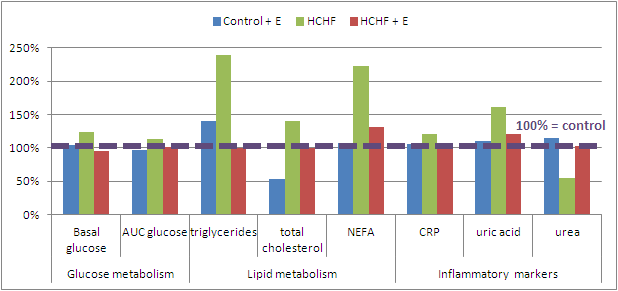
Figure 4: Basal glucose, AUC glucose after 2 g/kg body weight glucose load, triglycerides, total cholesterol, non-esterified fatty acids, c-reactive protein, uric acid and urea levels in rodents fed the supplemented control and the unsupplemented and supplemented high carbohydrate high fat diets; data expressed relative to unsupplemented control diet (data calculated based on Panchal. 2012).
These profound reductions in the amount of inflammatory visceral body fat, stand in line with the statistically significant improvements in glucose and lipid metabolism (cf. figure 4). As you can see the diet-induced increases in glucose, NEFA, triglyceride, cholesterol, CRP and uric acid, as well as the reduction of its counterpart, urea were completely blunted in the high carbohydrate + high fat group that received the ellagic acid enriched chow, an effect, the researchers attribute to...
  • an increase in fatty acid oxidation, indicated by increased CPT1 activity and
  • reduced inflammation, indicated the reversal of diet-induced increases in Nrf2 and NF-kappaB 
... in heart and liver of the rodents. That the addition of ellagic acid to the diet also minimized the necrotic damage to the liver of the animals, is thusly not surprising.

"So, shall I embark on the fruit and nuts diet?"

Despite those scientifically 'proven' benefits I should yet not have to tell you that it would not be particularly wise to take this study as an opportunity to ransack Trader Joe's dried fruit and nuts warehouses... As unreasonable as the contemporary condemnation of real (not dried!) fruit and (non-rancid!) nuts may be, it did not come out of nowhere, but has its roots in the detrimental overconsumption of both, nuts and fruits in the media-driven believe that adding tons of those healthy "superfoods" to your diet would allow you to live into your late 90s without ever having to worry about any of the ailments of the Western society. Both, nuts and fruit are yet only two "superfoods" within a "superfood diet", ... ah pardon, a whole foods diet, where neither of them is a "treat" or "cheat", but simply nutrition!
On a side note: Can you imagine that your ancestors sprouted a handful of nuts after all the work they had to shell them? They must have been nuts, if they did - don't you think so?
 Contrary to the impression you may get, when you follow the discussion on certain bulletin boards, eating healthy does thus not imply that you have to restrict your dietary repertoire to meat, fish, butter, eggs and the occasional sweet potato; this is all the more true, since ellagic acid is only one example for the myriad of already known and still to be discovered micronutrients with beneficial health effects, of which you would be depriving yourself, if your list of "allowed foods" contains no more than 5-10 items.

Think about it: Just as the FDA-approved food additives are "harmless" if you consume only one of them and potential hazardous, when you eat the whole variety that is present in the fast-food laden SAD diet, it is the synergy of all those ellagic acids and whatever their names may be that makes a varied whole-foods diet so healthy - don't miss out on that!

Exercise Performance - Another Reason to Go (Wal-)Nuts? Study Demonstrates Ergogenic Effects of the Literal Handful of Walnuts ☆ Heart, Brain, Prostate & Breast Benefit, Too!

The ergogenic effects are just the latest addition to the list of proven benefits of regular walnut consumption.
I don't have to tell you that I am real "nut nut". Despite the fact that I had to realize years ago that almonds, aren't, but strawberries are nuts and irrespective of the constant turmoil about their high energy content, nuts have and probably will always be on my meal plan (on a daily basis, by the way).

It goes without saying that the publication of Dae-Ik Kim's and Kil-Soo Kim' recent paper in the Journal of Laboratory Animal Research won't change this. Who would after all complain about the following possible side effects of regular walnut consumption?

Increased endurance & glutamine, glycogen, decreased lactate & ammonia levels

No one, would complain about theses - correct! What I do yet expect is that you will complain about this being a rodent study.... but honestly, we have hashed and rehashed time and again, so let's just content ourselves with what we have: A 4 week study in the course of which twenty-eight male ICR mice were randomly divided into four groups, a
  • Walnut extract preparation - 1kg Walnuts were soaked in 10L of 70% ethanol for 24h, filtered, lyophilized and powdered. The results were 56 g of walnut extract - "the dosage (600 mg/kg/day) was based on the daily recommended intake as raw walnut (adult standard: 42 g/day)" (Kim. 2013)
    vehicle (control)
  • walnut extract (WE300) at 300mg/kg per day
  • walnut extract (WE600) at 600mg/kg per day
  • walnut extract (WE900) at 900mg/kg per day
The extract (preparation see box) was administered to the mice once a day for 4 weeks. As the scientists point out, the mice were thus consuming the human equivalent of the recommended intake in raw walnuts, of which at least Kim et al. believe that it was 42g/day.

Forced swimming = endurance performance + stress test

Over the whole four week study period the mice were subjected to a weekly forced swimming test. Basically, that's like dropping you in a water tank where you can't stand or hold onto something and waiting. Needless to say that this is both, an endurance, as well as a stress test with which therodents "on" walnuts coped much better, than their peers in the vehicle control group.
Figure 1: Changes in in Lactate, Glucose, Glutamine, Ammonia and Triglyceride as well as the corresponding increases in time to exhaustion during forced swim test (Kim. 2013)
As Table 1 of Kim & Kim's paper tells us (not shown here), the changes in Lactate, Glucose, Glutamine, Ammonia and Triglyceride as well as the corresponding rapid (effects were visible after only 1 week) performance increases (see Figure 1) occurred in the absence of any differences in food or water intake. Moreover, "walnut intake did not cause weight gain, despite an increased energy intake".

I am honestly not sure about the energy content of the walnut extract, but in view of the fact that the mice consumed ~140g/kg of their chow (remember mice weigh only ~46g, so this leaves them at a total food intake of ~6.5g/day), it does not seem reasonable to assume that the walnut extract (~5.85mg at the highest dosage) would influence their body weight.

Apropos body weight

The questionable supposition that the mice in the walnut extract group should weigh significantly more than their peers because of a laughable 5.85mg of walnut extract in their diets, segues nicely into the promised brief review of the walnut studies that were published in 2013 - studies with pretty outstanding results:
  • Improved lipid profiles, even in healthy individuals (Wu. 2013) -- Significant reductions in non-HDL cholesterol and Apo-B (reduction in heart disease risk, Alzheimer's etc.) levels of 40 subjects (mean ± SEM: age 60 ± 1 years, BMI 24.9 ± 0.6 kg/m2; 30 females) after consumption of 43g of walnuts per day for 8 weeks (Figure 2, left)
    Figure 2: Changes in serum lipids (left) and serum fatty acid composition (right) in Wu (2013)
    The improvements occurred despite / because higher total fat, polyunsaturated fat, omega-6 and omega-3 content, and lower protein, carbohydrate and saturated fat content of the diet and were accompanied by signifcant changes in the serum fatty acid compositoin (Figure 2, top) of the subjects.
  • Acute beneficial effect on endothelial health and cholesterol efflux (Berryman.2013) -- Both changes, the walnut oil (51g) induced improvements in endothelial function and the increase in cholesterol efflux in response to the ingestion of 85g of walnuts contribute to increases in heart health. Interesting side note, separated nut skins (5.6 g), and de-fatted nutmeat (34 g) did not work the same magic.
  • Impressive figures: According to Lloyd-Williams et al. (2009) replacing the "average snack" with walnuts (or other healthy snacks) could result in approximately 2400 fewer CHD deaths and 425 fewer stroke deaths per year.
    Reduced prostate cancer risk (Reiter. 2013) -- It's only a rodent study, but it confirms epidemiological evidence from human studies (Spaccarotella. 2008, Carvalho. 2010) and the effect size of -25% is quite impressive.
  • Improved flow-mediated dilatation + improved systolic BP (Katz. 2013) -- Despite the additional 56g of walnuts in their diet the forty-six overweight adults (average age, 57.4 years; 28 women, 18 men) experienced no weight gain. What they did experience, though was a significant increase in FMD (1.4% ± 2.4% versus 0.3% ± 1.5%; p = 0.019) and beneficial effects on systolic blood pressure.
  • Healthy brain aging and improved cognitive performance (Willis. 2009; Pribis. 2011) -- Willis et al. observed a significant and dose-dependent improvement in cognitive abilities in old rats on diets with 2%+ walnuts. Pribis et al. found that the inferential verbal reasoning of their young subjects increased significantly (11.2 %); and that inspite of the fact that the subjects ingested only minimal amounts of walnuts in banabreads.
I guess I could extend this list with at least 10 additional studies. What I could not find, by the way, was more than one study reporting weight gain in response to the addition of 35g walnuts to the diet (the researchers expected a weight gain of 5.3 kg, de facto the participants gained 0.4kg and saw improvements in body composition, see Figure 3) and the overall effect was an improvement in body composition (see Figure 3). Studies such as the one by Bes-Rastrollo et al. (2012), which showed that a frequent nut consumption is associated with a reduced risk of weight gain (5 kg or more) in 8865 adult men and women who participated in te Seguimiento Universidad de Navarra project. A brief look at Joan Sabaté's 2003 review of the literature confirms that this is not just an outlier, but in line with previous research on the effects of walnuts on body weight:
"In well-controlled nut-feeding trials, no changes in body weight were observed. Some studies on free-living subjects in which no constraints on body weight are imposed show a nonsignificant tendency to lower weight while subjects are on the nut diets. In another line of evidence, preliminary data indicate that subjects on nut-rich diets excrete more fat in stools. Further research is needed to study the effects of nut consumption on energy balance and body weight. In the meantime, the available cumulative data do not indicate that free-living people on self-selected diets including nuts frequently have a higher body mass index or a tendency to gain weight." (my emphases in Sabaté. 2003) 
For someone as active as yourself (*lol*) even the extra 277kcal from a the suggested 43g of walnuts shouldn't be a problem. If you look back at the Kim study, it would furthermore appear that significant ergogenic effects can be achieved with half of that, as well.
Figure 3: Changes in body comp. during 6 months of consuming addi- tional 35g (~12 % energy intake) of walnuts (Sabate. 2005)
Bottom line: Walnuts are more than ergogenics, but in view of the fact that people are still afraid they may make them fat (often people who add an extra spoon of virgin olive or coconut oil to their protein shakes *rofl*), the ergogenic effects Kim & Kim observed in the study at hand could actually be the incentive they needed to eventually go nuts. And you know what? Their hearts (reduced CVD risk; Banel. 2009; Li. 2009), their prostate / breasts (reduced cancer risk; cf. Hardman. 2008; Carvalho. 2010; Reiter. 2013) and even their brains (Willis. 2009; Pribis. 2011) will thank them. If that's not convincing enough, just take another look at the improvements in body composition in the Sabaté study from 20035 (Figure 3).
References:
  • Berryman, Claire E., et al. "Acute Consumption of Walnuts and Walnut Components Differentially Affect Postprandial Lipemia, Endothelial Function, Oxidative Stress, and Cholesterol Efflux in Humans with Mild Hypercholesterolemia." The Journal of nutrition 143.6 (2013): 788-794.
  • Carvalho, Márcia, et al. "Human cancer cell antiproliferative and antioxidant activities of Juglans regia L." Food and Chemical Toxicology 48.1 (2010): 441-447.
  • Katz, David L., et al. "Effects of Walnuts on Endothelial Function in Overweight Adults with Visceral Obesity: A Randomized, Controlled, Crossover Trial." Journal of the American College of Nutrition 31.6 (2012): 415-423.
  • Kim, Dae-Ik, and Kil-Soo Kim. "Walnut extract exhibits anti-fatigue action via improvement of exercise tolerance in mice." Laboratory Animal Research 29.4 (2013): 190-195.
  • Li, Tricia Y., et al. "Regular consumption of nuts is associated with a lower risk of cardiovascular disease in women with type 2 diabetes." The Journal of nutrition 139.7 (2009): 1333-1338.
  • Pribis, Peter, et al. "Effects of walnut consumption on cognitive performance in young adults." Br J Nutr 107 (2011): 1393-1401.
  • Reiter, Russel J., et al. "A Walnut-Enriched Diet Reduces the Growth of LNCaP Human Prostate Cancer Xenografts in Nude Mice." Cancer investigation (2013).
  • Sabaté, J. (2003). Nut consumption and body weight. The American journal of clinical nutrition, 78(3), 647S-650S.
  • Sabaté, J., Cordero-MacIntyre, Z., Siapco, G., Torabian, S., & Haddad, E. (2005). Does regular walnut consumption lead to weight gain?. British Journal of Nutrition, 94(5), 859-864.
  • Willis, Lauren M., et al. "Dose-dependent effects of walnuts on motor and cognitive function in aged rats." British journal of nutrition 101.08 (2009): 1140-1144.
  • Wu, Liya, et al. "Walnut-enriched diet reduces fasting non-HDL-cholesterol and apolipoprotein B in healthy Caucasian subjects: a randomized controlled cross-over clinical trial." Metabolism (2013).