.

.
marylin monroe
Showing posts with label fruit. Show all posts

The Female(?) Athlete Triad - Part III/III: Road to Recovery! Step #2 = Accept There is No Magic Macronutrient Ratio

No need to raid another tomb, Lara, the quest for the one and only ideal macronutrient composition that will yield optimal results for the rest of your life ends here (img courtesy of Paramount)!
I am not planning to bore you with a longish summary of the previous installment(s) of this series, here. Still, I don't want to head on to the 2nd step of the "Road to Recovery", which is going to deal with the quest for the "optimal" macronutrient ratio, without a brief reminder of the central role of nutrient availability in both the etiology, as well as the recovery from the athlete triad - or, as Dr. Zanker from the Carnegie Research Institute at the Leeds Metropolitan University in the United Kingdom puts it, the simple fact that the "exercise associated reproductive dysfunction in women is attributable to deficits of readily available energy" (Zanker. 2006)

In a couple of more general remarks some of you have recently (not without good reason, by the way) criticized my excessive and in parts random use of mark-ups like bold print or underlining. In the introductory paragraph to today's post the word "readily" is however so important that the underlining is obligatory.

Your hypothalamus does not like to wait, therefore "readily" is the keyword, here!

It is after all the lack of appropriate readily available energy, primarily in the form of circulating glucose, liver glycogen, and adipose tissue triacylglycerol that precedes the low plasma insulin concentration and reductions in total body fat content and corresponding disturbance of leptin secretion, ghrelin, cortisol, thyroid and of course luteinizing hormone (see data in figure 1; the absolute levels from the healthy group may also serve as a reference to compare your own labwork to; mind the units!).
Figure 1: Hormonal and glucose metabolism (* indicates 24h values) of women with functional hypothalamic amenorrhea (not necessarily exercise induced) expressed relative to values in eumenorrheic control; values above the bars indicate the total values of the respective markers in healthy controls and may provide you with some orientation, when you are looking at your own bloodwork (data based on Loughlin. 1998)
In order to avoid / counter the reproductive and associated problems and break out of the vicious circle of the athlete's triad, Zanker proposes the following three steps (based on Zanker. 2006; yet with a couple of additions from my side): 
  • Avoid abrupt and rapid weight loss and maintain an “adequate” body fat content, which may be individually specific, but coincides with regular reproductive function.
  • Consume adequate amounts of energy to fuel your increased metabolic demands; never go below your resting energy expenditure, regardless of whether you  want to or even have to lose weight.
  • Make sure you get an adequate amount of carbohydrates either on a continuous (low GI carbs with every meal) or in a cyclic manner as part of a low(er)* carbohydrate diet with a baseline intake of 90-120g/day and additional carbs after every workout.
    *compared to the RDA of ~60% carbs
"Carbohydrates? But aren't those just making you fat?" With this very question that's now probably on the mind of one or two (or three ;-) of you, we did eventually arrive at the topic of this episode of the Athlete's Triad Series:
Is there a ideal macronutrient ratio that will prevent the onset
and help you get rid of the athlete's triad?
To be honest, I don't know the answer to this question... and although I had almost typed the word "yet" win the place where you now see the "..." , I must admit that I am not even sure if there actually is a definitive answer to this question. What I do have to offer, though, is a couple of things to keep in mind, when it comes to the macronutrient make-up of your diet.
  1. There is no such thing as a "bad" nutrient. There are about as many good arguments to vilify the overconsumption of protein, as there are arguments against the usual scapegoats, carbohydrates and fats.
  2. Glucose and saturated fats can be essential, too. Just because your body can produce carbs and saturated fats on its own, this does not mean that you do not have to, let alone should not eat them.
  3. The optimal macronutrient ratio will change over time - just like and in response to the way your physique, conditioning, lifestyle, training and general stress levels  will be changing. This implies that diet X, which may have worked magically for you, when you got rid of slabs of body fat is now that you are finally in the "normal range", let alone already so lean that your body's alarm bells are constantly ringing, hampering your progress.
And even if the previous comments on the importance of readily available energy and glycogen repletion would suggest that carbohydrates should make up the lion's share of the diet of any athlete trying to recover from the triad (or not to fall victim to it), an extreme high carbohydrate alone is neither guaranteed to solve the problem nor is it a sustainable way of eating you could stick to once you've "carbed" yourself out of the dark hole you have been digging over the past months.

Readily available energy? Does that mean I have to eat sugar all day?

Figure 2: Cortisol (left) and testosterone (right) levels in healthy men after 10 days on high protein vs. high carbohydrate diets (based on Anderson. 1987). Tegelman et al. report similar results from Swedish elite male Ice Hockey players after a reduction of fat and an increase in carbs (Tegelman. 2007)
On the one hand, we've known for over two decades that a high carbohydrate diet based on bread, vegetables, fruit, juices, pastry, and candy having a protein / carb / fat ratio of 10% / 70% / 20% will result in lower cortisol and higher testosterone levels (in men) than a high protein diet with a protein / carb / fat ratio of 44% / 35% / 21% that's based on lots of meat, fish, poultry, egg whites, and a liquid dietary supplement protein supplement (Anderson. 1987; see figure 2). On the other hand, a closer analysis of the data I compiled based on the tabular overview of pertinent studies on amenorrheic from the review by Manore (see figure 3 in the last installment) suggests that real.world advantage of carbohydrates depends on the deepness of the whole you already dug (the deeper the more advantageous) and your willingness / ability to cover or even surpass your daily energy requirements (the more you eat on a daily basis and in at least three square meals spread equally across the day, the less you will depend on the readily available energy from carbs).

Against that background, the high carbohydrate intake (62% of total energy from carbohydrates; nutrient ratio in grams 16% protein, 71% carbs, 14% fats) was probably necessary for the women in the eumenorrheic group with an energy intake of slightly less than 30g/kg body weight (figure 3, R5).
Figure 3: Macronutrient compositions (in kcal!) of amenorrheic and eumenorrheic women from 15 different studies (based on an overview in Manore. 2002)
For the eumenorrheic female athletes who were at, or way above the average mean energy intake of 35g/kg body weight, the "high" carbohydrate intake of 265g/day probably wasn't detrimental. On the other hand, it appears questionable, whether an increase in protein intake from 1.2g protein per kg of body weight to 1.5-2.0g/kg and a corresponding protein to carbohydrate ratio of 25% / 62% would not have been more facilitative to their goals (specifically if those include strength training). The same goes for both, the replacement of yet another part of the carbohydrate ration with an isocaloric amount of fats and the overall role of fats in the etiology of and the recovery from the athlete's triad.

The fat-phobia still loomed large, when the majority of studies was conducted

Part of the problem of reconciling theoretical considerations, such as the "availability advantage" of carbohydrates and the scarce and almost exclusively observational data based on which I compiled the overview in figure 3 of this, as well as the last installment of this series, is that eating patterns of both the eumenorrheic, as well as the amennorheic athletes was geared towards the dietary paradigm of the day. With "the day" being the late 1980s and 1990s, i.e. those years in which the fat-phobia literally climaxed, it should be obvious that the baseline diet was low in fat and high in carbs.

Against that background it should also be clear that anyone trying to "cut calories" would reduce the amount of fats, the "bad energy dense heart killers" and keep the intake of carbohydrates constant (=high). This is probably also, the reason that the ostensible disproportionate lack of fats in the diets of the amenorrheic women vanished, once I weighted the data with the number of participants.
Figure 4: Total dietary intake of protein, carbohydrates and fats (in g; left) and differences between women with and without regular menses (right); data expressed either as simple group averages or weighed for the number of study participants (same sources as figure 3)
The picture that emerges after this adjustment has been done (figure 4, right, light bars) is clear and stands in line with my initial remarks on the primary of readily available energy in the form of circulating glucose, liver glycogen, and adipose tissue triacylglycerol, of which at least the former are way more readily derived from carbohydrates than fats.

And even the triacylglycers do, as the name implies, require a certain amount of glucose for the glycerol backbone (could be produced in the liver from amino acids and/or fats, though) and a minimal amount insulin to be stored in the fat cells (can be secreted in response to high amounts of protein and fat, as well, though).

So no fats? Just carbs and some protein?

Yet though carbohydrates have the availability bonus and proteins are necessary to maintain, better even build muscle mass, you would be ill-advised to steer clear of all dietary fats and, even more so the many good foods that contain them. Not so much because of the "essential" polyunsaturated fatty acid, though. According to a study by Tomten and Høstmark the dietary intake of PUFAs in 20 female runners with regular (n=10) and irregular (n=10) menses (LH levels of 7.6 vs. 2.9 IU/l!) was not statistically different. The intake saturated fats (-28%) and even more the intake of MUFAs (-38%), on the other hand was (Tomten. 2009) and the corresponding total fat-intake of 1.1g/kg body weight was obviously not sufficient to maintain optimal hormonal levels in the presence of a training volume of 7.5h per week.

What about vegetarianism? I know a few of you won't like this, but unless you are at least ovo-lacto vegetarian, i.e. a person who eats dairy and eggs, you are going to have a hard time fueling your athletic endeavors appropriately. After all, vegetarianism is associated with hormonal and menstrual abnormalities even in the non-athletic population, when they are dieting (Pirke. 1986). If you combine a mild energy deficit, as it is often seen in vegetarian, let alone vegan athletes, simply because it's harder for them to cover their energy and specifically protein and fat requirements without guzzling omega-6 oils and soy shakes all day (both not advisable, by the way), it is actually not surprising that Benson et al. mention vegetarianism right along low calorie intakes, nutritional inadequacies and low body fat stores as one of the main contributers to the (female) athlete triad (Benson. 1996).
Now you can certainly argue that all this comes down to the energy density and the correspondingly lower overall energy intake and could have been compensated for, if the women with menstrual irregularities had simply eaten more carbohydrates. In view of the fact that they didn't do so, I can hardly refute this argument. On the other hand, we have seen in the previous installment that an overexpression of GH and ghrelin is in as much part of the problem as too little insulin and a pathologically high insulin sensitivity. And some more fat in the diet (alongside carbs / not as the sole energy source!) couId in fact come handy to get that back in check.

Moreover, having a carb to fat ratio of ~2:1 (in energy equivalents) and a baseline fat intake in the range  of 80-100g (total) as the female runners with regular menses in the Tomton sudy had, has the beauty of never having to throw away the egg yolks, being able to get your share of fatty fish, full fat dairy, Kerrygold butter, virgin coconut and olive oil and beef or better calf liver as well as nuts once in a while. This in turn will allow you not just to stay sane and flexible with your diet, but also to satisfy your need for all those vital micronutrients you won't find in any of E-number laden fat-reduced garbage from the "low fat" shelves at the supermarket.

You see, in the end it all comes back eating simply more of the usual suspects, many people would probably file under "a paleo diet with lots of (safe) starches & fruit to fuel the energetic demands of a hard working athlete", these days.

If we think of the hypothetical daily energy requirement of 2000kcal/day which is often used as a reference for the nutrition information on those products of which you are going to buy less in the future (most real foods don't have nutritional information printed on them, you know ;-), the corresponding "numbers" could be anywhere on a continuum
  • from 110g protein / 190g carbs / 100g fats, for someone without an endurance component in his workouts*, 
  • to 100g protein / 240g carbs / 80g fats for someone who has a major endurance component and / or follows a high volume lifting routine*
    *pre- and post workout nutrition are not included, here!
This approach would ensure that you get enough protein, appropriate amounts of readily available energy, mainly in the form of safe starches and fruit, quasi unlimited amounts of vegetables and so much fat that you don't have to resort to the devastating "chicken breast, rice and broccoli diet", which will only worsen your situation.


References:
  • Anderson KE, Rosner W, Khan MS, New MI, Pang SY, Wissel PS, Kappas A. Diet-hormone interactions: protein/carbohydrate ratio alters reciprocally the plasma levels of testosterone and cortisol and their respective binding globulins in man. Life Sci. 1987 May 4;40(18):1761-8.
  • Benson JE, Engelbert-Fenton KA, Eisenman PA. Nutritional aspects of amenorrhea in the female athlete triad. Int J Sport Nutr. 1996 Jun;6(2):134-45.
  • Laughlin GA, Dominguez CE, Yen SS. Nutritional and endocrine-metabolic aberrations in women with functional hypothalamic amenorrhea. J Clin Endocrinol Metab. 1998 Jan;83(1):25-32.
  • Manore MM. Dietary recommendations and athletic menstrual dysfunction. Sports Med. 2002;32(14):887-901.
  • Pirke KM, Schweiger U, Laessle R, Dickhaut B, Schweiger M, Waechtler M. Dieting influences the menstrual cycle: vegetarian versus nonvegetarian diet. Fertil Steril. 1986 Dec;46(6):1083-8.
  • Tegelman R, Aberg T, Pousette A, Carlström K. Effects of a diet regimen on pituitary and steroid hormones in male ice hockey players. Int J Sports Med. 1992 Jul;13(5):424-30.
  • Tomten SE, Høstmark AT. Serum vitamin E concentration and osmotic fragility in female long-distance runners. J Sports Sci. 2009 Jan 1;27(1):69-76.
  • Zanker CL. Regulation of reproductive function in athletic women: an investigation of the roles of energy availability and body composition. Br J Sports Med. 2006 Jun;40(6):489-90; discussion 490.

Conventional vs. Organic: It's Not About Getting More, But Getting Less For Your Money. Less Pesticides, Dioxins & Co

Image 1: The Ökomonitoring program took a very different approach to the question whether or not organic products are worth the extra cost, they did not look for the additional edge, but rather the "subtractive edge", if you will, and tried to answer the question: "Can we even produce 'organically' in an increasingly polluted environment"; now ten years after the program started the answer appears to be "Yes!" (MLR. 2012a)
"Organic produce is no better than conventional! You are being ripped off!" Statements like this have made the headlines in the past couple of days and many people (obviously not you, though!) are scandalized or shaking their head haughtily uttering things "I knew it, and that's why I always buy the cheapest..." What both groups are missing, though is the simple fact that the question the scientists posed, or rather the question the journalists put to the forefront, i.e. "Are organically produced fruits and vegetables more nutritious?", is nonsensical, because it would imply that the absence of certain chemical agents and production methods would increase the amount of nutrients a plant puts into its fruit, leaves, roots or whatever. Since I have discussed this with my friend Carl Lanore on yesterday's joint SHR + SuppVersity News Round Up pretty extensively (in fact so extensive that we could not cover the other topics I had lined up - sorry for that, folks!), I won't go into more detail on that here, but simply repeat that the fallacy of this approach was part of my reasoning not to bore you with write-up / comment #5325 published that's been published on the bazillion of blogs within the past couple of days, but rather give you the long and short of a governmentally subsidized program that's been running for 10 years, now, here in Germany: the Ökomonitorin program of in Baden-Württemberg (this is one of the individual states here in Germany).

It's not about what's in there, but about what is not!

The researchers who are mainly working at the University of Stuttgart set out with a whole different research question than most of their colleagues. Rather than trying to answer loosely defined questions such as "What's better: Conventional or organic", they wanted to know whether or not it would even be possible to "produce organic" in an environment that is already profoundly polluted; and though I don't want to give away too much in advance, after 10 years and ten-thousands of samples of organic and conventional fruits, vegetables and animal products being analyzed the answer is "Yes it is!"
"Organic fruits and vegetables had on average 180x lower pesticide content than conventional products; and only 5% of the samples from organic produce were objectionable."
That's the conclusion the researchers in the 10-years special report that has been published in July 2012 (MLR. 2012b). Since I know that you don't content yourself with universalities like this (otherwise you would hardly be here ;-), I would like to invite you to let me walk you through some of the detailed results of the latest data from 2011, although this may not be the exact same goods you have (or haven't) been buying in the course of the last year (I just checked: Only ~6% of you are actually from Germany)

The good the bad and the equally ugly

While the general trend that emerges does in fact speak in favor of the organic products, a brief look at the data in figure 1 should suffice to see that despite the fact that the number of offenders, i.e. products with pesticide residues above the maximally allowed threshold is close to zero, even organic produce is far from being pesticide free.
Figure 1: Percentage of conventionally and organically produced products with detectable (those did not have to be above the allowed threshold levels!) pesticide residues (data based on MLR. 2012a)
Of all the categories I picked when I compiled figure 1 there are however four product categories that caught my eye immediately, because the "organic advantage" as you may call it, is particularly small, here: Wine, plant oils and processed fruit and vegetables (the latter category included frozen, usually relatively pesticide free, but also canned food and dried foods, as well as fruit jars etc.). Intriguingly, in all of those four the pesticides could (and in the case of the Wine, the researchers even proved that) have gotten into the food-chain during the processing / manufacturing process, as well - in other words processed and organic tend to be contrastive pairs.
Figure 2: Percentage of products with pesticide levels above the allowed threshold (data based on MLR. 2012a)
When it comes to the actual "offenders", i.e. those products with levels above what is officially allowed, here in Europe, there are actually seven of which I feel that they really stand out (one for each day of the week, isn't that great?):
Mothercorn, the "abortion fungus" of the middle ages, the first source of LSD and the result of inappropriately stored and subsequently moldy grains / flour being used in the production of breads, is a potential cause of auto-immune diseases and lethal toxicities.
The mothercorn (Claviceps purpurea) content [µg/kg] of multi-grain breads with rye and wholemeal rye bread (please mind the leap on the primary axis; data based on MLE. 2012a)
The ingestion of 2 mg of mothercorn does already lead to adverse reactions which range from nausea over headaches, and cramping to a loss of sensation in the extremities and vascular occlusions (the latter will also arise from chronic low-grade intoxications)- in pregnant women it will induce contractions of the uterus and spontaneous abortion. The ingestion of 5-10g of the ergot-alkaloids from the fungus kill an adult man... not exactly what you want to have in your bread, right? Not even in "harmless quantities" - which is what even the worst offenders would have to be considered, still.
  • the processed foods - irrespective of whether you buy veggies or fruit, you can be sure that the contamination raises with every processing step; be smart not lazy and buy whole foods, learn how to prepare them and cook for yourself
  • cereals - 3.4% of the "oh so healthy superfoods", of which at total 72% of the conventional and 36% of the organic ones contain pesticides, are also on the list of items even the European officials suggest you should better not eat, if you don't want to become sick
  • legumes - another favorite of mainstream dietitians are not just among the worst offenders (24% of the conventionally produced legumes contain pesticides above the tolerable limit), they are also the only product where even the organic variety is not suitable for human consumption in 11% of the cases and as if that was not enough, the number of substances above that threshold amounts to 17 compounds in the conventional and 3 substances in the organically produced legumes
  • leafy greens - the health food per se may not be among the worst offenders but in those 6.7% of the samples that had pesticides above the the threshold level, the scientist were able to identify 27(!) different pesticides (note: not all pesticides were found in all samples and the worst offenders were not broccoli & co, but rather salads)
  • ginger (=ingwer)- the conventional variety something many people use to improve their health had higher than tolerable levels in 12.5% of the cases; a health food "gone unhealthy", if you will
  • berries - they may not be among the worst offenders, but they are "versatile": With 5 different pesticides in the samples the scientists analyzed they can't compare with the processed veggies with 45 different pesticides, but are doing quite "well"
  • exotic fruit and citrus fruit - while with them the conventional farmers obviously assume that the consumer would throw away the peel anyway; or, and this segues right into our next topic, there are no governmental controls and regulations in place; after all, you should be aware that Germany is not exactly the country to grow "exotic fruits" ;-)
If we seize on the notion of "it's not us, it's only the others that contaminate their produce, ship it to Europe (or the US) and poison us", we must however realize that things aren't so easy as they seem: While the German organic produce may in fact be the less polluted one, neither the Israelis nor the South Africans or Moroccans, but rather our European friends, the Italians are trying to poison us ;-)
Figure Y: "Worst offenders" statistics for the countries of origin of organic produce (based on MLR. 2012b)
Now, all jokes aside, it is simply not possible and probably also highly un-rewarding to replace one prejudice, i.e. all organic produce is good with another more sophisticated one such as all organic produce from Germany is good and everything from Italy, Egypt and Greece is poison. Therefore, it is probably also not so important that the intricacies of these statistics are meaningless for the majority of you who are (I just checked) US residents and not among the 6% "resident" (=German) SuppVersity students ;-)

Organic = Say no to GMO!?

With the different legislative situation here in Germany, the quantitative data on GMO "contamination" in figure 3 is probably likewise irrelevant for many of you, but with the production of GMO corn being banned, here in Germany, it does give you a sneak peak on what can happen if the government is willing to act on behalf of its people (the majority of Germans is against GMO) instead of the industry (in all fairness it must be said that it is the US and not the European, let alone the German agrar-industry that's constantly trying to push GMO corn and other produce into the German market).
Figure 4: Relative percantage of soy and soyproducts that has been genetically modified (MLR. 2012b)
Even among the conventional produce, the number of outliers was small - roughly 5% of conventional products contained <0.1% corn from genetically modified plants - a result which is probably also to be accounted for by the awareness of the industry that they will have to throw all their produce away once the GMO-skeptic consumers realize that product is contains significant amounts of genetically modified plants.

The data in figure 4 does yet also show that things look different for soy products, most of which are imported from countries where the production of GMO foods is actually allowed (like the US ;-) and even non-GMO crop can be exposed to cross-contamination. If we take a closer look and discard the annual variations, it does yet become obvious that the GMO content of organic products is just as their pesticide content still much lower than it is in conventional ones. What is pretty troublesome, though, is that in 2011 25% of the products that are advertised as "GMO free" contained small amounts (<0.1%) of genetically modified soy - for you, my American friends this means: Having a label alone does not protect you from "GMO fraud" ;-)

Eggs, salmon, animal productts and other notable observations and changes from 2002-2012

Before I'll conclude this post with a couple of notes on trends and general observations the scientists who have been working on the Ökomonitoring program over the past 10 years made and let you make up your own mind of "whether or not you feel that getting less is worth paying more", let me briefly address the issue of dioxin-laden organic eggs Carl and I have been talking about, yesterday, already:

Image 2: If you have not done so, already, I highly suggest you read my previous post "Urban Gardening: 12x More Cadmium in Your Tomatoes Than in the Conventional Produce? Plus: Domestic vs. Foreign - What's Healthier?". After all, your own organic tomatoes and other produce can be effected by the environment in which you grow them, as well.
  • Not just organically produced eggs, but also organically produced salmon have on average higher levels of DDT, PCB and total dioxins (TEQ) and HCB, DDT2, PCB 153, Dieldrin, Endosulfan, Chlordan, Toxaphen, Tribromanisol, PBDE, respectively (note: wild salmon is almost free of any of the latter!)
  • Those contaminations are not brought about by what the farmers do, but rather what they didn't do, i.e. make sure that their free ranging hens are not running around on toxic soils and their fish are not swimming in a toxic sea - and this is where the initial research question of the Ökomonitoring program, "Can we even produce organically?", must be answered with a somewhat shabby: "It depends" and the one parameter it depends on is the environment, to which the animals (and to a much lesser degree, the crop) are exposed
Now, the implications of this are not that all organic animal products are worse than their conventional counterparts (in fact the number of products without any residues is larger for the organic products, unfortunately those products which are contaminated contain much higher levels!), but rather that you have to be choosier and try not to rely on the label "organic", if you know your local farmer and trust him, you may be better off buying his non-organic eggs that those from an organic farm on contaminated land...
Find out if your area has contaminated soil by using the MyEnvironment search engine at epa.gov! Enter your area code and get the result right away. If you type in "Bronx New York", for example, you will learn that the major risk factor from air pollution is formaldehyde, that there are two final NPL sites and so on and so forth (thanks to Carl Lanore and Alisa Profumo for pointing this out on today's Casual Friday).
But enough of that let's wrap it up for today, with a couple of more or less unrelated, but interesting facts, the first of which is so important that I decided to repeat it, although I mentioned it at the beginning of the article, already:
What is Furan? Furan is a heterocyclic compound that has originally been used in the chemical manufacturing industry. It does however also occur during the combustion of coal and is a component of tobacco smoke, as well as in a number of heat processed food items such as canned and jarred foods and coffee (FDA. 2004). Furan is carcinogenic to rats and mice and was classified as ‘possibly carcinogenic to humans’ (International Agency for Research on Cancer, 1995; see as well Cordelli. 2010; Chen. 2012)
  • on average 180x lower pesticide residues in organic fruits and veggies - that's the astonishing result after 10 years of Ökomonitoring
  • no = ZERO pharamcologically active substances in any of the testes organic produces
  • antibiotics residues in organic honey were reduced from 23% to 0% from 2003 to 2005; no complaints thereafter
  • the mycotoxin load is about equally high in conventional and organic produce
  • No significant differences in terms of organic contamination and pesticide residues exist between animal products; the dioxin load in eggs free ranging hens and organic salmon are exceptions to this rule (while levels spiked in 2009, when "buying organic" really took off over here and more and more farmers started producing "organic eggs", the levels have been slightly declining over the past years)
  • the way organic coffee is roasted leads to increased furan levels in organically produced roast coffee
  • the amount of acrylamide in cookies is equally high in organic vs. conventional products, the in organic chips is higher and the number of samples with levels above the 1,000µg/kg threshold is higher as well
  • no differences were found in terms of trans fatty acids in ready-made meals
  • organic softdrinks are free of preservatives
  • no artificial colorings in organic sweets
Now it's up to you - organic, yes or no? And remember: We cannot always make everything 100% right, but that does not mean that you should give up trying.


References:
  • Chen T, Williams TD, Mally A, Hamberger C, Mirbahai L, Hickling K, Chipman JK. Gene expression and epigenetic changes by furan in rat liver. Toxicology. 2012 Feb 26;292(2-3):63-70.
  • Cordelli E, Leopardi P, Villani P, Marcon F, Macrì C, Caiola S, Siniscalchi E, Conti L, Eleuteri P, Malchiodi-Albedi F, Crebelli R. Toxic and genotoxic effects of oral administration of furan in mouse liver. Mutagenesis. 2010 May;25(3):305-14.
  • Food and Drug Administration. Exploratory Data on Furan in Food, vol. 2011. 2004 < http://www.cfsan.fda.gov/∼dms/furandat.html >
  • International Agency for Research on Cancer. Summaries & Evaluations, vol. 2011. 1995. 
  • Ministerium für Ländlichen Raum, und Verbraucherschutz Baden-Württemberg (MLR). Ökomonitoring. Ökomonitoring Bericht für das Jahr 2011. June 2012b.
  • Ministerium für Ländlichen Raum, und Verbraucherschutz Baden-Württemberg (MLR).Ökomonitoring. 10 Jahre Ökomonitoring. 2002 – 2011. Jubiläumssonderausgabe. June 2012b.

EPIC Study Says: Vegetables, Fish, Dairy, Pasta & Rice Reduce, Softdrinks, Processed Meat, Margarine, Spirits and Potatoes Increase Waist Circumference - Really!?

Image 1: The EPIC project unites scientists
from all over Europe (EPIC, IARC. 2011)
I don't know whether it is a good idea, for an anti-epidemiologist like me (I mean, come on, epidemiology vs. controlled experiments is like astrology vs. astronomy) to post this, but a 13-year (1992-2005) meta-analysis (Romaguera. 2011) of data from 48,631 men and women from 5 countries participating in the European Prospective Investigation into Cancer and Nutrition (EPIC) study is probably as good as as epidemiology can ever get and with scientists from 12 different institutes all over Europe, there is at least some hope that the results of their investigation into the association of food groups/items consumption "on prospective annual changes in 'waist circumference for a given BMI' (WCBMI), prox for abdominal adiposity".

Unfortunately the first of the typical shortcomings of EPIC studies (pun intended) like this becomes obvious in the previous citation, already, as the quotation marks before "waist circumference" indicate that the latter "was measured either at the midway between the lowest rib and the iliac crest (the Netherlands, and Potsdam-Germany) or at the narrowest torso circumference (the other centres)." And even worse,
at follow-up examinations, participants in Norfolk (United Kingdom) and Doetinchem (the Netherlands) were measured by trained technicians using the same protocols as at baseline, whereas other centres provided self-reported data.
I guess you can imagine how "exact" these waist circumference are - if not, try and "measure" your personal waist circumference, you will be astonished how easy it is to "diet down" from 35" to 32"... it's a pitty that this kind of 'weight reduction' is not sustainable ;o)

Be that as it may, it argues in favor of the scientists that they did a validity test with 408 men and women from the Danish cohort beforehand and it turned out that "a high correlation between the self-reported and technician measured WC was found". Furthermore, the scientists were able to extrapolate association with baseline BMI and used these later in the regression analysis to make up for potential measuring "mistakes" on part of their subjects. If we thusly assume that at least this part of the data is reliable - I don't think I have to go into any detail as far as notoriously inaccurate food frequency questionnaires are concerned - the study provides some tangible insights into the influence the eating habits of the general population has on the accrual / loss of body fat.
Figure 1: Association (expressed as beta² coefficients, left axis) of certain foodstuffs and beverages (daily consumption in grams, right axis) with increases (positive beta²) and decreases (negative beta²) in waist circumference in 48,631 subjects from the EPIC-DiOGenes project (data adapted from Romaguera. 2011)
If you have a closer look at the data in figure 1, it's quite easy to recognize the major offenders, if you compare the association strengths (beta²) of a given food with the total amount of this foodstuff/beverage in g/day the men and women in the EPIC-DiOGenes project consumed. High beta² values indicate a positive association, which means that study participants who report (!) that they eat much of this food / drink much of this type of beverage, were more likely to increase their waist circumference.

Image 2: If you have any interest in milk, colostrum or dairy in general, make sure you read my recent write-up on milk and milk consumption!
Now, while spirits may have an even higher association with abdominal adiposity than soft drinks, the overall contribution of Jack Daniels and Co to the obesity epidemic, which has a similar handle on Europe as on the US, is nevertheless negligible, because even men "booze" way to seldom to get fat just from booze. On the other hand, the negative association of fish (beta²=-0.05) and waist circumference is much stronger than that of milk, but since fish consumption is equally low for both men and women, chances are that, overall, milk (beta²=-0.01) may contribute just as much or even more to keep (at least some of) Europeans, who love their milk (you can read more on milk if you follow the link beyond image 2) and despise fish, from bursting out of their pants and skirts than fish does, despite having the higher and thus less beneficial beta² coefficient.

I bet, some of you are just about to freak out that both "vegetable oils", as well as pasta and rice and (worst of all) breakfast cereals are associated with reductions in waist circumference. At least in the eyes of the paleo-cultists out there, this may disqualify the study as devil's work ;-) People like Robb Wolf or Matt Lalonde, whose pointed analyses go beyond the common black-and-white cave-paintings you will find on the bazillion of paleo-blogs out there, would yet notice that the men and women in the study actually consumed relatively low amounts of these foods. Roughly 63g of rice and pasta for men and 52g for women is certainly a tolerable amount. And to be honest, I have not seen anybody die from a well filled tablespoon of vegetable oil per day, either ;-)

Almost "experimental" seems the last finding of the study I want to mention, which is the (calculated) effect the replacement of (-100kcal energy from) soft drinks, margarine, processed meat and white breads (the major offenders) with either (+100kcal from) dairy or fruits would have on the changes in waist circumference in the course of one year.
Figure 2: Model calculation of the beneficial (lower beta² coefficients) effects of iso-caloric (100kcal/day) replacements of soft drinks, margarine, processed meat and white bread by fruits or dairy (data adapted from Romaguera. 2011)
As the data in figure 2 goes to show the effect the statistical model predicts that the effects of fruit would be more profound... this, however, is something I dare question, simply because the different macronutrient composition of dairy (moderate protein, moderate fat, relatively low carb) vs. fruit (no fat, no protein, high carb) simply forbids such statistical thimblering that neglects the macronutrient composition and focuses solely on the caloric value... ahh, one last word: Whenever, this crucial distinction between eating calories and eating food (I am starting to think that maybe some of the scientists actually eat calories?) will reach mainstream science, I will immediately let you know ;-)

6x Bananas a Day!? Meta-Analysis: Lower Glucose, Insulin and HbA1c Levels From 'Catalytic' Dose of 36g Fructose

Figure 1: At least according to the USDA data, the average US citizen did never in the last 40 years get even close to the "catalytic" dose of fructose - at least not if we go by his / her daily HFCS consumption.
I usually don't start these articles with a disclaimer, but in this case I want to make sure that this post is not misinterpreted as a corn-refiners advertisement (and contrary to one of the authors of the Sievenpiper study, Coca Cola has unfortunately as of yet never covered my travel expenses ;-)... anyways, whenever the word "fructose" is used in the following lines it to the simple monosaccharide found as part of a complex nutrient matrix in many plants and their fruits (who would have expected that?). It is not used to denote the controversial results of a three-step enzymatic isolation process (Cornstarch → alpha-amylase → oligosaccharides + glucoamylase →  glucose + xylose isomerase →  42% fructose + 50–52% glucose + other sugar; cf. Wikipedia. "High Fructose Corn Syrup") that's at the heart of a very emotional debate about who would be to blame for the current obesity epidemic, now that the bad fats are no longer bad enough to be the scapegoat and ultima ratio for why we get fat.

Junk food is more than HFCS and fruit is more than fructose!

Fortunately, you, as a "whole food eating" SuppVersity reader, don't really have to care about the whole HFCS business. With your minimal intake of processed foods, your exposure to high fructose corn syrup should ideally be identical to the one of the parents and grandparents of America's obese children in the flower power seventies (~0.1-1g, see figure 1); a time, when your parents would not tell you to "beware of high fructose corn syrup", but to stay away from "those hairy, drug-addicted, reprobate hippies next door". Against that background, today's SuppVersity article is to be understood as an incentive to rethink, whether or not it is really necessary, let alone beneficial to deprive yourself of a whole class of vitamin and micronutrient-laden foods, simply because they contain a small number of molecules of which you are told that they "must not to be eaten, if you want to stay lean & healthy".

To help your thought process along, I have compiled the data from a recently published meta-analysis (that's a study, the results of which are based on data from multiple previous trials, which was weighed and compiled to come up with "new" data with a larger empirical foundation and thus greater significance). And I am honestly curious whether or not the evidence Sievenpiper and his colleagues presented in favor of the existence of a"catalytic dose" of  ≤36g/day of fructose that's been shown to improve, not compromise, blood glucose, insulin and HBA1C, when it is consumed instead of 36g of carbs from other sources (the studies in the review used either starches or simple sugars with almost identical beneficial results, by the way) will have catalytic effects on your opinion making process ;-)
Figure 2:  Effect of isoenergetic exchange of "catalytic" fructose doses (≤36g/d) for other carbohydrates (starches or simple sugars) on glycaemic endpoints: HbA1c, fasting blood glucose and fasting blood insulin, data calculated based on analysis of the scarce literature that is currently available (adapted from Sievenpiper. 2012)
The improvements in HbA1C, which is still the gold standard for evaluating long-term blood sugar level, in fasting blood glucose and insulin levels were across the board statistically significant, regardless of whether or not you apply the quality criteria, Sievenpiper and his colleagues used to weigh the results of the individual studies (cf. figure 2). Accordingly, the authors are right, when they point out that
[...] this small meta-analysis of controlled feeding trials supports earlier13C NMR spectroscopy investigations and acute feeding studies showing that ‘catalytic’ doses (≤36g/d) of fructose may improve glycaemic control [and that this] benefit is seen without the adverse cardiometabolic effects reported when fructose is fed at high doses or as excessenergy. (Sievenpiper. 2012)
Based on the data in figure 1, which clearly shows that the "average American" does not and never did pass this "catalytic threshold level" it may - at first sight appear odd that 42% of your countrymen and -women are supposed to be obese by the year 2030 (Hellmich. 2012)... at least for so long until you realize that for every American who follows your lead and consumes virtually no HFCS, there must be another one who consumes this person's 43.3g of HFCS on top of his own 43.3g of HFCS on a daily basis and would thus easily surpass the "scientifically proven" catalytic threshold levels which was (and I leave it up to you to decide whether this is coincidence or not) in none of the studies achieved from HFCS intake, by the way (I guess I don't have to tell you that my calculation is of mere illustrative nature, despite the fact that the 43.3g /day HFCS intake are actually from the USDA dataset for 2010).

Bad news for the guy who eats / drinks your daily share of 43.3g of high fructose corn syrup, ...

...but what does that mean for you? As long as your only significant fructose source are whole fruits and the few vegetables that contain more than trace amounts of fructose, you can answer this question by taking a look at the data in figure 3. The small figures on top of the bars will tell you how many 100g servings of apples, dates, pears or tomatoes you can consume until you hit the catalytic limit*uhuhhh...*: 3.9x 100g servings, of apples, for examples, or 5x 100g servings of bananas, or a whopping 32.7x 100g servings of lemons... sounds plenty? Well, I don't know, but certainly plenty enough to finally stop worrying when Adelfo Cerame would not ruin his health, let alone his physique, when he eats a banana along with his postworkout shake, wouldn't you agree?
Figure 3: Number of 100g servings of various common fruits to get to the more or less arbitrary  ≤36g/day threshold.
Notwithstanding, this ≤36g/day limit does certainly appears more or less arbitrary. This is all the more true in face of previous results by Livesey & Taylor, who could not find evidence that such a thing as a "threshold dosage" for the Hb1AC improving effects of fructose even exists (Livesey. 2008) or the fact that a "low-GI fruit intake [and not the number of servings of fiber-laden cereals!] was the strongest independent predictor of [lowered] HbA1c" in a 2011 6-months low-GI diet experiment by Jenkins et al. who compared Kellog's... ah, pardon me, I meant the medical orthodoxy's gold standard, the high-cereal fiber diet in 152 participants with type 2 diabetes with a simple low-GI diet (Jenkins. 2011).

Can ≤35g of fructose per day really be the answer to everything?

Though the main reason for the arbitrariness of the 36g limit certainly is the scarcity of valid experimental data from well-controlled human trials, Sievenpieper et al. claim that their reference for the "catalytic range" was in accordance with "an emerging literature" that "has shown that low-dose fructose (≤10g/meal) may benefit glycaemic control".

Now, those of you who have read my "Carbohydrate Shortage in Paleo Land" post from back in June 2011, will probably remember that from a mere physiological point of view every healthy (=nondiabetic and with an intact liver) human being, including the tiniest woman, should be able to handle a minimum of ~100g of carbohydrates on a daily basis. If we now take the 2:1 glucose to fructose ratio, of which Walliset al. found that it is just as effective in repleting muscle gylcogen stores after a workout as the same amount (90g) of pure glucose, and apply it to the 36g fructose threshold this yields a "total carbohydrate threshold" of 108g - coincidence or physiological necessity?

And even when you didn't replace some of the starches or other simple sugars for your daily dose of 2kg of apples (another example of exclusively illustrative nature), you would maybe get fatter, but according to the results of Silbernagel et al. not a single gram fatter than from the same amounts of calories from glucose from fructose or glucose conducted with healthy young men; cf. Silbernagel. 2011).

You can have another apple today and will still (or rather hence?) live tomorrow ;-)

Image 3 (edited in response to anon & JP, thx!): Certainly impressive what lifelong caloric restriction did to the 27.6 year-old ape on the right, if you take a look at his wrinkled age-mate on the left, no? Suggested read: "Health and Longevity Effects of Intermittent Fasting"
Overall it does therefore seem more than unlikely that a healthy, non-sedentary or even athletic individual has to worry about eating another apple, when he or she already reached their purported catalytic limit of 36g with the pound of blackberries, two bananas and a huge grapefruit this person could have eaten earlier in the day.

Moreover, skipping on the apple would also mean that you would miss out on its recently confirmed life-extending effects (+130% in yeast; Palermo. 2012), of which Vanessa Palermo and her colleagues from the Dept. of  Biology and Biotechnology “Charles Darwin” have shown that they are the prerogative of the whole fruit and not a result of the high antioxidant or polyphenol content of apples, as they occurred only, when the yeast is treated with a handcrafted extract that had approximately 26.7 g/100ml of fresh apple in it... and guess what, that apple, Golden Delicicious, happens to be one of my personal favorites, taste-wise, or course ;-)
Bottom line: I know it is more than questionable to which extend (1:20, 1:100, not at all?) the lastly cited life-prolonging effects of whole apples can be extrapolated to human beings, but that does neither diminish the perplexing results of Sivenpiper's meta-analysis nor long-established cancer protective effects of fruits in general and apples in particular (eg.  Veeriah. 2006;  McCann. 2007; Yoon, 2007; Gerhauser. 2008; Zessner. 2008; Jedrychowsk. 2009; Liu. 2010; Reagan-Shaw. 2010) and should therefore suffice to put more than a non-legible font-size "1" questionmark behind any previously taken decision of yours that it would be better to deprive yourself of these delicious superfoods (=fruits) than trust on your livers ability to to what she has evolved to do and turn the slow influx of relatively low amounts of fructose and glucose into energy and deliver the rest of the vitamins, polyphenols, and other micronutrients via the bloodstream to other organs.
References:
  • Gerhauser C. Cancer chemopreventive potential of apples, apple juice, and apple components. Planta Med. 2008 Oct;74(13):1608-24. Epub 2008 Oct 14. Review. 
  • Hellmich J. Obesity could affect 42% of Americans by 2030. USA TODAY. Aug 05, 2012 < http://www.usatoday.com/news/health/story/2012-05-07/obesity-projections-adults/54791430/1 > accessed Aug 07, 2012
  • Jandrain BJ, Pallikarakis N, Normand S, Pirnay F, Lacroix M, Mosora F, Pachiaudi C, Gautier JF, Scheen AJ, Riou JP, et al. Fructose utilization during exercise in men: rapid conversion of ingested fructose to circulating glucose. J Appl Physiol. 1993 May;74(5):2146-54.
  • Jedrychowski W, Maugeri U. An apple a day may hold colorectal cancer at bay: recent evidence from a case-control study. Rev Environ Health. 2009
  • Jenkins DJ, Srichaikul K, Kendall CW, Sievenpiper JL, Abdulnour S, Mirrahimi A, Meneses C, Nishi S, He X, Lee S, So YT, Esfahani A, Mitchell S, Parker TL, Vidgen E, Josse RG, Leiter LA. The relation of low glycaemic index fruit consumption to glycaemic control and risk factors for coronary heart disease in type 2 diabetes. Diabetologia. 2011 Feb;54(2):271-9. 
  • Livesey G, Taylor R. Fructose consumption and consequences for glycation, plasma triacylglycerol, and body weight: meta-analyses and meta-regression models of intervention studies. Am J Clin Nutr. 2008; 88, 1419–1437. 
  • Liu L, Li YH, Niu YB, Sun Y, Guo ZJ, Li Q, Li C, Feng J, Cao SS, Mei QB. An  apple oligogalactan prevents against inflammation and carcinogenesis by targeting LPS/TLR4/NF-κB pathway in a mouse model of colitis-associated colon cancer. Carcinogenesis. 2010 Oct;31(10):1822-32. 
  • McCann MJ, Gill CI, O' Brien G, Rao JR, McRoberts WC, Hughes P, McEntee R,  Rowland IR. Anti-cancer properties of phenolics from apple waste on colon carcinogenesis in vitro. Food Chem Toxicol. 2007 Jul;45(7):1224-30. 
  • Reagan-Shaw S, Eggert D, Mukhtar H, Ahmad N. Antiproliferative effects of apple peel extract against cancer cells. Nutr Cancer. 2010;62(4):517-24. 
  • Palermo V, Mattiv, F, Silvestri R, La  Regina G, Falcone CM. Oxidative Medicine and Cellular Longevity. 2012 [Article in press]
  • Sievenpiper JL, Chiavaroli L, de Souza RJ, Mirrahimi A, Cozma AI, Ha V, Wang DD, Yu ME, Carleton AJ, Beyene J, Di Buono M, Jenkins AL, Leiter LA, Wolever TM, Kendall CW, Jenkins DJ. 'Catalytic' doses of fructose may benefit glycaemic control without harming cardiometabolic risk factors: a small meta-analysis of randomised controlled feeding trials. Br J Nutr. 2012 Aug;108(3):418-23.
  • Silbernagel G, Machann J, Unmuth S, Schick F, Stefan N, Häring HU, Fritsche A.Effects of 4-week very-high-fructose/glucose diets on insulin sensitivity, visceral fat and intrahepatic lipids: an exploratory trial. Br J Nutr. 2011 Jul;106(1):79-86. 
  • Veeriah S, Kautenburger T, Habermann N, Sauer J, Dietrich H, Will F, Pool-Zobel BL. Apple flavonoids inhibit growth of HT29 human colon cancer cells and modulate expression of genes involved in the biotransformation of xenobiotics. Mol Carcinog. 2006 Mar;45(3):164-74. 
  • Wallis GA, Hulston CJ, Mann CH, Roper HP, Tipton KD, Jeukendrup AE. Postexercise muscle glycogen synthesis with combined glucose and fructose ingestion. Med Sci Sports Exerc. 2008 Oct;40(10):1789-94.
  • Wikipedia contributors, "High-fructose corn syrup," Wikipedia, The Free Encyclopedia, < http://en.wikipedia.org/w/index.php?title=High-fructose_corn_syrup&oldid=505539604 > accessed August 7, 2012. 
  • Yoon H, Liu RH. Effect of selected phytochemicals and apple extracts on  NF-kappaB activation in human breast cancer MCF-7 cells. J Agric Food Chem. 2007  Apr 18;55(8):3167-73. Epub 2007 Mar 21.
  • Zessner H, Pan L, Will F, Klimo K, Knauft J, Niewöhner R, Hümmer W, Owen R,  Richling E, Frank N, Schreier P, Becker H, Gerhauser C. Fractionation of polyphenol-enriched apple juice extracts to identify constituents with cancer chemopreventive potential. Mol Nutr Food Res. 2008 Jun;52 Suppl 1:S28-44.

Not All Vitamin C is Created Equal: AA-2βG, a Powerful Vitamin C Analogue From Goji Berries Outperforms Its Cousin L-Ascorbic Acid and Teaches Scientists "Nature Still Knows Best!"

Vitamin C, also known as L-ascorbic acid probably is the best known of all anti-oxidants; and the marketing  departments of the food companies know that and how to make use of its popularity with slogans like "Extra rich in vitamin C", "Extra Vitamin C", etc. Back in the days, when food was still exclusively nourishing and nobody expected it to heal the ailments it, or other food was causing, ascorbic acid was mostly added to products to extend their shelf-life (this is still common practice, btw.). Today, however, the highly processed foodstuff the unhealthy majority of the fast food society, we have become, is consuming on a daily basis contains vitamin C to... well, I guess to be more marketable. After all, scientific evidence for the purported beneficial effects of vitamin C in isolation, i.e. outside of the natural nutrient mix of real food (vegetables, fruits, meat, eggs, etc.) is scarce and a recent study (Zhang. 2011) from the College of Life Science at the Ningxia University in Yinchuan, Ningxia, China, suggest that structural and compositional differences between vitamin C as we know it, i.e. l-ascorbic acid, and the naturally occurring mix of ascorbic acids and its structural analogues may be the actual reason for the lack of effect all the added ascorbic acid in our foodstuff has on the health of its consumers.


Image 1: Dried Goji or Wulfberries, a
natural source of powerful VitaminS(!) C.
1 gram of the dried fruit contains about
5mg of the power-antioxidant AA-2βG
(data from Toyoda-Ono. 2004)
The paper (Zhang. 2011), which appeared in the May issue of the Archives of Pharmacological Research, reports the results of in-vitro and in-vivo analyses of the anti-oxidant activities of AA-2βG, a natural vitamin C analogue from Goji berries (Lycium barbarum L.). From a molecular perspective, 2-O-β-D-Glucopyranosyl-L-ascorbic acid (AA-2βG) is nothing but plain ascorbic acid (AA) with an added D-glucose moiety and a β-glucoside linkage at the C2 position of the AA molecule. While the fact that this "extension" should (see below) reduce the count of hydrogen radicals or electrons the molecule can donate to scavenge NO2- molecules from two (AA) to one (AA-2βG), it adds to the stability of the molecule, which in its original form (ascorbic acid) cannot "is poorly stored in the body [which] makes it difficult to sustain high concentrations of AA within the body for therapeutic interventions". So, other than science, nature, in her infinite wisdom ;-), obviously knew about the storage problem with vitamin C all along and hid the solution in a fruit that, despite having being used in traditional Chinese medicine for hundreds of years, appeared on the screen of western medical science (and in a huge amount of commercial supplements) only very recently: Goji berries, lat. Lycium barbarum L., the dry fruit of L. barbarum (cf. image 1).

For the alpha- variety, AA-2αG (also known as AA-2G), which has a D-glucose moiety and an α-glucoside linkage at the C2 position, studies similar to the one performed by Zhang et al. had already found that despite the reduced amount of donable hydrogen radicals or electrons (see above), compared to normal ascorbic acid, the AA-2G radical that formed in the process of a first DPPH  [2,2-diphenyl-1-picrylhydrazyl is a dark-colored crystalline powder composed of stable free-radical molecules used to test the in-vitro anti-oxidant capacities of various chemicals compounds] scavenging was "able to react with another DPPH molecule to form a covalent adduct", this covalent adduct from the second reaction was then capable of "slowly quenching a third DPPH radical molecule to generate an unidentified product", so that one molecule of this vitamin C analogue, despite ostensible structural inferiorities, scavenges one additional DPPH radical compared to plain L-ascorbic acid. And while the 2-O substituted AA derivative does lack the ability to to scavange O2−radicals in vitro,
[...] it was more efficient at scavenging H2O2 and OH- than AA (p < 0.01 and p < 0.05, respectively) (Figs. 2B, 3A). This implied that the AA-2βG and AA [ascorbic acid] antioxidant mechanisms differ such that the antioxidant activities of AA-2βG are efficient at scavenging H2O2 and OH- instead of directly scavenging O2−radicals.
With different mechanisms of action, however, the radical scavenging effects of L-ascorbic acid and its derivative(s) add up. This makes the naturally occuring mix of vitamins C an even more potent weapon in the nutritional, supplemental and pharmacological war against oxidative stress reduction and the prevention of lipid peroxidation and cell damage (e.g. erythrocyte hemolysis; cf. figure 1).
Figure 1: Percentage of hemolytic red blood cells in a solution with 500µM H2O2 at various concentrations of Ascorbic Acid (AA) and AA-2βG cells vs. control (0µM) without added anti-oxidants (data adapted from Zhang. 2011)
If you bear in mind that even in the absence of H2O2 roughly 9% of the erythrocytes are damaged by oxidation, the level (~13%) at which the protective effects of AA-2βG saturate (cf. figure 1) indicates that the vitamin C analogon blocks H2O2 induced hemolysis almost completely.
Figure 2: Liver-protective effect of different doses of AA-2βG(dose in mg/kg) in CCl4-induced mouse injury
model; ALT, AST on primary, MDA on secondary axes (data adapted from Zhang. 2011)
Similarly astonishing are the liver protective effects of AA-2βG, of which Zhang et al. found in experiments with CCl4 intoxicated rodents that, in contrast to untreated animals,
[...] serum ALT and AST levels in animals pretreated with AA-2βG were reduced significantly compared to those in the untreated group (Table III) [and] AA-2βG exhibited dose-dependent protection against liver injury, as serum ALT and AST activities in mice given a high AA-2βG dose (300 mg/kg) decreased dramatically to levels similar to those in untreated animals.
So, after all, this seems to be another instance, where nature knew best. Even with all the bioflavonoids, esters, minerals or whatever else supplement producers keep adding to plain L-ascorbic acid to justify the exorbitant prices of their products, the natural vitamin C mix in a bunch of fresh Goji or Wulfberries still outperforms the fanciest supplement.

One (not Two!) Kiwi(s) A Day Keeps the Doctor Away. Golden Kiwi Boosts Vitamin C Status, Reduces Lipid Oxidation and DNA Damage.

Image 1: Golden and green Kiwi
fruits (image by Zespri)
In the pseudo-scientific camp of hardcore low-carbers fruit is getting a real bad rep, lately. Only a few weeks ago, Hunter et al. (Hunter. 2011) had published a review of the anti-oxidant potency of kiwi fruits, which puts into question, whether abstaining from fruit consumption altogether is necessary or even just beneficial for healthy, active human beings in the long run. A more recent study conducted by a group of scientists from various European countries (Brevik. 2011) does now provide experimental evidence that the good old saying "An Apple a day keeps the doctor away!" may be just as or even more applicable to kiwifruits in general and the particularly phytochemical rich golden variety Actinidia chinensis var. Hort 16A, in particular.

The scientists recruited 24 men and women (20-57 years, BMI 20-30 kg/m²), specifically selecting subjects who already consumed modest amounts of fruits and vegetables in their diet and excluding subjects, who used contraceptive pills, medicines or supplements, were on a diet aimed at weight correction, had diagnosed diabetes, cancer or cardiovascular disease, consume >30 units (15 glasses of wine) of alcohol/week, habitually or undertook >6h of vigorous exercise/week. All that half of  the subjects had to do was eat one additional golden Kiwi per day (in a second period the dosage was "escalated" ;-) to 2 kiwis). This turned out to be a dietary intervention with significant effects on antioxidant status, malondialdehyde levels and DNA damage in circulating lymphocytes:
Plasma vitamin C increased after supplementation as did resistance towards H2O2-induced DNA damage. Purine oxidation in lymphocyte DNA decreased significantly after one kiwifruit per day, pyrimidine oxidation decreased after two fruits per day. Neither DNA base excision nor nucleotide excision repair was influenced by kiwifruit consumption. Malondialdehyde was not affected, but plasma triglycerides decreased. Whole blood platelet aggregation was decreased by kiwifruit supplementation.

Before you run to your local fruit store and buy their whole stock of golden kiwi, I just want to mention that there was no clear dose-dependent effect (cf. figure 1) in this or previous studies done by the same or other researchers.
Figure 1: Effects of supplementation with one or two kiwis a day
on glucose, cholesterol and triglycerides (data adapted from Brevik. 2011)

In other words, eating an additional 100 kiwis a day, won't make you any healthier than eating one or two; and the additional fructose (over-)load may in fact turn against you, as the increases in blood glucose and the smaller decrease in triglycerides even with the consumption of only two kiwis shows (cf. figure 1). So, as "golden" and rich in phytochemicals Actinidia chinensis var. Hort 16A may be, as so often: moderation is key.

Fruit Olympics: Study Analyses Antioxidant and Total Phenolic Content of 62 Fruits

Did you ever want to know how your favorite fruit would perform in the most prestigious disciplines of the "Fruit Olympics", i.e. antioxidant capacity and phenolic content? Yes? Well, I guess a group of researchers from China has just done you a favor...

Xu et al. (Xu. 2011) analysed the antioxidant capacity by Ferric-reducing antioxidant power (FRAP) assays and the free radical scavenging capacities by Trolox equivalent antioxidant capacity assays (TEAC) and found:
Seven fruits had the strongest antioxidant activities among 62 tested fruits [...] they were Chinese date, pomegranate, guava, sweetsop, persimmon, Chinese wampee and plum (sanhua). In addition, olive showed the strongest free radical scavenging ability, and cherry and pineapple also had high antioxidant capacities. Because of their high antioxidant activities, it could be speculated that these fruits will be beneficial for the diseases caused by oxidative stress.
An interesting observation is that the total antioxidant capacity measured by FRAP and the radical scavenging capacities directly assessed by Trolox show only a weak correlation of R² = 0.0337 (0<1; R = 1 would indicate 100% correlated), which would "suggest that the compounds capable of reducing oxidants could be different from those scavenging free radicals in these fruits". By removing the four fruits with the highest antioxidant capacity, however, the correlation increases to R²=0.7169, which makes me think that the lack of correlation might be explained by artifices of the measuring process at high antioxidant concentrations. It is nevertheless an interesting thought that, after all, the amount of antioxidants (measured by FRAP) would only partly explain the free-radical scavenging capability of a certain food.
Figure 1: The Chinese or red date (also known as Jujuba), an antioxidant powerhouse with an abundance of polyphenols (photo by Marco Schmidt, Wikipedia)
Next to antioxidants, the "perfomance" in terms of total phenolic content, constitutes the second most prestigious discipline of the "Fruit Olympics". Xu et al. used the Folin–Ciocalteu method, "which relie[s] on the transfer of electrons from phenolic compounds to the Folin–Ciocalteu reagent in alkaline medium, and is a simple and widely used method" and found that
[...] the total phenolic contents varied from 11.88 to 585.52mg GAE/100 g with the difference of 49-fold, and the mean value was 71.80 mg GAE/100 g for 62 fruits.Chinese date (585.52    +/-18.59 mg GAE/100 g) had the highest total phenolic content, followed by sweetsop (405.41 +/-16.70 mg GAE/100 g), guava (194.11+/-7.01 mg GAE/100 g), pomegranate (146.94+/-0.04 mg GAE/100 g), Chinese wampee (116.10+/-7.48 mg GAE/100 g), cherries (114.56+/-4.72 mg GAE/100 g), persimmon (112.09+/-4.60 mg GAE/100 g) and plum (sanhua) (102.43    2.83 mg GAE/100 g), but pear (honey) had the lowest total phenolic content (11.88    0.11 mg GAE/100 g) among the tested fruits.
Another result is that olive oil had the highest content of gallic acid (50.25 ± 4.87 mg/100g), followed by wax apple and Chinese date. The latter also had the highest content of cyanidin-3-O-galacoside (13.5 ± 0.11 mg/100g, while one of my personal favorites, the pomegranate, outperformed the competition in terms of  quercetin-3-glucoside (11.1 ± 0.60 mg/100g). If you are looking for hesperitin, a natural COX-2 inhibitor (anti-inflammatory), lemons should be your "fruit athlete" of choice.
Figure 2: Although he is not among the "top athletes", a recent study has shown that "an apple a day [in fact] keeps the doctor away" (photo by Firr2000)

In view of all this data, don't forget the motto of the original Olympic Games: "Its taking part that counts!" Or, in other word, get your daily serving of healthy fruits and if you cannot stand Chinese dates, or Jujuba's as they are commonly called, as well, eat something less exotic - remember: A recent study validated the old saying "an apple a day will keep the doctor away".

Going Nuts On Berries: Ellagic Acid in Rasp- and Blueberries, Pecans, Walnut & Co Protects Against Visceral Obesity

Image 1: I hope you are not one of the guys who spits the tiny seeds of the raspberries out. That is not just disgusting, you would also spit away ~90% of their ellagic acid content.
Nuts and fruits, once hailed as healthy superfoods have been under serious scrutiny within the sometimes overtly "health-conscious" blogosphere. Yeah, consumed in excess both will make you fat; but I would venture the guess that it would be easier to kill yourself by drinking too much water, than by eating too many almonds and bananas... well, before I get derailed here, let's take a look at the data from a recently published study on the effects of ellagic acid, a dilactone of two gallic acid molecules that is found in a wide variety of - guess what? - nuts (pecans, walnuts, cashews, brazil nuts, etc.) and fruits (raspberries, pomegranates, grapes and blackcurrants, plums, grapes, cherries and the list goes on)!

Good for your heart, good for your gut, good for your metabolism, ... but bad for you belly fat

In previous studies ellagic acid has already been identified as a potential heart protectant (Kannan. 2011a, 2011b); it has been shown to ameliorate the progress of cancer (Losso. 2004), to protect from Staphylococcus aureus biofilm formation (Quave. 2012), to exert potent anti-inflammatory effects (Umesalma. 2010), to protect the gut (Gonzalez-Sariaz. 2010),... an open list of health benefits, on which the anti-visceral fat effect Panchal et al. observed in their 16-week rodent trial is probably not going to be the last health-benefit to be added.
Figure 1: Ingredient (g/kg) and macronutrient (% of total energy) composition of the control and the HCHF diet (diet according to Pudjal. 2010, which was used as a reference diet by Panchal. 2012).
In the study at hand Sunil K. Panchal, Leigh Ward and Lindsay Brown kept 8-9 week old male Wistar rats on regular (extreme high carbohydrate, cf. figure 1) or high carbohydrate + high fat (the scientists even state that explicitly and don't mislabel their diet as simply being "high fat"!) diets either with or without 0.8g ellagic acid per kg chow.
Figure 2: Ellagic acid (µg/g dry weight) content of methanol extract of selected nuts and fruits (based on Daniel. 1989)
In view of an average food intake of 30g and 22g in the control and HCHF diet groups and given an average weight of 400-450g per rodent, the animals thusly consumed roughly 40-60mg ellagic acid per kg body weight per day*:
  • control: 60mg/kg per day - human equivalent ~ 10mg/kg
  • HCHF: 40mg/kg per day - human equivalent ~ 6mg/kg

    *note: I calculated those myself, Panchal et al. provide an estimate of 50mg/kg, as a reference
If we take the data from a 1989 study by Daniel et al. as a reference (figure 2) and assume that you weigh ~80kg and that your stomach is about as effective in extracting the ellagic acid from the dry part of the fruit (it is interesting to note that in strawberries >90% of the ellagic acid is in the pulp, while in raspberries 87% is in the seeds) as the laboratory equipment of the scientists was, and if we further take into account that most fruit are ~90% water, you would have to eat ~3,200g of raspberries or blackberries to get your daily dose of 6mg of ellagic acid; or, due to the lower water content (most nuts have ~5% moisture; cf. Beuchat. 2006) 2,181g pecans or 1,220g walnuts.
Note: The above calculation is by no means scientifically valid. In addition to that, the ellagic acid content of fruits and nuts vary according to season, origin, storage, etc. So, don't blame me, if - despite adding a bag of walnuts and a huge basket full of raspberries to your pizza, cola, pasta, twinkies, hamburger, fries, etc - you still gain weight on your high fat high carbohydrate (=standard American diet), ok?
No matter how (in-)accurate the above calculations may be (as I noted, they are probably not very accurate), I am not as confident as Panchal et al. that the average diet with its ~1g of total polyphenols would more or less 'automatically' contain the required 480mg-800mg of ellagic acid, "if the majority of polyphenols in the diet are taken from the fruits and nuts containing ellagic acid".

A cup of blueberries and a handful of nuts a day keep the doctor away?

Although it would seem that Panchal et al. have not done their homework as far as the real-world implications are concerned (and as I will argue in the conclusion - mishaps like these are at the heart of the "superfood myths"), the results of their experiments suggest that ellagic acid could be one of the rare cases, where it may be worth helping nature along, by extracting and capping a polyphenol that is, at least in some cases - such as pomegranate, for example, where large amounts are contained in the leaves (Lei. 2003) - not even necessarily contained in the edible part of the fruit / plant.
Figure 3: Body weight gain, food intake, water intake and energy intake (left); body composition data (right) of rodents fed either a standard high carbohydrate (regular corn starch) or an energetically dense high carbohydrate high fat diet with or without 0.8mg/kg chow ellagic acid for 16-week (data adapted from Panchal. 2012).
If you take a look at the ameliorative effect the lower ellagic acid dosage ('lower' simply due to the lower intake of the energetically more dense high carbohydrate high fat chow) exerted you will see that its effects are surprisingly depot-specific: Contrary to the total body fat mass, which is (within the statistical margin) virtually identical in all groups, the allegedly dangerous abdominal fat was reduced by -33% and -36% by the treatment in both the control (remember >90% of the energy from cornstarch ;-) and the HCHF group, respectively (the reduction was similar in all visceral fat depots; data not shown).
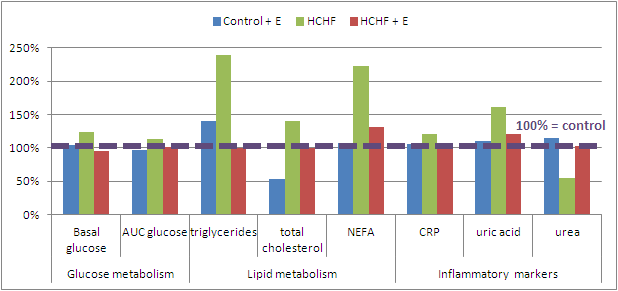
Figure 4: Basal glucose, AUC glucose after 2 g/kg body weight glucose load, triglycerides, total cholesterol, non-esterified fatty acids, c-reactive protein, uric acid and urea levels in rodents fed the supplemented control and the unsupplemented and supplemented high carbohydrate high fat diets; data expressed relative to unsupplemented control diet (data calculated based on Panchal. 2012).
These profound reductions in the amount of inflammatory visceral body fat, stand in line with the statistically significant improvements in glucose and lipid metabolism (cf. figure 4). As you can see the diet-induced increases in glucose, NEFA, triglyceride, cholesterol, CRP and uric acid, as well as the reduction of its counterpart, urea were completely blunted in the high carbohydrate + high fat group that received the ellagic acid enriched chow, an effect, the researchers attribute to...
  • an increase in fatty acid oxidation, indicated by increased CPT1 activity and
  • reduced inflammation, indicated the reversal of diet-induced increases in Nrf2 and NF-kappaB 
... in heart and liver of the rodents. That the addition of ellagic acid to the diet also minimized the necrotic damage to the liver of the animals, is thusly not surprising.

"So, shall I embark on the fruit and nuts diet?"

Despite those scientifically 'proven' benefits I should yet not have to tell you that it would not be particularly wise to take this study as an opportunity to ransack Trader Joe's dried fruit and nuts warehouses... As unreasonable as the contemporary condemnation of real (not dried!) fruit and (non-rancid!) nuts may be, it did not come out of nowhere, but has its roots in the detrimental overconsumption of both, nuts and fruits in the media-driven believe that adding tons of those healthy "superfoods" to your diet would allow you to live into your late 90s without ever having to worry about any of the ailments of the Western society. Both, nuts and fruit are yet only two "superfoods" within a "superfood diet", ... ah pardon, a whole foods diet, where neither of them is a "treat" or "cheat", but simply nutrition!
On a side note: Can you imagine that your ancestors sprouted a handful of nuts after all the work they had to shell them? They must have been nuts, if they did - don't you think so?
 Contrary to the impression you may get, when you follow the discussion on certain bulletin boards, eating healthy does thus not imply that you have to restrict your dietary repertoire to meat, fish, butter, eggs and the occasional sweet potato; this is all the more true, since ellagic acid is only one example for the myriad of already known and still to be discovered micronutrients with beneficial health effects, of which you would be depriving yourself, if your list of "allowed foods" contains no more than 5-10 items.

Think about it: Just as the FDA-approved food additives are "harmless" if you consume only one of them and potential hazardous, when you eat the whole variety that is present in the fast-food laden SAD diet, it is the synergy of all those ellagic acids and whatever their names may be that makes a varied whole-foods diet so healthy - don't miss out on that!