.

.
marylin monroe
Showing posts with label motivation. Show all posts

Adelfo Cerame - Pre-Contest-Prep: Rest, Recovery and the Underestimated Value of Taking a Week Off.

Image 1: If this is how you feel, than it is about time you take one week off from whatever routine you are on.
It's only Thursday and I feel like I could use an extended weekend (luckily this will be one, with Monday being a holiday, here in Germany ;-), already. Some feel like it's life or work that is getting in their ways, for others its their hobbies, like blogging and training (that's me ;-), but, after all, if we are honest with ourselves, in almost all cases there is "no one" or "nothing" that really stands in our way, other than we, ourselves. I mean, oftentimes we are so busy with our everyday routines that we begin to feel to be externally controlled, although, in almost all cases, we are the ones who decide / believe that we must follow the exact same routine day in and day out.

The results of this practice, in the best case, are boredom and discontent - in the worst case, however, our routines will burn us out and make us sick. Adelfo, our man at the  2012 Wheelchair Nationals, is well aware of the fallacy of routines - especially when it comes to going to the gym day in and day out and he knows that taking a day off before you feel it is utterly necessary is way smarter than digging a whole out of which you cannot escape, no matter how "hard" you rest ;-)

One Week Out = One Week Off

I'm taking a week off from training, before the hot phase of my contest preparation begins. The time, this stands out of question, is well spent to heal my nagging pains, to rest my body, who has already been sending me the first signs of a cold and, most importantly, to be able - mentally as well as physically - to really kickstart my contest preparation in October.
Image 2: Comparison shots from September, 1st to September 21 2011 - the prep has not yet begun, therefore no major changes in this time of experimentation (photos by Adelfo Cerame, 2011)
As it happens, I am also just reading Rob Regish's Blueprint. In his book, Regish mentions that a depressed immune system, and subsequent infections, like if you're getting a cold out of nowhere are tell-tale signs that is is about time to take a week off from training... Now, while this idea obviously was not new to me, reading it black (or should I say blue ;-) on white, from someone with Robb's years of experience in training people, and as one among a whole host of other valuable tips, really helped to put me at ease with my decision to take the week off... Let's be hones, I assume for many of you it won't be different: we are always hesitant to just stay at home lying lazy on the couch, when we "ought" to be in gym. For some its the fear to gain fat, for other's (as myself) it's because we are afraid to lose some of the muscle we have been working so hard for over the past weeks, months and years. And this fear haunts us, although we all "know" (our brain knows, but our hearts don't) that all we will lose (if anything) is some easily replenishable muscle protein, i.e. there won't be any substantial loss of muscle mass, the muscles will only lose some volume.

"You should always listen to your body!"

Well, I guess you will have heard this verdict before "listen to your body" - but what if your heart, certainly a part of your body, cries - "I am afraid I could lose muscle!" and it cries so loud that you can hardly hear the your aching muscles under the pain of weeks and months of continuous training. Now, what can your do? I guess, the best thing will be to advice your brain to tell your heart to shut up and rest. At least that is what I decided to do and to take my mind off the issue of losing muscle or getting fat, I am sitting down and getting the plan for my contest preparation stream-lined. I am planning my workouts (and off times !), sketching the meals I will be eating and deciding on which  the foods that will make up the majority of my diet in the next 4-5 months.

"Rest appropriate nutrition" - cutting back carbs, when you don't need them

Image 2: Healthy post-workout meal of the week - 7oz raw wild caught salmon, 12oz sweet potatoe, 6 carrots, 1c mangoes, 1 tbs raw blue agave and some refreshing coconut milk - the all natural sports beverage!
A pros pos nutrition, I am still fasting 16 hours and feeding for 8 hours, but during my off week all my meals are high in protein and fat and low in carbohydrates. Examples would be ...
  • raw milk, carrots and raw cheese, or 
  • raw/seared steaks / sashimi with carrots or fruit and coconut oil, or
  • raw wild caught salmon from image 3, but without the sweet poatoe 
Basically a high quality protein source + some additional fat (if the former is not high in fat) + a minimal amount of carbs from veggies or fruit. I must admit that I still sneak in a meal from time to time, but this is partly psychological, because I know that this is the last week I can to it without messing up my contest prep, where I have already planned on the three days were I will deliberately "break" my diet:  thanksgiving, christmas and my birthday... and even those will be pre-planned refeeds.

Refeed? I guess you have already been waiting for this keyword to occur. After all, I promised you to report on my experience with a fruit based refeed... Well, I gorged on fruits just as I would have done with pancakes and the processed carbs that I usually eat on my re-feeds, and... I would have to say that even though I stuffed myself with fruits I did not get that comatose or sick feeling that I usually get, with the crappy foods from the grocery store. While I am still not a 100% sold on the idea, I am toying with the idea to start out my prep with fruit-based refeeds. We will see whether this will be sustainable, once I start getting leaner... for now, it works fine, though.

Adelfo Cerame's personal blueprint: Mens sana in corpore sano

Video 1: Adelfo does single arm cable rows 2 weeks before the hot phase of his contest preparation.
As far as my training is concerned, I have been toying back and forth with some of the suggestions from Regish's Blueprint. I've been reading the whole book on the past weekend and am still in the process of sorting out those training principles of which I think that they make a valuable addition to my routine. Don't get me wrong, the book is awesome, but if there is one thing I have learned in the past, then this is never to copy a routine from someone else to a T. Yet despite the fact, that there are some profound differences as far as the nutritional protocol is concerned (this is quite obvious, as the book outlines a muscle building not a contest prep diet), I really do like the weight training protocols and I hope to find a way to combine my constantly evolving contest prep diet with some of the training strategies from Regish's Blueprint...

I will also try and use my week wisely to do some meditating, soul searching and spend some time with the Lord, as I like to be spiritually healthy just as I am physically healthy. And, in case spirituality is not for you and you do not feel like taking a week off, anyway, you may want to check out the promised training video (video 1), head to the gym and treat yourself to a large portion of wild-caught salmon with delicious sweet potatoes and some carrots (cf. image 2) ;-)

Student Spotlight: Adelfo Cerame - A Terrible Accident Paved His Way to Competitive Bodybuilding

Image 1: Adelfo Cerame in his job as a firefighter (backrgound) and as a competive bodybuilder at the 2011 Buckeye Classic, where he took an amazing 2nd place (foreground).
His name is Adelfo Cerame Jr and he is a competitive natural wheelchair bodybuilder and physical culture enthusiast. Although he says of himself that he is just a regular guy that has a passion for fitness, nutrition, and the physical culture lifestyle, his willpower, toughness and absolute dedication made him succeed even after an accident that would probably have stopped the career of any other aspiring physical culturist in its tracks.

It is thus more of an honor than a mere pleasure for me that he was not only willing to recount his story, some of you may already have heard of on Super Human Radio in the SuppVersity Student Spotlight, but that he will also be documenting his preparations for the upcoming Wheelchair Nationals in March '12 in a series of blogposts, images and videos on the SuppVersity.
SuppVersity exclusive:
Adelfo Cerame's Road Road to the Wheelchair Nationals 2012

Don't forget to check back for exclusive weekly updates on Adelfo's progress. In his contest-prep documentation you are goint to learn more about Adelfo's raw-foods approach to intermittent-fasting and in his pictures and videos you will see how diet and training will gradually transform a well-built athlete into a freakishingly ripped muscle-freak with a realistic chance of grabbing his pro-card at the Nationals in March '12.

The Crash, the shock... the motivating challenge

My journey started on November 10, 2005, when I was involved in a car accident that left me paralyzed from the waist down, being diagnosed as a T-12 paraplegic. The reality of paralysis and not being able to walk again was a huge eye opener and reality check for me. I had to cope with the fact that things would be a bit different now, and I would have to learn and adapt to a new way of living. The realization of being a paraplegic broke me down spiritually, mentally and physically. It took me about a year to come to terms with my situation, and once I came to terms, I embraced it with open arms, and used it as a driving tool to challenge and motivate myself. I rebuilt myself from the ground up, from my self-esteem, my relationship with God, my new outlook on life, to my physical fitness and physique.

"It took me a while to figure out the whole dieting scheme and put it all together "

Image 2: Adelfo late 2007 (left) and in summer 2008 (right), when, as a result of research, networking and experimenting, for the first time in his whole life, he was finally able to see his abdominal muscles.
I started getting into bodybuilding around 2007 when I was browsing through “you tube” videos and I saw these guys in wheelchairs posing and flexing in bodybuilding competitions. I was so amazed when I saw these incredible physiques from people in wheelchairs, like myself. After looking and reading more into wheelchair bodybuilding, I thought to myself that I can do this; and that’s when everything began for my passion and love for physical culture.

Through research, networking, and experimenting, I was able teach myself about nutrition, fitness and dieting. Grasping the concept of weight loss and dieting was like finding a formula for a math problem after trying to figure it out for years.  I eventually figured it out and did my first bodybuilding contest in 2008.

Image 3: Adelfo during his firefighting days before the accident. While he was not exactly athletic, he never had weight issues with all the physical labor.
Before my injury, I have always been athletic. I played organized sports all through my childhood and adolescent years. Even my occupation as a wildland firefighter before my injury was physically demanding. I knew about fitness and exercise but did not really understand the aspect of the nutrition side of it until I started bodybuilding. I always thought that I was a slave to my subpar genetics and that I can never attain a shredded physique with washboard abs because I was not genetically gifted, but I eventually proved myself wrong with that concept.

"I had to find a different method of maintaining my weight, because I could not run or hike anymore"

Image 4: Adelfo after his first bodybuilding competition in the summer of 2008 where I took 1st place
As you can see from my photo before my injury, I was never really over weight or obese, I considered my self in pretty good condition, but I never really had that physique that I obtain now. My nutritional habits were horrible, I ate what I wanted and when I wanted, and I drank too much alcohol. During my firefighting days my diet consisted of pizza and a 6-pack of beer on a daily basis and the occasional bar hopping. The only reason I stayed in good physical shape as I was, due to the physical demands of my job. I ran 5-6 miles and hiked on a daily basis, and during fire campaigns, I worked 14-21 days straight doing 16 hour shifts hiking up and down mountains fighting fire, so I was burning hundreds of calories on a daily basis, which allowed me to eat and drink what I wanted, and not having to worry about letting myself go. I did not realize how important nutrition was back then, but finally realized the importance after my injury because now I had to find a different method of maintaining my weight because I could not run or hike anymore to burn the calories that I was so use to just shedding.

Image 5: 2010 was not a good year for Adelfo. In the beginning stages for my prep for the 2010 season, he was bed ridden for almost the whole year, due to an pressure ulcer on my behind that was infected with MRSA and needed surgery.
Throughout these past 4 years of my experience with bodybuilding and the whole physical culture lifestyle, I have gained a lot of knowledge about nutrition and fitness. My diet and training methods have evolved and will continue to keep evolving, because of my willingness to keep an open mind and apply and experiment with new strategies, methods and philosophies to my diet and training.

"A perfect diet should be something that you can convert into a lifestyle"

I have tried many, and different approaches to dieting. Through experiment, trial and error, I have taken what has worked for me and used it to build (or still building) a perfect diet, which suits me. I feel a perfect diet should be something that you can convert into a lifestyle not just a 12-week thing then get off of it. A diet should be flexible where you can still be happy, social, and not live like a hermit due to the fear of  “F” ing’ up your diet. I call it find your happy medium.

For my nutrition, I am a big fan of having a high fat, high protein, and low-carbohydrate diet. I feel that my body runs better on fats, but I understand that carbohydrates have their place and importance in nutrition, so I also incorporate some carbohydrates into my diet.

Making a handicap your training advantage

You think you could use some advice on your own training, diet and supplementation regimen and want it from someone who obviously knows what it takes to build muscle and lose fat? You can reach out to Adelfo via Facebook.
For my training I like to lift heavy and I’m not a real big fan of resting in between sets even if I am lifting heavy. Since I no longer have the use of my legs, I have the advantage to train individual body parts twice a week. An exemplary week would look like that:
  • Monday- chest/ triceps (emphasize chest)
  • Tuesday- back/ biceps (emphasize back)
  • Wednesday- rest
  • Thursday- triceps/ chest (emphasize triceps)
  • Friday- biceps/ back (emphasize biceps)
  • Saturday- shoulders and 1 body part depending on what I worked out on Friday.
  • Sunday- rest

Adelfo finds sticking to basic supps both economical and effective

For my supplementation, I try to just stick to a quality protein powders, bcaa’s, creatine and oils like macadamia and coconut oil. If I have extra money to spend then I’ll supplement with N.O.’s , pre-workouts (only when I prep), fat burners and beta alanine.

Intermittent fasting is the newest tool in Adelfo's contest prep arsenal

Image 6: There is no doubt - Adelfo knows how to get (back) in shape.
What drew me to Intermittent fasting was the claims that some have made by being able to hold single digit BF% year round. I have no problem cutting for a contest and showing up on stage in great condition, but the hardest part for me, and I think I speak for most, is being able to maintain that contest physique. Even on a high fat, low carb diet (anabolic solution diet) during my off-season, I still can't hold my contest physique unless I was on a calorie deficit, but who wants to do that all year!

Convenience is a big plus of intermittent fasting

Another factor that made me want to try Intermittent fasting, and I think it was the deciding factor for me to experiment with it for my upcoming contest prep, was the relief from not having to prep meals for the whole day and waking up super early just so I don't miss breakfast. I was just getting burnt out on prepping meals and basing my daily schedule around my meals. My meals kind of dictate how my schedule goes.
Coming soon: Dr. Andro's Intermittent Fasting Write-Up - All about its effects on your training, your physique and your general health. You may also want to check out my posts on glycogen-free muscle growth in the meantime.
A final word from Dr. Andro: If Adelfo's bio got you interested - and I am pretty sure it has - make sure you don't forget to check back for the upcoming SuppVersity exclusive "Adelfo Cerame's Road Road to the Wheelchair Nationals 2012 - Raw Foods and Intermittent Fasting Pave His Way"! The best way to make sure you don't miss it, is to join the SuppVersity Facebook page, where you will find all the daily updates on what's going on in the world of exercise and nutrition science.

The SuppVersity Student Spotlight: Duong Nguyen - Twelve Weeks of Intermittent Fasting Got Duong a Mind-Boggling, "Aesthetically Muscled" Physique

Image 1: Duong at the beginning and 
end of what is one of the most impressive
12-week transformations I've seen in quite
some time: -31lbs on the scale; -4" off the
waist and +0.5" chest circumference!
Being a true science geek, I soak up complicated studies like a sponge, but even as a practicing scientist (from another research area, though) all that knowledge would not help me to avoid looking like Sponge Bob, if my interest in the application of abstract theories to real world scenarios was not at least as pronounced as my interest in the formulation of geeky hypothesis about biochemical processes in petri dishes. Consequently, I have always been fascinated by the logs and stories of real people (not nameless subjects in a study) posted across the various health- and fitness bulletin boards, blogs and personal homepages on the Internet and lately, as it happens, I spotted one such story I found so extraordinarily appealing that I decided to ask its author, if he accepted to be the 'protagonist' of the first installment of a new regular column on the SuppVersity, the intention of which is to honor those of its "students" (i.e. you, ladies and gents!) whose stories can serve as an inspiration for others to follow in their footsteps:
The SuppVersity Student Spotlight! I want your stories! You do not have to be as ripped as Duong to inspire others. Maybe you are the admirable former fat guy, who fought off diabetes, the cancer survivor or former anorexic, who is about to start a new healthier life or "just" a geeky physicist like me, who loves the way working out and eating healthy makes him/her feel - whoever you are, tell me your stories and give others the chance to be inspired by your success!
His name is Duong Nguyen and the way he managed to change his body within no more than 12 weeks is so amazing that I will let the pictures (cf. image 1) speak for themselves and just have Duong tell you the inspiring story behind his new "athletically muscled" self [I edited the headlines, put some emphases and wrote the captions for the images].

Image 2: Before becoming an inspiration
for others, Duong got inspired by the story
of "America's Personal Trainer", Tony Little.
I. Duong's Story

As a young kid I was never lean or thin like a lot of other kids. I wasn't obese, but was considered "fat" especially as an Asian person.

I remember back when I was in 5th grade, my older sister would tell me that I should exercise. When I asked her why, she would respond with "so you don't look so fat". Me being in 5th grade at the time, I didn't care about looking fat. I knew she didn't want to look fat (not sure of the reason though), but at that time I didn't care that I was fatter than the other kids.

Even Duong needed "a Little" inspiration

However, what actually convinced me to finally start working out was an infomercial...a Tony Little (cf. images 2 & 3) infomercial to be exact!

I don't remember the exact product he was selling at the time, but I'm sure it was a series of videos showing people how they can workout at home to lose weight. What I remembered most about those infomercials was the story about how he got into a car accident, stopped working out and ate like crap because he felt sorry for himself. Image 2 shows the picture they showed of him looking all bloated and out of shape.

Image 3: Tony Little after his 1st accident
- yes, this the guy from image 1!

Seeing these before pictures and then seeing Tony Little as he was on the infomercial in the great shape that he was, had a huge effect on me!

Seeing what he looked like in his before and after pictures made me think that it was possible for me to make a change to my body with exercise!

So after seeing his infomercial multiple times (it was always on tv), I started to do some of the exercises Tony showed on his infomercial and this is how I got started working out.

The exercises were just things like push ups, sit ups, and other calisthenic type exercises, but I felt like I was getting results just from doing these simple exercises.


Then, when I was in 9th grade, my parents bought me a Weider home gym and weight set which allowed me to workout with weights. I fell in love with lifting weights and was able to build a decent base just from working out at home. I was still fat but I was getting stronger and could tell by looking in the mirror that I was gaining muscle!

Supplements are part of the game ...

This also was the beginning of when I would start using supplements. The story of how I got started using supplements is probably the same way a lot of others started; seeing an idol/role model sponsor a supplement and thinking that was how you can become just like them.

My favorite football team at the time was the Denver Broncos and Shannon Sharpe was one of my favorite players. He endorsed the supplement company EAS and I thought if I wanted to get big and muscular like him, then I needed to use EAS supplements. So I ordered some Myoplex meal replacement packets and Creatine HP as my very first supplements.

I remember making some great gains using the meal replacement and creatine so I was totally sold on using supplements!  I believe I must have gained 20 lbs over a course of 3 months. I thought "Wow, these supplements really do work!"

... but lifting heavy and proper nutrition remain the foundations of success

I didn't start lifting real "heavy" weights though until I joined the football team in the 10th grade. The program they had all their players on was a basic periodization program based on the Bigger, Faster, Stronger principles.

I gained a lot of strength and muscle mass doing this but unfortunately, I still did not know much about nutrition at the time. All I read about was how I needed to eat large amounts of food to gain muscle...which I did, but I also gained a lot of fat doing this. So, after I was done playing football, I wanted to lean up and look good with six pack abs, so I attempted my first diet in order to lose fat. At the time, the no carbohydrate/Atkins diet was all the rage so that's what I went with.

Progress means learning from mistakes

Image 4: Duong before starting
his 12-week intermittent fasting
approach to a new, ripped self.
Being that this was my first attempt at dieting, I made a lot of the same mistakes that newbies tend to make. My diet was too low in protein, too low in fat, and too low in calories in general. I also lifted weights using higher reps to "tone" the muscles and did too much cardio as well. I didn't know any better at the time...that was what the muscle magazines told me to do and I was just trying to get a six pack.

Needless to say, my first dieting attempt was a failure. Sure I lost fat but also lost a lot of muscle and strength. I also did not even end up with a six pack!...perhaps a very blurry one at best.

And now of course that I was smaller, I wanted to bulk up and be big again. At this time, I still hadn't learned the proper way to bulk yet, so I basically just ate whatever I wanted. I was still under the impression that I needed to stuff my face in order to grow.

You need to experiment in order to find what works for you

I also tried several different lifting methods/programs during bulking. I remember trying 5x5, HST, German Volume Training, DoggCrap Training, and other various programs that I found online. Some worked better than others but the experience and knowledge I gained was crucial in my overall development.

After a couple of these bulk/cut cycles, I did learn over time how to be more successful at each one, which means I retained muscle while cutting, and kept the fat gains at a minimum while bulking. Notwithstanding, bulking is still a difficult undertaking for me as you can see in my before picture (cf. image 3) - I just love to eat!

II. What Worked for Me

Image 5: This is the 'new Duong'!
Looks like a celebrity, doesn't he?
After multiple cut cycles of low carb diets eating every 2-3 hours, I stumbled across Martin Berkhan's Leangains website. His intermittent fasting approach to eating really interested me, as I never really did like eating breakfast and also didn't like having to eat every 2-3 hours. It basically went against everything about eating/dieting that was the norm.

The potential for muscle loss during the fasting periods did concern me, but seeing all of Martin's clients' before and after pics displaying their success inspired me to give IF(intermittent fasting) a try for this cutting period. So I read all that could about intermittent fasting on Martin's website and started my cut.

It's all about making a diet your diet 

Martin's recommendations call for a 16 hour fast and an 8 hour feeding window. My fast ended up being longer with a shorter eating window, but that was just because it fit my schedule better.

So everyday I would wake up, fast until around 3:30 pm when I would have protein shake followed by a workout, post workout shake, and dinner. Then maybe 1 or 2 hours later, I would have another protein shake. I squeezed my entire calorie intake for a given day into that short 4-5 hour period.

In terms of what I ate, I followed a low carbohydrate, high protein, high fat diet. On most days, I would eat chicken thighs and whole eggs for the high protein, high fat content along with some veggies and berries or a grapefruit.

You can't max-out on every workout - listen to your body!

For my weight training, I did a full body split training 3 times a week. Two of those days were "heavy" days so I trained using weights where I could only get 5 reps. The other day was a "medium" day so the rep range for that day was 8-12 reps.

My off days from weight training were reserved for either cardio or rest depending on how I felt. If I felt good, I would go do cardio. Otherwise I would just stay at home and rest. Most of the time I felt good, so I ended up doing cardio 3 or 4 times a week most weeks.

Image 6: BCAAs were a staple of
Duong's supplement regimen
Supplements can tip the scales

I felt certain supplements were very helpful with my cut. Here are the supplements I took advantage of during my cut:
  • BCAA's & creatine - used for possible muscle preservation and anabolism during workouts
  • Fatburner / thermogenic - used to decrease hunger, provide energy, increase mood, and increase metabolism
  • Testosterone booster - used to increase testosterone, decrease estrogen, and control cortisol
You can find all the details of my eating, training, and supplementation on my blog Aesthetic Muscle

III. What I Think, Finally Made the Difference

All in all, I have been weight training for about 10 years now but I have never really been satisfied with the way I looked until fairly recently.

More specifically though, my recent cut in the before and after pictures above was a difference of 12 weeks. I went from 189 lbs down to 168 lbs and am still continuing to cut. I would have to say that this has been my most successful cut so far as I seemed to have retained all my muscle and actually gained strength during the 12 weeks. I am also the most "ripped" I've ever been been.
Image 7: Already ripped and still making progress; two current progress pics at 165 lbs.
It was also the "easiest" cut I've had. With the IF eating pattern, it sometimes almost feels as if I am not even dieting since I am I am eating so much at once and getting so full.

IV. Suggestions for Others

If I had to go back and do it all over again, I would definitely have wanted a mentor with the proper knowledge and experience to guide me. Although there was a lot of information available in magazines and the internet, I never quite knew what information was right. Having a mentor to guide me [or the SuppVersity to study < comment Dr. Andro ;-] would have saved me years of training incorrectly, not dieting right, and using a bunch of crap supplements.
Attention: If you want to "hear" more about Duong, listen to Carl Lenore's Super Human Radio on
Thursday, July 28 2011 at 1pm ET Duong and me (Dr. Andro) will be talking about his journey.
update: Show is now available as podcast, click here to download!
There was a also a period of maybe 2-3 years where I was tired of being fat and also getting fat during bulking periods, and I just wanted to be lean all the time. So I dieted down and stayed on a low carb diet with no bulking periods for a few years. Doing this cost me a couple of years where I could have been putting on muscle if I had known how to do it correctly. This was a mistake that I could have avoided if I had a mentor.
Advice from Dr. Andro: Don't forget to visit Duong's blog Aesthetic Muscle for more information about his awesome transformation!
Also remember, that consistency is the key. Even though I didn't know what I was doing in terms of nutrition for most of my weight training "career", I was always consistent with the weightlifting. I may not have been training and eating optimally, but I did love lifting weights and was able to build a decent amount of muscle over the years. I just didn't learn about proper nutrition until fairly recently and this was when I was truely able to transform my body.

Adelfo Cerame - Road to Wheelchair Championships: Don't Let Red Flags and Banana Skins Stop You!

Image 1: I don't see that chair. I see an amazing physique, a great friend and an outstanding competitor!
I have alway been looking up to Adelfo Cerame Jr. - ever since I first heard his voice on my friend Carl Lanore's radio show, Super Human Radio. "That's a true super human, this guy!", that's what I thought; and this has not changed, now that we know each other for almost a year and I am calling him a friend. It has little to do with the fact that he is sitting in a wheelchair and "still competing" (so what?). In fact, I tend to forget that from time to time and am tempted to ask him why on earth he has no leg day in his weekly training regimen (I mean, come on no leg day ;-). No it's not that damn chair that amazes me. It is the way he is marching forward - constantly! Yeah, marching, not rolling! And that he almost stumbled last week and asked for help and reassurance to re-balance himself only heightened my respect for him.... but I guess, I'll let him tell you his whole story.

Dieting in between shows… Not as easy as I thought it would be

I thought that I would just be able to cruise with the physique I've built before the Florida NPC Wheelchair Nationals; just trucking along the next 15 weeks... but I guess, it just doesn’t work like that - or am I simply not used to dieting in between shows? It's the first time for me to do that and it has become somewhat of an ambivalent experience. On the one hand, I keep learning things about my body and my psyche on a daily basis, on another hand, it is a pain in the ass, or rather my psychological sanity, to always eyeball my body fat percentage while I am initially gradually increasing and eventually gradually decreasing my caloric intake to make a smooth transition over to the next show. It’s, to be honest, by no means what I expected.

You never know! And that's the problem :-/

Image 2: When being ripped to shreds and at the best you ever were in your life was not enough once, what if it ain't enough the next time as well?
It’s that mental uneasiness nothing physical that's really burning you out. A stress that, in the end, can have detrimental physical side-effects, as it hampers clear judgment and you run the risk of making mistake after mistake ending up ruining your physique by changing your diet and training regimen on an almost daily basis and constantly thinking you need to do more, oh, ah... no less - confusion!

Before I started working with other people, I always felt this was something that was characteristic for competitors, only. I mean, why would a "normal" being worry about whether the 10g of carbs could slow down his fat loss by 0.5% per month? But after seeing the most ambitious of my clients struggle with the same problems, I know that I probably don't have to tell you about that feeling of not doing enough or just being about to ruin everything you have been working so hard for - right?

2nd place no more!

For me it's yet even worse. I mean, imagine this: You've put all your efforts and focus at the task at hand. Doing your very best and sometimes even more to achieve your goals and still you fell short of your goal - the one goal to which you have dedicated 25 weeks of your life (I guess by now you know that I am talking about the pro-card for the overall I did not win in Florida, right). Now, there is just one more chance and 15 weeks to make it happen. Your last chance to attain your goal this year.
Image 3: It felt as if I must have nailed it, and then... "2nd place, Adelfo Cerame Jr."
First you are mad, then you are pissed and now you are more motivated than ever. But what if you missed your goal again? Things begin to get nerve wracking, your thoughts are racing, you can hardly focus on your lifts and ... you feel just like I did the last days :-(

Competitiveness + Drive + Motivation + Fire • Ego = TNT

Competitiveness, drive, motivation, fire. I have emphasized the importance of each of these in my past blogpots, but when you add them all up and multiply them with your ego, you get an explosive mixture. On their own, each of them can be huge plus; together, however, they need to be handled with utmost care, because otherwise they will have you go to extremes - detrimental extremes, training- and diet-wise. You start to make unwise, if not straightforward stupid decisions. I didn’t realize it until this week. Until I had to take a step back, to see that I was about to run myself into the ground.
 
A crash course in vexillology

I know that you would never be so stupid to (over-)train against better judgment, but the following list of red flags may still come handy. I mean, don't we all have "that friend of mine", who happens to have all these embarrassing questions or problems he does not dare to ask, so that we have to do it for him?
    Image 4: Bulls are probably the only ones who would be better of if they simply ignored "red flags". For humans, on the other hand, the ignorance has similarly nasty consequences as the enraged overreaction of a bull in the bullfight arena.
  • Red Flag 1 - Trying to do more after your workout: I never used to do this but I’ve notice myself lately doing extras after my training sessions. Even though I knew that my body was already beat down from an already insane workout; this little man on my shoulder kept whispering in my ear: "One more! Just one! Good, and now another one..."
  • Red Flag 2 - Trying to tweak your training regimens to the extremes: Adding more reps, more sets, heavier weight; there’s a difference between improving your training regimen and just being ridiculous, and I was approaching the latter like a bullet train.
  • Red Flag 3: Doing things out of the norm: I rarely do any cardio; and if I do, then for a good reason. Yet as of late, I was struggling not to join the ranks of the skinny cardio-maniacs.
  • Red Flag 4 - Over analyzing: I am "meticulous", as Adel likes to say, somewhat too much into the figures for his liking, yeah... but what happened in the last week was borderline OCD. Almost as in the good, or rather bad old days of previous contest preps, when I was close to weighing and measuring every blueberry I ate.
So, does "your friend" ever show any of those "red flag symptoms"? Yeah? Well, maybe it helps him to break free from the vicious cycle if you talk to him about the underlying psychological culprits, which were - at least for me...
  • Culprit 1 - Wanting to outdo² yourself: There’s nothing wrong with bettering yourself but I think I started to take it to an extreme, where the one thing that "improved" was my own insanity. Nothing was good enough, progress was insignificant, and everything went just way too slow...
  • Culprit 2 - Having a chip on your shoulder: I guess after, that last show, I’ve had a big chip on my shoulder, and for those of you that have had this issue before, it can be a good or a bad thing, or both. You better make sure it is the former or get rid of that chip!
  • Culprit 3 - Not wanting to disappoint others: I don’t want to disappoint people! Plain and simple! Whether it’s my performance on stage or how I bring in my physique; I don’t want to disappoint.
By now "your friend" should either be relieved that, compared to this guy with the guestposts on the SuppVersity, he still feels pretty normal, or he should better go on and read the following list of solution, which worked for me:
  • Solution 1 - Leave it in the past, and focus on now! One of my biggest issues is that I always tend to compare old contest prep pictures with current ones. To a certain degree this is unquestionably necessary, but in the course of this prep it was insane. Every week I would be sitting there staring at the pictures trying to figure out how my progress was paring up with last preps progress. Overanalyzing, seeing things that are not there and missing some (like my abs ;-) which were clearly visible, I was psyching myself up into a frenzy, until... I just yelled at myself "STOP IT!", put the pictures from three months ago into the folder, where they belong and returned to evaluating my contemporary progress on a week by week basis.
  • Solution 2: Accepting that things don’t happen the same way: You can’t expect your body to progress exactly the same way as it did before. Just as your experience growth and your physique changes (I mean, this is what progress is all about, right), the way your body behaves, when you approach contest day will change as well. You will have to tweak your diet, your training, your everything to the "new you" and it was a mistake on my part to lull myself into believing that "If I just do everything exactly the way I did last time, my body must react exactly the way it did last time!" And when it turned out that this prep was not going to become a carbon copy of the last, that scared the heck out of me. Once I realized how stupid these expectations actually were, it took a lot of the stress away.
  • Image 5: Moe, the bartender, or Barney the drinker? As long as he is a friend, it does not matter. He will be there when you need someone to take a pound or two of the load you are carrying off your shoulders, if you dare asking him.
    Solution 3 - Ask for help when you need it: I’m pretty keen on crunching my own numbers and monitoring my own prep, from diet to nutrition. There are times, when I have other stuff going on outside of bodybuilding that have priority. In weeks like that going through the numbers becomes increasingly stressful. In concert with the "I am not making enough progress" craze of the last weeks, everything appeared to get out of hand. Those are the moments where you are lost, when you don't have someone or are too stubborn to turn to someone for help. "Help", yeah, that was the title of the email that landed in Adel's inbox a couple of days ago. Adel, or Dr. Andro, as many of you know him, is pretty much the only one I trust with this stuff, so I emailed him, told him my situation, and asked if he could help me out with some of the thinking from time to time with my prep from here until June 23. And although he did not really make any changes to the regimen I had prepared for myself just knowing that he is there, just like a "human safety net", really helped take some of the insanely heavy mental load off of my shoulders.
I guess, "your friend" can consider himself lucky that you are a friend for him, as Adel is for me. I mean, you have read the whole blogpost, right? Did not skip to one of the SuppVersity science news, when I mentioned that you would obviously never make a mistake like that, but maybe a friend of yours, right? That's good! And I am sure that "your friend" will do the same for you, just in case you should ever maneuver yourself into a similar situation ;-)

Adelfo Cerame - RtWC: 5 Tricks to Ignite Your Competitive Nature and Attain Things You Never Thought Possible

Image 1: Hard to imagine, but this man was not born with outstanding abs and even believed it was "not in his genes" to attain a physique like this.
I don't know if you have noticed, but our common friend Adelfo is stepping up his game. I can still remember when it took him a week to come up with an article which still needed way more than just some superficial editing. These days however, he is not only training and dieting harder than ever (and I am absolute certain, this time the judges won't be able to place him second!), he is also making himself a name as an author, both here, at the SuppVersity, as well as over at his sponsors' Myotropics Physique Magazine. His latest article on Confidence as the key to a "sexier you" is as much of a motivational slam-dunk, as today's installment of the Road to Wheelchair Nationals series, here at the SuppVersity. So, after you have internalized, or as Adelfo wrote "packed away the psychological wrenches", head over to the Myotropics website and check out how being comfortable with your self alone can turn a shrinking violet into a beautiful swan ;-)

Rediscover your competitive nature!

It's still six weeks out and yet I am already feeling it: My competitive nature is kicking in; not that it was lacking prior to this week, I just have a more heighten sense of things now, that my second and last competition of the year draws nearer. Just one last crack on my pro-card before the end of this competitive season and, one last crack on the overall! If that's not enough for my competitive juices to fully kick in, what else?

Image 2: As long as you really want it you can achieve all sorts of marvelous things ;-)
Still, even though I’ve been doing things right and have never gone astray from my constantly revised game plan, I have been missing this urging feeling deep down in your soul, this craving, the desire, the absolute determination to win, which will keep you pushing and pushing as the show approaches.

It’s either you want it or you don’t! And if you don't want it, you won't get it.

In the end, it's always you will that will help you overcome whatever will come into your way. Let  your competitive nature take over: Let your will be your engine and your mind be your steering wheel and achieve feats you would never have deemed possible.

Constant progress and success will keep your will alive

On your journey, seeing constant forward progress can be a great motivator. When you’re constantly seeing changes in your strength and in your physique or even improving your own well being, this will add more fuel to the fire. It will keep you motivated and allow you to push even harder.
Image 3: My progress from the pre-bodybuilding era in 2005 (left) before and 2006 (middle) after my accident to my last contest, the Wheelchair Nationals in Florida, earlier this year (right). If it had not (re-)discovered my competitiveness taken up bodybuilding and learning about training and nutrition, I would probably still believe that my genetics would never allow me to surpass the form I had in the image on the right
I can still remember the day I saw my abdominals appear for the first time in my life. It was one of these rare "once in a life" moments, a moment that made me realize that I was able to accomplish a feat of which I had always believed it was impossible. And yet, having accomplished the impossible did not make me complacent. Seeing those abs just stoked up the fire, I wanted to see how much further I could push, what else would be humanly (or inhumanly ;-) possible!

Achieving the impossible: If I can do it, you can do it, as well!

I am well aware that not everyone of you will have the courage or desire to step on stage, which is why I have compiled a list of tips that will help you harness your competitive nature, even if competing does not really seem to be an option for you, right now.
Figure 1: Here is an example of one of my food logs on myfitnesspal.  These are my daily caloric intake and macros and food staples; if I’m seeing forward progress every week with these settings, then I keep sticking to it, if progress halts or digresses then I evaluate and make adjustments.
  • Try to set personal records in the gym every week – whether you increase the weight by 10lbs or just 2½ lbs, every week doesn't really matter; even that one rep more or a slight improvement in form, volume, intensity... all that is forward progress that will keep your fire burning. Go ahead, outdo yourself! 
  • Keep a food log, and keep track of your calories, macros and the types of food you eat. Use a free calorie counter application like “my fitness pal” (this is the one I use). It’s easy to use and holds you accountable to your diet. It allows you to evaluate what caloric intake; macros and food choices work well for you to help you propel your forward progress. Make yourself accountable!
  • Take progress pictures every other week, so you can evaluate your current progress by placing pictures side by side (see images 3 + 4). I can't exactly tell you why, but this allows for a way more objective evaluation of where you came from and where you are now, than the mirror - let alone the scale!
     
    Personally, I have made a habit of taking my progress pics every Sunday morning before my re-feeds; and while it does not have to be Sunday for you, it is advisable to always take them in the morning (before whatever may have happened in the course of the day can have messed with the way you look), with the same camera and lighting. Otherwise, you may have a bunch of pictures, you cannot compare because on one of them your abs shine due to the flattering lighting conditions, on another one you just have been carb-refeeding and look bloated, ... Track and evaluate your success objectively
  • Image 4: My 12 week transformation (left); Duong's 12 week transformation (right);  I followed his progress step for step like a stalker and made sure that my weekly progress kept up with his or even better; I even emailed him for f#cks sake at one point and asked what was his caloric intake was during a certain week! *lol* – Now you get a picture of how competitive I can get.
  • Find a photo of someone with a pretty impressive physique, but make sure that it is realistic and attainable. Post that picture on your wall, fridge or use it as your screen saver. This photo will remind you of your goals, it will motivate you and propel your training, it will help you to keep on track as far as your diet is concerned and it will serve as a yardstick you can compare your progress pictures (see previous bulletin point) to. Take myself for example – I used my friend Duong’s photo (see image 4) as one of my tools to help harness motivate me and drive competitive nature. He transformed his physique in 12 weeks using an intermittent fasting protocol. I wanted to do the same, and then some! So for those 12 weeks, my goal every week was to be one step closer to attaining Duong’s physique. Find yourself a virtual competition or role model! 
  • You just have to want it! There’s nothing more competitive than wanting something so bad, that you’re willing to do whatever it takes to get it – heart; desire; passion; drive… all should be geared towards that one end.
    Dedicate yourself whole-heartedly! 
With these 5 strategies, you've got a whole compilation of psychological wrenches in your ever-growing toolbox. Put them into the "mindset" compartment, right next to the overcrowded supplement, nutrition and training compartments and use them wisely.

Motivation Trumps Supplementation! Moderate, Starvation Free Weight Loss With Carnitine & Motivational Support

What if one of those would be displayed prominently on every Snickers bar and other candy - would that be unethical?
I must admit that I probably have a positive bias towards the latest study, Satoshi Odo, Koji Tanabe an Masamitsu Yamauchi who work for Lonza a company that describes itself as "a global leader in life sciences" and the Aichi Gakusen University in Japan have just published in the online Journal Food and Nutrition Sciences. Why? Well, it demonstrates the value of education, motivation and making people take responsibility for their own well-being. Something that's still largely unappreciated and maybe even feared by the medical orthodoxy and it's victims... ah, pardon me, "patients", of course.

Words and wisdom trump pills and meal plans

Actually the researchers did nothing we would not have seen in countless of studies before. They recruited 24 male subjects with an, in US terms, pretty low BMI of 25 - 28 kg/m² and a waist circumference of 85-100 cm who had not been following any kind of regular exercise program before the intervention. The subjects were then assigned to one out of four groups:
    L-carnitine does also affect IGF-1 levels (read more)
  • Car +M: 500mg/day carnitine / no instruction
  • Car -M: 500mg/day carnitine / plus instruction
  • Pla +M: placebo / no instruction
  • Pla -M: placebo / plus instruction
The hypothesis the scientists had in mind was that the motivation program, which comprised (1) a face-to-face 30 min session with the principal investigator at the baseline visit, where the subjects were informed about L-carnitine and its metabolic functions, learned about the beneficial effect of weight loss on the risk of metabolic diseases, and were encouraged to perform daily physical activities like “taking stairs” instead of “using escalators”, (2) wearing a step-counter and evaluating its data on a daily basis, (3) doing a 7-day food log before the intervention began and comparing the latter to a second food log that was to be filled 7 days prior to their last visit at the lab.

"I am so freakin' motivated, but I don't want to eat less..."

All that sounds pretty non-sensical (and I guess there may be a cultural aspect to it, due to which it may be slightly less effective in the US), but the "success" of this "motivational intervention" - as minuscule as it may have been over the course of this 4-week intervention without a prescribed diet / exercise regimen - cannot be denied (see figure 1 & figure 2).
Figure 1: Changes in body composition and daily activity level in the course of the 4-week "intervention" (Odo. 2013)
This is particularly true, if you take into consideration that despite being "motivated to keep daily calorie intake between 1500 and 1,800 kcal", the energy intake of most of the subjects exceeded 2500 kcal/day and did thus not really differ from baseline in figures 1 the scientists also evaluated the effect the dietary / supplement intervention had on glucose and lipid metabolism and found
  • Keep motivated and add some GTE to the equation, if you want to improve your glucose metabolism. The data above shows, green tea extract is in fact as potent as metformin (learn more)
    decreased triglyceride levels in Car +M  
  • no sign. effect on total cholesterol 
  • n.s. increase in LDL in all but the Car +M group  
  • no sign. change in HDL  
  • non-significant increase in adiponectin in Car +M
  • no changes in HbA1c in any group
  • significant increases in insulin in the non-motivated groups
And last but not least Odo et al. investigated what they call "safety parameters". Every normal human being would call the latter a standard blood panel, which did, as you would expect, not show and pathological changes (I mean what could exercise and carnitine do to those guys?) and ran a couple of liver and kidney tests, where - and this is interesting - only the non-motivated, non-supplemented group showed a single statistically significant, but physiologically irrelevant change in urea nitrogen levels, which increased from 13.0 to 15.0mg/dL.


Want to add 10 kg to your bench in one session sugar pills and the brocebo effect make it possible (learn how)
Bottom line: Actually there are two messages you can take away from the study at hand. One is that carnitine works. Taken at a dosage as low as 500mg/day alone yielded in parts borderline, but still significant health improvements in the absence of any prescribed dietary or exercise intervention. The more important message, on the other hand pertains to the effect of the "motivational protocol". Despite the fact that you will probably agree that this was not exactly what should become the "gold standard" for future interventions the mere knowledge of why the subjects were supposed to eat less, make healthier food choices and be more active was enough to make a significant difference. And that irrespective of whether the subjects ended up receiving the carnitine or the placebo supplement.

As mentioned before, there certainly is a cultural bias involved here, but is that reason enough to say: "Wtf, this won't work for Americans anyway!" Should results like this not rather be an incentive to try and change a climate, where people rather wait for the next weight loss drug than to start taking their life into their own hands, before their diabetes has made their fingers so numb that this is no longer possible? I would think so and that's actually part of the reason the SuppVersity and the SuppVersity Science-Round Up on Super Human Radio exist.

The (Over-)Motivational Roots of Orthorexia, Overtraining & Co - Plus: Symptoms, Recovery Times & Scientific Questionnaire to Recognize Early Signs of Overtraining

Image 1: Does not look motivated, right? This kitty just knows about the value of carefully planned laziness!
Originally I had planned another article for today, but after Adelfo's somewhat unexpected "2nd place victory", I do not just want to go back to business as usual and thusly decided to take a brief look at what science has to say about winning, losing, motivation and getting back on track. And lo and behold loosing due to the obviously subjective decision of judges and the subsequent "discouragement", which, in psychological terms, could be subsumed under "non-self determined amotivation", is something that is significantly more prevalent in high performing athletes (Bulgarian title and medal holders in this particular study) than in the 2nd row of top athletes (Chantal. 1996).

When it comes to motivation "over-" can be worse than "under-"

And while the Bulgarian athletes in the 1990s certainly had other "amotivational" factors they were suffering from than our friend Adelfo, his original motivation - his accident and the subsequent paraplegia - serve as a valid example that determination and the absolute will to achieve your aims is not only able to overcome adverse events, aka extrinsic amotvational factors, but that it is in your hands, or rather your mind, to turn remove the preceding "a-" and turn "a-motivation" into true motivation.

For some of you this may seem pretty irrelevant. A brief example and another piece of information from the Chantal study, will yet probably disabuse you. Let's assume you are working towards a 200lbs bench press, or trying to shed the notorious last inches of body fat from wherever they are bothering you and if I asked you "How motivated are you?", your answer would be "crazy" or "insanely motivated!" and "at least more motivated than the guy with the 250lbs bench press over there, man!" If you recognize yourself, you got something in common with the low performing top athletes from the Chantal study. They were across-the-board more (intrinsically) motivated than their peers.
Image 2: If you start avoiding going out with your friends because of the food, you are already in serious trouble and all the "healthy eating" you believe you do won't help that.

Over-motivation and the slippery slope to serious health problems

Now, does that mean that being intrinsically motivated is a bad thing? That really wanting to achieve your aims in the absence of people putting spokes into your wheels is a disadvantage? Certainly not. Without appropriate motivation you are not going achieve anything in life. On the other hand, being highly motivated can be a double-edged sword - an in the case of exercise and nutrition, it very often is! A group of Italian researchers has recently published the findings of a large scale investigation into the dietary patterns of 577 athletes and came up with pretty unsettling results: 28% of the subjects scored high to very high on the so-called ORTO-15 test, a questionnaire that was developed to identify pathological eating behaviors characterized by the obsessive desire to eat healthy - or what the patients believe to be healthy.  

Orthorexia nervosa or other eating disorders are yet by far not the only negative side effects of being over-motivated. A more subtle and yet in essence similar consequence which is the probably the most common cause of failure for the average gym rat is over-training - and this is true for both the obese (pre-)diabetic, as well as the lean workout machine. In both groups you will find those, who - often against better judgement - follow the "more is more and if that does not work better, I'll do even more" principle to overtraining, over-dieting, "chronic fatigue" and "adrenal burnout". Other than orthorexia, where your social environment will probably soon discover that something is getting out of hand (listen to the early warnings!), overtraining often goes unrecognized until the hole you have been digging for weeks, months and sometimes years is so deep that performance stagnation and decline are the least of your worries.

Is it even possible to recognize "overtraining" before it is too late?

The reasons for the difficulties trainees as well as trainers have to determine whether stagnation or decreases in performance are a result of "under-" or overtraining are manifold, one obviously is the mere necessity of overload to induce adaptation and thus increases in performance, muscle size and weight loss (the latter in response to "dietary underload" ;-) - the proverbial work in the park is getting you from one side of the park to the other, but not next to Adelfo on the stage. Unfortunately(?), the same holds true for the seven two-hour mega-workouts some people perform 52 weeks per year.
Figure 1: Brief overview of the different "types" of what often is referred to as "overtraining", the symptoms, and the average recovery times (based on Purvis. 2010)
If you take a closer look at the overview the three degrees / types of overtraining the words "months to years" referring to the time it will take you to recover from real overtraining will hopefully make you rethink my previous warnings that it is more than likely that overtraining and not thyroid, adrenal or whatever other primary (not secondary to OT) pathologies is the real culprit in >50% of the "sudden" instances of "adrenal burnout", "chronic fatigue syndrome" and co. amongst the low-carb paleo crossfit crowd.

Mind over motivation! But can you identify when much becomes too much?

Against the background that Dianna Purvis and her colleagues from the Uniformed Services University of the Health Sciences, Bethesda, conclude in a 2010 review of the literature  that we still don't have identified a "single factor" or found a reliable "diagnostic tool [...] to definitively establish a diagnosis".(Purvis. 2010), it is all the more important to tame your motivation and let reason prevail, when it comes to planning your nutrition and workout schedule.
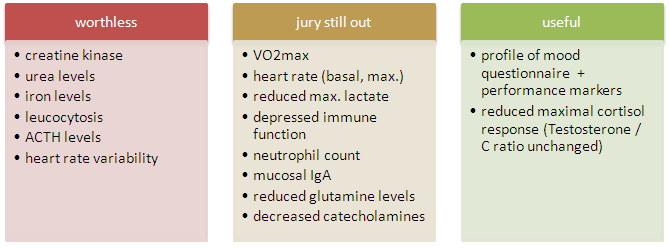
Figure 2: Overview of selected biomarkers that have been investigated for their usefulness to idenfify over-reaching or overtraining (based on an overview in Purvis. 2010)
By incorporating and sticking to appropriate recovery phases, both on a short-, as well (and this is often neglected) on a long(er) term basis and keeping an eye on those markers I put in the "useful" column in the above overview of hitherto scientifically investigated biomarkers for overtraining, you should yet hopefully be able to avoid at least "phase three" of the overtraining syndrome, where taking 2-3 months is no longer an option, but a physiological necessity.

And if you don't have a "profile of mood questionnaire" handy, but still believe in the power of evaluations based on 0-4 scales, I highly suggest you download the free staleness score test Dr. Jack Raglin developed for the US military. It's free, so don't be shy! Here you go for the download: "Training Distress Scale"