.

.
marylin monroe
Showing posts with label methionine. Show all posts

Amino Acids for Super Humans. Part IV: Purported Ergogenics - Beta Alanine, Carnitine, Glutamine

This relevant for all of you - regardless of whether you can or cannot spare the time: Tune in live and listen to me @ Carl Lenore's Super Human Radio to learn that amino acids are far more than just the building blocks of the proteins of your body...

Listen live to SHR @ 12:00PM ET
Amino Acids for Super Humans. Part IV
Purported Ergogenics - Beta Alanine, Carnitine, Glutamine

In the fourth installment of the show, we are going to look at three of those amino acids everyone interested in fitness and body building knows: Beta Alanine, Carnitine and Glutamine. Will the increase performance, fat loss and muscle gains, as some supplement companies would have it, or will they mostly cost your hard earned money or even make you sick? Tune in live @ 1pm ET and learn more!

Show Notes: Amino Acids for Super Humans. Part III - Sulfur, More Than Just Rotten Eggs.

Amino Acids for Super Humans. Part III
Sulfur, More Than Just Rotten Eggs

notice! this are 100% uncorrected show notes not originally intended for publication

In this episode we are going to tackle:
  • methionine (essential amino acid, EAA)
  • cysteine (conditionally essential amino acid)
  • n-acetyl cysteine (acetylated variety of cysteine, not found in food sources)
  • taurine (non-essential amino acid)

methionine

α-amino acid with the chemical formula HO2CCH(NH2)CH2CH2SCH3. This essential amino acid is classified as nonpolar.
  • along with cysteine, methionine is one of two sulfur-containing proteinogenic amino acids.
  • its derivative S-adenosyl ethionine (SAM) serves as a methyl donor è DNA; less well known: biotin & ALA (=alpha lipoic not linoleic acid) synthesis
an intermediate in the biosynthesis of
German study by Wienecke (2011) shows that methionine is the #1 deficient AA in athletes (RBC, not serum measures)

methionine & heart disease: improper conversion of methionine can lead to atherosclerosis.
  • improper conversion is attributed to commonly occurring genetic and acquired factors including deficiencies of folate and vitamin B12 
  • folic acid is itself not biologically active, tetrahydrofolate and other derivatives after its conversion to dihydrofolic acid in the liver are required for the homocysteine "recycling"
  • another way to convert homocysteine back to cysteine (one step away from methionine) requires glycine betaine (NNN-trimethyl glycine = TMG)
    • recent evidence suggests that this betaine-homocysteine methyltransferase (BHMT) is of greater importance in the methione cycle than methione synthase (previously thought to be the major mechanism for homocysteine recycling)
the methionine paradox: mice lose weight and live longer without methionine
  • studies show methionine restriction without energy restriction extends mouse lifespan (e.g. Miller. 2005)
  • problem: just rodent data, mechanism of action probably involves UCP1 (mitochondrial uncoupling) in brown adipose tissue, of which adults have little to none; overall, underlying mechanisms poorly understood
  • human application / implications? impractical and not advisable to follow a no methione diet, but these results + the possibility of “overtaxing” the methionine cycle clearly suggest that “more ain’t always better”

cysteine & cystine

Cysteine is found in most high-protein foods, including:
requirements increase with stress, injury, inflammation, aging ; note: essential for hair and nails & connective tissue

we have to distinguish cysteine vs. cystine
  • cystine = two cysteine molecules linked by a weak disulfide bond
  • cystine can be used to produce glutathione by macrophages and astrocytes
  • but lymphocytes and neurons prefer cysteine and must rely on the glutathione that is produced by the macrophages and astrocytes, if unoxidized cysteine is not available
  • as so often: what matters is the proper ratio of cysteine to cystine for both groups to get their preferred substrate for glutathione synthesis
cysteine and cystine in whey: what you should know about "undenaturated" whey
  • cysteine content of undenaturated whey is 7.6-fold higher than that of casein; denaturated whey is mostly cystine, though
  • denaturation takes place if whey is blended at high speeds (mechanically) or heated above 118°F ~ 48°C
  • common forms to produce whey isolates
    • ion exchange - uses various amounts of heat and is thus potentially damaging  
    • microfiltration methods – depends on method, but generally less damaging  
      • CFM – cross flow microfiltration yields a high quality (8i.e. low carb, low fat isolate), but only if cold filtration is explicitly mentioned, you can be sure that the whey is chilled during the filtration process
      • cold filtration – here you are sure about the temperature, but not about the pressure; often used to produce concentrates (higher carb & fat content)
  • advice: look for CROSS FLOW MICROFILTRATION @ low pressure & low temperature for an “optimal” whey isolate
  • note: concentrates may be superior in terms of cysteine / cystine ratio, because they are less processed than isolates

  • also noteworthy: there is little cysteine in soy; in fact so little that it is even artificially added to “good” soy proteins
bare in mind: even with a high cysteine protein source, some of the cysteine will be oxidized in the course of the digestive process the resulting, more stable cystine molecule will then be absorbed via a different transporter

other especially valuable sources of cysteine are
  • milk and 
  • egg-white
both eggs and milk are unique* in that they contain the stable and highly absorbable di-peptide glutamylcysteine

*guess why: nourish the organism in his state of maximal growth > what does this tell you about the value of these nutrients for a “physical culturist”?

why not take straight glutathione?
  • contrary to marketing claims, standard oral supplements are not absorbed, i.e. the glutathione does not reach the blood stream [Dr. Rouse talked about that in one of the SHR epigenetic shows]
  • purported alternative NAC = n-acetyl cysteine = amine protected version of cysteine that is rapidly hydrolyzed in the body to the amino acid cysteine and may thus serve as a readily available highly absorbable substrate for glutathione production

n-acetyl-cysteine - NAC

I will not discuss its use in kidney injury or acetaminophene, paracetamol, etc. poisoning and other acute treatment strategies such as liver failure etc.


evidence pro supplementation

University of Kentucky: Ferreira. 2011 - N-acetylcysteine amide & N-acetylcysteine amide both ineffective; but NAC, used as control effective in in-vitro muscle fibers
  • NAC increased total force-time integral (FTI; N·s·cm)

Victoria University of Technology, Melbourne: Medved. 2004 > lower rise in K+ [potassium] = less fatigue
  • intravenous NAC: 125 mg.kg-1.h-1 for 15 min and then 25 mg.kg-1.h-1 for 20 min before and throughout exercise
  • the rise in plasma K+ concentration at fatigue was attenuated by NAC (P < 0.05). The ratio of rise in K+ concentration to work and the percentage change in time to fatigue tended to be inversely related (r = -0.71; P < 0.07)
  • time to fatigue during NAC trials was correlated with Vo2 peak (r = 0.78; P < 0.05), suggesting that NAC effects on performance may be dependent on training status

Victoria University of Technology, Melburne: Medved. 2004 > enhanced muscle cysteine and GSH availability
  • NAC intravenously infused at 125 mg.kg(-1).h(-1) for 15 min and then at 25 mg.kg(-1).h(-1) for 20 min before and throughout exercise
  • Muscle TGSH (P <0.05) declined and muscle GSH tended to decline (P=0.06) during exercise. Both were greater with NAC (P <0.05).
  • related study (also from Victoria University) > McCenna. 2006
oral supplementation

Baylor College of Medicine, Houston: Reid. 1994 > NAC inhibits muscle fatigue in humans.
  • NAC 150 mg/kg or 5% dextrose <> 12g NAC for adult human being 160pounds < unrealistic due to  side effects (diarrhea)
  • tibialis anterior electrostimulation
    • @10 hz: NAC increased force output by approximately 15%; evident after 3 min of repetitive contraction, persisted for whole 30 minutes 
    • @40 hz: NAC had no effect on fatigue induced using 40 Hz stimuli or on recovery from fatigue
University of Kentucky Medical Center: Matuszcak. 2011 > delayed fatigue in handgrip exercise
  • NAC @ 150 mg.kg(-1) vs. saline <> 12g NAC for adult human being 160pounds < unrealistic, see above
  • NAC delayed fatigue (130% baseline) and inhibited glutathione oxidation
University of Kentucky Medical Center, Lexington: Ferreira. 2011 > increase in cysteine
  • NAC capsules (9 ± 2 or 18 ± 4 mg/kg) or solution (0, 35, 70, or 140 mg/kg). 
  • Intensity of GI reactions to 140 mg/kg NAC was significantly higher than placebo
  • Plasma cysteine concentration increased with NAC dose from 9.3 ± 0.7 μM (placebo) to 65.3 ± 6.7 μM (140 mg/kg); 
  • however, there was no difference (p > .05) in plasma cysteine for 70 mg/kg vs. 140 mg/kg
  • plasma thiols are maximized by oral administration of 70 mg/kg
bottom line: this would suggest the optimal dosage preworkout would be 5.6g for 160 pound male (cf. side effects, below), and it would be useful mainly for endurance athletes


evidence against supplementation for strength athletes, specifically

University of Florida: Childs. 2001 > Supplementation with vitamin C and N-acetyl-cysteine increases oxidative stress in humans after an acute muscle injury induced by eccentric exercise.
  • eccentric arm muscle injury 
  • vitamin C (12.5 mg/kg body weight) and NAC (10 mg/kg body weight) for 7 d 
  • LDH and CK activities were elevated to a greater extent in the vitamin C and NAC group 
  • higher levels of lipid hydroperoxides and 8-Iso-PGF2alpha [prostaglandin] 
Baylor College of Medicine, Houston: Khawli.1994 > NAC inhibits fatigue, BUT depresses contractile function in vitro
  • Fiber bundles incubated in 0.1-10 mM NAC exhibited a dose-dependent decrease in relative stresses developed during 30-Hz contraction (P < 0.0001) with no change in maximal tetanic (200 Hz) stress.
  • NAC (10 mM) also inhibited acute fatigue.
also: various findings, where there were changes in serum values, but no performance increase, such as Medved. 2003 (despite intravenous administration)


how bad is oxidation, anyway?

University of Kentucky: Chambers. 2009 > NAC treatment reduces stretch induced glucose uptake in muscle fibers
  • N-acteyl cysteine (NAC), a non-specific antioxidant, ebselen, a glutathione mimetic, or combined SOD plus catalase (ROS-selective scavengers) all decrease stretch-stimulated glucose uptake (P < 0.05) mediated by reactive oxygen species and p38 MAP-kinase 
related findings [in vitro vs. in vivo]

  • Univ. of Melbourne: Merryl. 2010 > muscle glucose uptake during contraction is regulated by nitric oxide and ROS independently of AMPK >> “NAC prevented contraction-stimulated glucose uptake
  • vs. University of Melbourne: Merryl. 2010 > N-Acetylcysteine infusion does not affect glucose disposal during prolonged moderate-intensity exercise in humans.  
    • beware: “neither NAC infusion nor exercise significantly affected muscle reduced or oxidised glutathione” < 80 min of cycle ergometry at 62 +/- 1% of peak oxygen consumption not exhaustive enough?

NAC, general health & more

...NAC for visceral fatloss
  • suggested by Marc McDougal & other, cf. mind & muscle forum 
  • hypothesis: tnf-alpha, il-6 < reduce inflammation = get rid of visceral fat
  • sounds logical, but studies are missing
     
  • dosing scheme with anecdotal evidence for effectiveness: 2x 600mg NAC + 1g Vit-C  
  • why vitamin C?
    • Vitamin C is supposed to prevent NAC degradation to S-Nitrosothiols > whole blood deoxygenation
    • toxicity evidence for NAC from human studies missing (same is true for protective effect of vitamin C, though)  
 ... NAC for lliver health

University of Ankara: Ozgur. 2010 > in combination with EGCG protective effect against free radical damage in the liver by mobile phone radiation (guinea pig study)
  • 300 mg/kg NAC injected !
  • similar results in other studies on EM-radiation

protection against lead / liver carcinoma, eg. University of Léon, Spain: San-Miquel. 2006
... other (some not sufficiently verified) benefits
  • solves mucus (COPD, common cold)
  • supposedly (insufficient evidence) protective against destructive effects of hyperglycemia on pancreatic beta cells 
  • useful for glutathione repletion in autism 
  • treatment of obsessive-compulsive disorder (experimental) 
  • […] everything where increased glutathione levels would play a role

usefulness of chronic supplementation(?)
  • in view of Childs. 2001 NAC is best been taken on non-workout days 
  • usual dosages range from 400-1200mg 
  • @True Protein its 7$ a 100g; ca. 100 day supply = not too expensive 
my personal recommendation: if you are on a budget, better spend the money for undenaturated whey protein with a high cysteine to cystine ratio; you won’t be getting enough cysteine for glutathione production without side-effects from NAC alone, anyway

common adverse effects to NAC
  • skin rashes,
  • gastrointestinal problems, vomiting
  • headache, dizziness, blurred vision


    Taurine

    food
    (data from
    Spitze. 2003
    )
    mg Taurine /kg
    Beef
    430
    Beef liver
    688
    Beef lung
    956
    Beef spleen
    874
    Beef tongue
    1752


    Cheese
    61
    Milk (regular)
    8.3
    Milk (homogenized)
    151
    Whey
    660


    Pork (loin)
    610


    Chicken (breast meat)
    160
    Chicken (dark)
    1690
    Poultry
    3280
    Poultry (liver)
    4878
    Turkey (7% fat)
    2100


    Clam
    5200
    Cod
    314
    Fish (mixed)
    1000
    Herring
    1544
    Mussel
    6550
    Oyster
    700
    Salmon
    1300
    Salmon (juice from can)
    22132
    Shrimp
    310
    Tuna
    2000
    Whitefish
    1500
    a non-essential amino acid, promoted as cell volumizer

    Taurine (2-aminoethanesulfonate) is the most abundant amino acid in the body and can be obtained preformed in the diet or synthesized from cysteine in the body

    taurine accounts for only 3% of the free amino acid pool in plasma, but
    • 25% in liver
    • 50% in kidney
    • 53%, in muscle
    • 19% in brain

    dietary sources, see table (left); generally found mainly in meat and fish

    taurine synthesis
    synthesis occurs in various tissues via 2 different, cysteine dependent pathways
    • cysteine dioxygenase (CDO) pathway – liver, adipose tissue (recent, Ueki. 2009 “the physiological function of taurine in adipocytes is not known”, but clearly anti-inflammatory, TNFα may decrease CDO expression)
    • cysteamine (2-aminoethanethiol) dioxygenase (ADO) pathway – almost ubiquitous

    metabolic function(s)
    • essential for development of the central nervous and visual systems
    •  a major constituent of bile
      • Watanabe. 2011: Lowering bile acid pool induces obesity and diabetes through reduced energy expenditure
      • you will notice the effect on stool with higher doses of taurine è diarrhea
    •  an important organic osmolyte
    • both taurine and its precursor hypotaurine can act as antioxidants

    neurological functions
    • important: taurine actually crosses the blood-brain barrier
    • Taurine is one of the most abundant amino acids in the CNS and plays an integral role in physiological processes such as
      • osmoregulation, 
      • neuroprotection and 
      • neuromodulation
    • T activates GABA(A) and glycine receptors
    • T inhibits NMDA and Ca(2+) channels
    • T counters negative effects of glutamate (mediated via Ca2+ influx modulation, cf. Bulley. 2010)
    • various neuroprotective effects
      • against ethanol toxicity (Taranukhin. 2010)
      • against morphine (Zhou. 2011)
      • against anything associated with prolonged N-methyl Daspartate (NMDA) receptor activation, e.g. by glutamate (Wu. 2005)

    taurine and cancer, antioxidant & radical formation
    • decreased levels of taurine in breast cancer (taurine = involved in normal cell apoptosis, not enough taurine?) – (Agouza. 2011) >> CORRELATION not causation(!)
    • inhibits H2O2 formation in adipose tissue exposed to insulin
    • capable of inhibiting ROS generation, cf. eg. Schaffer. 2009
    • mechanism of action: taurine plays its antioxidant role not by directly scavenging ROS but rather by
      • inhibiting the generation of these and/or
      • by interfering with their oxidant actions
      • there is at least one exception, since taurine does have the capability of scavenging a particular compound, hypochlorous acid, an oxidant that activates the tyrosine kinase signalling cascade that leads to the formation of inflammatory mediators
    taurine and insulin, glucose & diabetes
    • T is frequently depleted in diabetic state (Schaffer. 2009)
    • additional taurine restores insulin secretion in protein malnurished rats (Batista. 2011)
    • studies also indicate that taurine exerts hypoglycemic effects by enhancing insulin action
    • taurine increases glycogen synthesis, glycolisis and glucose uptake in the liver and heart of adult rats
      • pancreatic islets from mice having taurine, secreted more glucagon than those from control ones at low glucose concentrations
    •  Taurine administration improved insulin sensitivity and controlled hyperglycemia and hyperinsulinemia in fructose-fed rats as well as it restored the glucose metabolizing enzyme (Nandhini et al. 2005)
    • taurine has shown to better ameliorate insulin sensitivity in type 2 diabetes when compared to N-acetylcystein in a study with humans
    • taurine has the ability to suppress the progression of diabetic nephropathy (kidney health) through its antioxidant effects
    • Taurine exerts effects in glucose homeostasis through two known mechanisms:
      a) its effects upon β-cell insulin secretion
      b) interfering with the insulin signaling pathway and post receptor events
    taurine and heart health
    • purported mechanism for beneficial effects: cholesterol regulation via bile salts + its demonstrated ability to reduce oxidative stress and inflammation
    • twenty two healthy male japanese, aged 18-25, the effects of 6g/day taurine supplementation during 3 weeks versus placebo (Mizushima. 1996)
      • diet specially designed to increase their cholesterol levels < design flaw
      • group receiving the taurine supplementation suffered significantly smaller increases in these parameters [total & LDL]
    • increases HDL to LDL ratio (not seen as that important in 1996, not reproduced in ovariectomized rats by Choi, 2009) in rat study (Choi. 2006)
      • 5 weeks supplemental taurine in drinking water
      • “plasma concentrations of total cholesterol, glucose and LDL-cholesterol were significantly reduced”
      • additional reduction in triglycerides (reproduced by Choi, 2009)
      • lower liver weight (indicative of less fat accumulation)
    •  important: similar beneficial effects in high vs. normal cholesterol diets (Park. 1998)
    • counterevidence from epidemiological studies: higher taurine levels in serum (and sulfur compounds in general) = lower HDL-C
      • what if the bodies of these persons deliberately produce taurine to benefit from its positive effect on HDL?
      • again: epidemiology = pretty worthless without understanding the underlying mechanisms of action
    •  a study with rats showed that microvascular inflammatory injuries caused by hyperglycemia, became reverted after supplementation with taurine (Casey. 2007)
      • dosage: 200mg/kg = 32mg/kg; approx. 2.5g taurine per day
    •  Taurine has demonstrated to lower homocystein plasma levels: an independent marker of cardiovascular risk // cf. NAC can raise homocysteine!
    • Taurine supplementation reduces platelet aggregation in diabetes patients
    • 3g/day of taurine for 7 weeks; significant decrease in TG (of 8 mg/dl) while the group that had placebo presented an increase of 3g/dl ; obese patients (Zhang. 2004)
    • Taurine is considered to decrease blood pressure (BP) through a mechanism consisting of an interference on the angiotensin II signalling, which is in charge of causing vasoconstriction and the subsequent increase in blood pressure
    • in a double blind placebo controlled trial, 19 borderline hypertensive patients were supplemented with 6 g of taurine a day, what resulted in a significant decrease of systolic and diastolic BP, while the placebo group suffered no changes in this parameter
    • anti-hypertensive effect probably partly due to reduction of norepinephrine
    • even acutely / after heart failure: taurine can help patients with congestive heart failure - improves contraction of the heart muscle

    taurine obesity & weight loss
    • significant weight loss in previously mentioned study by Zhang: 3g/day of taurine for 7 weeks; significant decrease in TG (of 8 mg/dl) while the group that had placebo presented an increase of 3g/dl ; obese patients (Zhang. 2004)
    • 2010 data from c. elegans, every scientist’s darling [transparent, cheap, genome is known, not too complex, etc.], also shows: add taurine = prevent weight gain (Kim. 2010a)
    • previous study showed reduction in stress and thus decreased symptoms of aging in the same model (Kim. 2010b)
    • T triggers lipolysis & PKA [protein kinase A] in insulin treated adipocytes (Pina-Zentella. 2011); two mechanisms
      • stimulating cAMP-dependent PKA catalytic activity and 
      • favoring PKA activation by cAMP as a consequence of lowering the H(2)O(2) pool
    •  very recent finding: keeps bile acid levels high and thus prevents weight gain and obesity (Wantanabe. 2011)

    taurine and cell (muscle) structure / ergogenic potential / other
    • “cell volumizer” – rather helps with transportation of nutrients, but more importantly minerals across the cell membrane
      • control of ionic flux and effect on osmoregulation è influencing anabolic processes (proper hydration = anabolic)
      • useful for “back pumps” on roids
    • Taurine exerts this action by altering phospholilpid mehyltranferase activity, an enzyme which determines the phosphatidylethanolamine (PE) and phosphatidylcholine (PC) content of the membrane. 
      • taurine elevates the PE/PC ratio, what gives place to an alteration of cellular membrane fluidity and the improvement of its ability to resist toxic insults. (Yamaguchi. 2001)
    • also relevant for roid users: taurine = hepato-protectant; found to be effective against various toxins, eg. carbon tetra-chloride, hydrazine, 1,4-naphthoquinone
    • joint health: decreasing the degradation of hyaluronic acid
    • taurine is an effective stimulator of GH and PRL secretion in rats, and that the mechanism of this action involves the opioid peptidergic system in the hypothalamus (Ikuyama. 1988)
    • T increased exercise duration to exhaustion in rats, but decreased concentrations of threonine (-16%), serine (-15~-16%), and glycine (-6~-16%) in muscle (Ishikura. 2011)
    • 3% oral taurine in drinking water supplementation may increase muscle performance and reduce muscle injury caused by exercise (Dawson. 2002)
      • vs. beta-alanine = taurine depletion!
      • beta-alanine rats had only insignificant plus in running performance + lost weight + had sdepleted methionine levels, higher CK, but lower LDH
      • taurine group had sign. higher glutamine levels

    Amino Acids for Super Humans. Part III - Sulfur, More Than Just Rotten Eggs.

    This relevant for all of you - regardless of whether you can or cannot spare the time: Tune in live and listen to me @ Carl Lenore's Super Human Radio to learn that amino acids are far more than just the building blocks of the proteins of your body...

    Listen live to SHR @ 12:00PM ET
    Amino Acids for Super Humans. Part III
    Sulfur, More Than Just Rotten Eggs
    update: Episode available for download, now!

    In the third installment of the show, we are going to look at the commonly overlooked. yet vitally important sulfur-containing amino acid methionine, its "children" and "grand children", cysteine, n-acetyl-cysteine (NAC) and the purported "cell volumizer" taurine.

    As usual, I will do my best to provide relevant examples and relate the theory to practical advice. The magic of individual amino acids will be tackled in the shows to come.

    Diet Deoptimization with Rice Protein: Less Weight Gain, Lower Cholesterol and Fatty Acid Synthesis - So What?

    Image 1: Rice protein power - I'd bet a pouch of casein protein that this Chinese "body builder" must have eaten plenty of rice protein. I mean, check out how ripped he is! Update: Garymar informed me that this is a Japanese comedian called Yoshiaki Yamane - sorry, my mistake ;-)
    The "real" supplement news have been pretty slow as of late - there have not been any, to be precise. Unless you are interested in yet another study on an exotic African or Asian root or herb and its "antioxidative activity" in the petri-dish, you would probably have been as bored as I was by the latest articles in respective journals. And if Stephen Watt had not asked my opinion on a study my colleagues over at ergo-log had in the news, as of late, I would probably have ignored a "rodents on rice protein" study from the Department of Food Science at the School of Food Science and Engineering of the Harbin Institute of Technology in Harbin, China (Yang. 2012) - the headline ergo-log headline "Fat percentage too high? Add rice protein to your shake", did however look too intriguing not to take another look at a study, the abstract of which I did not really suggest that rice protein would actually help you burn body fat.

    Rice for lactose intolerant vegetarians and poor Chinese farmers ...

    What the scientists from the Middle Kingdom had done, was to feed three groups of 7-week (adolescent*) male Wistar rats on diets containing either
    • 22.9% casein - could the one in your cheap protein blend, after all it was from China ;-),
    • 23.2% rice protein A - extracted from Oryza sativa L. cv. Longijng by alkaline / acid extraction, or
    • 23.2% rice protein E - extracted by sigma aldrich via heat stable starch degradation
    The total experiment lasted two weeks and aside from the protein faction, the composition of the chow, to which the rodents had ad-libitum (=whenever they wanted) access was identical.
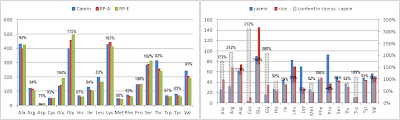
    Figure 1: Blood amino acid concentrations in rodents fed casein or rice protein (the figures in % represent the relative level of the given amino acid in the RP-A group compared to the casein group, e.g. RP-A rats had 92% of the amount of Alanine, the casein rats had in blood; left; data adapted from Yang. 2012) and absolute and relative amounts of amino acids in casein and rice protein (open pars indicate relative amount of the given amino acid in rice compared to casein, eg. 172% more alanine in rice than in casein protein; data adapted from Morita. 1997)
    The latter, i.e. the being identical, cannot be said of either of the amino acid structure of the casein and rice protein (figure 1, right), nor the amino acid contents and ratios in the plasma of the lab animals (cf. figure 1, left), though.

    ... yet not necessarily for aspiring physical culturists!

    The muscle head and fitness fanatic that you probably are, you will certainly already have realized that the level of BCAAs in the blood of the animals on the rice protein diets was 26% and 29% (RP-A and RP-E, respectively) lower than that of the rodents receiving the casein chow. An observation which was to be expected in view of the -27% lower BCAA concentration in rice compared to the casein protein (Morita. 1997; figure 1, right). Astonishingly, this does not hold true for all other amino acids, for glycine, for example, the amino acid content in the source was 2x higher, the serum levels were yet only 15% higher than in the casein group (note: the casein chow was enriched with cysteine, in this particular case a comparison of source vs. serum levels would thus be futile).
    Figure 2: Fecal analysis (left) and changes in body weight, as well as absolute body fat percentage and food intake  (right) of adolescent male Wistar rats (data calculated based on Yang. 2012.
    If you also take into account that a 7-week old male rat has just become fertile (at about the 6th week of its life), think of yourself, your brother or son at the age of 16y, of what you / he ate and how much weight he gained and then take another, closer look at the data in figure 2 I would say that the question whether switching from casein to rice protein would actually help you lose fat appears more than warranted. After all, we are looking at weight (not fat!) gain in a period of growth (the body fat levels of the rodents, were 2.1%, 1.9% and 1.8%, respectively, cf. figure 2, right). If the latter were totally absent, you would call that "failure to thrive" - a term that would not strictly apply in the situation at hand, though.

    In view of the huge fecal loss of dietary fat (+60% over casein) and dietary protein (+145% in the RP-A and +217% in the RP-E group), the 5% lower fat free mass in the rodents on the rice protein diets and the reduced ALT and AST levels, which are not necessarily indicative of "improved liver function", but rather of a reduced hepatic protein turnover, it seems as if "Rice protein reduces body weight gain, energy availability and storage in adolescent rodents due to its lower digestibility" would have been a more appropriate title for the study than "Rice protein improves adiposity, body weight and reduces lipids level in rats through modification of triglyceride metabolism" - and alas, a very similar study, yet without the data on the "body weight gain", has already been published by the same research group in 2011 (Yang. 2011).

    Diet-deoptimization a novel weight loss strategy?

    Image 2: I guess the Chinese have heard how the Americans got rid of their corn and soy and do now try to pull off a similar "it's good for your health"-stunt with rice protein as the US did with their "healthy" vegetable oils and soy proteins.
    Personally, I would yet suggest to call the study "diet-deoptimization by the provision of less palatable, less digestible chow to rodents", but I guess in that case the results would never have made it to ergo-log and subsequently to the SuppVersity. It was thus pretty clever to disguise what could simply be a natural (side) effects of a reduced energy intake (-5%) and reduced energy absorption (-60% from fat and -145% or -217% from protein), i.e. a reduction in fatty acid synthesis and an increase in breakdown (you may remember that even rodents need fat, right?), as evidence that (I quote from the conclusion) "rice protein can modify triglyceride metabolism, leading to an improvement of body weight and adiposity" - wouldn't you agree?

    In the end, the protein and fat wasting effects of the rice protein diets could even explain the advertised "beneficial" impact on the lipid profile with VLDL/HDL ratios of 0.19 and 0.16 vs. 0.24 in the RP-A and RP-E groups vs. the casein group. Whether similar effects could be observed in a human trial and whether these "improvement" (from one end of the normal range to another) would decrease the risk of heart disease, is yet questionable. Moreover, the reduction (or replacement; not necessarily the complete elimination) of the whopping ~60% carbohydrate content (488g cornstarch and 100g succrose per kg of chow) in the diet and/or the replacement of the pro-inflammatory soy-bean oil with e.g. olive oil would probably elicit way more beneficial effects on the triglyceride and blood glucose level in humans than a switch from casein to indigestible and in rodent-terms obviously non-palatable rice protein.