.

.
marylin monroe
Showing posts with label acid load. Show all posts

11% Increase in Type I Fiber Cross Sectional Area During 12 Weeks of KHCO3 Supplementation: Are Alkali Supplements Fiber-Type Specific Anabolics W/ Add. Metabolic Benefits?

Muscle toning with bicarbonate? Without weight gain? For some women probably a dream come true ;-)
I guess, you will be hard-pressed to find another website with a similar amount of information the effects of alakali (mostly sodium bicarbonate) supplementation on exercise performance and metabolism as the SuppVersity. Irrespective of the previous posts on "baking soda" or the recent elaborations on the importance of a well-controlled acid base ratio (learn more), I am quite sure that the results of a recently published study from the Tufts Medical Center and the Bone Metabolism Laboratory, Jean Mayer USDA Human Nutrition Research Center on Aging at Tufts University will come as a surprise even for the most regular visitors among you - to be honest, I was and am still surprised myself ;-)

So what's the surprise?

In their 12-week rodent study that was devised to elucidate whether the addition of a neutralizing amount of potassium bicarbonate (KHCO3) to purified diet designed to match the standard acid forming Western way of eating would ameliorate the urinary nitrogen loss and affect the muscle fiber size and number, as well as the levels of circulating and muscle-specific IGF-1 in thirty-six vitamin D sufficient or deficient, 20-month-old, Fischer rats, Lisa Ceglia and her colleagues did not only observe (relative changes in brackets are expressed for vitamin D sufficient / insufficient animals)...
  • higher urinary pH (33% / 34%, after only 6 weeks),
  • lower urinary nitrogen losses (-28% / -42%) and
  • increased circulating 25OHD levels (3% and 15%);
they also observed significant increases in the cross-sectional area of the soleus muscles of the animals that did not depend on the vitamin D status of the animals.
Figure 1: Vitamin D levels, 24h urinary Nitrogen / Creatine ratio, cross sectional area of soleus (type I fibers; CSA1) and extensor digitorum longus (EDL; type II fibers, CSA2) after 12 weeks in rodents on KHCO3 supplemented diets with / without adequate vitamin D, data expressed relative to unsupplemented control (Ceglia. 2013)
As the data in figure 1 goes to show you, this effect was fiber-type specific and was not observed in the extensor digitorum longus (EDL), which is - contrary to the soleus - type II (fast twitch, glycolytic; learn more) fiber dominant. What is surprising though is the fact that the researchers did not observe corresponding increases in muscle weights (p > 0.05).

Unfortunately, the scientists don't address the "growth vs. weight" discrepancy in the discussion of the results, so that we are left to come up with our own hypotheses to explain why this may have been the case. We know that it cannot be the mere result of decreased food intakes or total body weight - both were virtually identical in all groups (just a note: the muscle weight per total body weight did not differ either). Moreover, the scientists explicitly state that "the lower UNi/Cr could be considered an indicator of reduced muscle proteolysis" - so that common sense would dictate an increase in muscle size and mass as it was in fact observed in previous human studies from the same laboratory:
"In a 6-week study in 19 healthy adults (average age 62 years), KHCO3 supplementation attenuated a protein-induced rise in UNi/Cr excretion by over 50 % compared to placebo (Ceglia. 2009). A larger study in 162 adults (average age 62 years) given a lower bicarbonate supplement dose or no bicarbonate, also demonstrated a 6 % decline in UNi/Cr excretion (Dawson-Hughes. 2009)." (Ceglia. 2013)
In fact, the provision of the bicarbonate supplement in the latter of the two studies did also increase the lower extremity power of the healthy older women who participated in the study by 13%; an observation that speaks in favor of the practical relevance of bicarbonate supplements - at least in the context of a normal / low vegetable and correspondingly low dietary alkali intake and that irrespective of the presence / absence of increases in skeletal muscle mass.

So what's the general mechanism here?

What about the muscle fiber specificity? The scientists speculate that the difference may simply be mediated by the "size difference of type II fiber subtypes (IIa, IIb, IIx) in rat EDL muscle and an inadequate [study] duration to detect a significant fiber size effect." This alone would, warrant a "larger and longer-term" at the end of which it may be possible to "fully characterize effects of this dietary
intervention on muscle morphology." (Ceglia. 2013)
If we simply discard the (as of now inexplicable) absence of increases in muscle weight and focus on the increases in muscle cross-sectional area it would in fact appear as if the alkali-induced improvements in nitrogen retention are the primary cause for the "muscle building" effects, the New Yorker researchers observed.

The latter appears all the more likely, in view of the fact that neither the provision of vitamin D nor the addition of bicarbonate (or a combination of both) resulted in significant reductions in the catabolic signaling molecules E3 ubiquitin ligases, MURF1 and MAFbx. Still, if we don't assume that the rodents expended much more energy and simply burned off the extra protein it must have gone somewhere, so that the most likely explanation for the inconsistencies would actually be the time-point at which the signaling molecules were measured. After all, a pre- vs. post comparison doesn't tell us what happened during the 12-week supplementation period. Neither do we know whether the acid-base balance does not target a completely different set of anabolic molecules than exercise or protein nutrition so that the scientists may simply have missed measuring the "correct" markers of anabolism / catabolism to be able to fully explain their observations.


Bottom line: There is still much to be learned about the effects and detailed mechanisms of alkali supplementation. So much, in fact, that the addition of large boluses of potassium bicarbonate to a whole foods diet that includes large amounts of net alkalizing vegetables and fruits (funny how difficult it was to write that this way around and not "fruits and vegetables" ;-) as a means to increase your gains appears to be unwarranted or at least unnecessary at the moment.
Latent acidoses can set you up to become obese (learn more)
For someone following a typical Western and or high meat + fat / high grain or otherwise acid forming diet without adequate "vegetable buffer" a medium dose alkali supplement providing ~67.5 mmol of bicarbonate (~647mg of KHCO3 or 800mg NaHCO3/baking soda, which was the dose that has been used in the previously mentioned human study by Dawson-Hughes et al.) ingested twice a day, could yield all sorts of metabolic benefits, of which you have learned in previous posts on sodium bicarbonate and the acid base balance here at the SuppVersity that they go way beyond increases in muscle strength and cross-sectional area and reach into the realms of metabolic disease and even cancer.

Suggested reads:
  • Calcium, Magnesium, Potassium & Co in Food, Water & Supps - Getting Enough is Easy, Knowing How Much Is Not! (read more)
  • SuppVersity Science Round-Up on Sodium, Potassium, Alkalinity & Co (listen now)
  • Science Round-Up Seconds: The Macro-Mineral Alphabet & the Potential Health Hazards of Diet-Induced Latent Acidosis (read more)
  • Previous SuppVersity posts on sodium bicarbonate (browse all)

References:
  • Bailey JL, Zheng B, Hu Z, Price SR, Mitch WE. Chronic kidney disease causes defects in signaling through the insulin receptor substrate/phosphatidylinositol 3-kinase/Akt pathway: implications for muscle atrophy. J Am Soc Nephrol. 2006 May;17(5):1388-94. Epub 2006 Apr 12.
  • Ceglia L, Harris SS, Abrams SA, Rasmussen HM, Dallal GE, Dawson-Hughes B. Potassium bicarbonate attenuates the urinary nitrogen excretion that accompanies an increase in dietary protein and may promote calcium absorption. J Clin Endocrinol Metab. 2009 Feb;94(2):645-53. 
  • Ceglia L, Rivas DA, Pojednic RM, Price LL, Harris SS, Smith D, Fielding RA, Dawson-Hughes B. Effects of alkali supplementation and vitamin D insufficiency on rat skeletal muscle. Endocrine. 2013 May 11. 
  • Dawson-Hughes B, Castaneda-Sceppa C, Harris SS, Palermo NJ, Cloutier G, Ceglia L, Dallal GE. Impact of supplementation with bicarbonate on lower-extremity muscle performance in older men and women. Osteoporos Int. 2010 Jul;21(7):1171-9.

Supercharging Creatine With Baking Soda: Study Shows Increased Peak Power and Endurance - Plus: How Bicarbonate Could Help You Lose Fat & Build Muscle

The pH of your urine is not a reliable measure of your bodies acid base-status
I have written about the "love affair" of creatine and baking soda before. Once, in the "The Pharmacokinetics of Creatine" series (Part I, Part II), where I outlined how you can "brew" your own KreAlkalyn replacement using creatine and NaHCO3, and another time back in 2010, when I discussed the data from a dissertation by James J Barber, who had conducted a preliminary investigation into the joint ergogenic effects of N-Amidinosarkosin (creatine) and NaHCO3 (baking soda) on the repeated sprint performance of recreational athletes.
You can learn more about beta alanine & bicarbonate at the SuppVersity

The Hazards of Acidosis

Build Bigger Legs W/ Bicarbonate

HIIT it Hard W/ NaCHO3

BA + Bicarb are Synergists

Bicarb Buffers Creatine

Beta Alanine Fails to HIIT Back
The complete results of a follow up investigation by Barber, who now works at the Human Performance Laboratory at the California Polytech State University, are going to be published in the next issue of the Journal of Strength and Conditioning Research (Barber. 2012); and they underline what you, as a diligent student of the SuppVersity, knew all along: Baking soda is not only cheaper than 99% of the commercially available supplements, it is also more ergogenic than the average junk the guy at GNC is trying to sell to you.

Soda? But that must be bad for you?! False!

For their study, the researchers recruited a group of 13 healthy previously trained (>5h of aerobic and >2h of HIT per week) young men (age 21.1 ± 0.6 yrs, BMI 23.5 ± 0.5 kg/m²; VO2Max 66.7 ± 5.7 ml/kg-min). In a double-blinded crossover fashion (meaning that each participant had to complete every condition, i.e. "crossover", and neither he, nor the researchers knew whether he had been given the active or the placebo treatment, i.e. "double-blinded"), the men had to consume a supplement containing either
  • placebo: 20g maltodextrin + 0.5g/kg maltodextrin,
     
  • creatine (only): 20g creatine + 0.5g/kg maltodextrin, or
     
  • creatine + NaHCO3: 20g creatine + 0.5g/kg baking soda*

    * for all supplement the total dosage was divided into four smaller doses, which were to be taken at 9:00 a.m., 12:00 p.m., 6:00 p.m., and 10:00 p.m.; the subjects also completed a 48h dietary recall and were asked to consume identical foods during each condition
before their peak power, mean power, relative peak power, and bicarbonate concentrations were assessed during six subsequent 10-second repeated Wingate sprint tests on a cycle ergometer with 60s rest periods between each sprint. To preclude any carry-over effects from previous tests, or rather supplementation, each experiment was followed by a three-week washout period.
Figure 1: Total and relative peak power output (left) and relative peak power output in the individual trials (right; data adapted from Barber. 2012)
As you can see in figure 1, Barber et al. were able to confirm his initial results. Interestingly, only the creatine + NaHCO3, yet not the creatine only regimen elicited statistically significant increases in both the relative power output (in W/kg; p < 0.05 for both) and the total power output (p < 0.05 only in the creatine + NaHCO3 trial; cf. figure 1, left). Moreover, the creatine + NaHCO3 supplementation lead to "the greatest attenuation of decline in relative peak power over the 6 repeated sprints." (cf. figure 1, right).

Creatine + baking soda: Additive or synergistic effects

An interesting question the scientists probably ignored, because their GNC guy did not yet tell them about the "extraordinary superiority of buffered creatine", is whether the ~37g of sodium bicarbonate the subjects ingested simply added to the beneficial effects the 20g of creatine had on the repeated sprint performance of the athletes, or whether the baking soda also decreased the breakdown and facilitated the uptake of creatine (cf. figure 2)
Figure 2: Relative increase in creatine in dry muscle mass of horses, after supplementation with creatine monohydrate, Kre-Alkalyn or Gastner's patented creatine + sodium carbonate +sodium hydrogen carbonate formula (posted first in "The Pharmacokinetics of Creatine: Part 1/2" based on Gastner. 2010)
And while it may not be important for your HIIT sessions, whether the mechanism behind the performance increase is additive of synergistic, it could well make the one-rep difference on a deadlift or bench press competition, in the course of which each additional phosphocreatine molecule counts.
"Cholesterol is the devil and sodium is his little brother!" Everyone who still believes everything the medical orthodoxy says, please raise your hands!
A note on the dangers of "salt": Firstly, baking soda is "only" ~28% sodium, which means that for every 4 grams you ingest you get roughly 1 g of sodium. Secondly, it is arguable how much of the sodium is effectively taken up and will be floating around in your blood. As T. Lakhanisky points out in his dossier for the Belgian government: "The uptake of sodium, via exposure to sodium carbonate, is much less than the uptake of sodium via food. Therefore, sodium carbonate is not expected to be systemically available in the body." (Lakhanisky. 2002) And thirdly, there is more and more evidence that suggests that the chloride rather than the sodium content of common table salt (NaCl = NatriumChloride) is the root cause of "sodium induced hypertension" in "sodium sensitive" individuals / animal models. Only recently, a study by Schmidlin et al. showed that chloride loading induced hypertension in the stroke-prone spontaneously hypertensive rat despite profound sodium depletion (Schmidlin. 2010). So, if you asked me, rather than pointing at salt as the #2 on the list of greatest evils (obviously cholesterol is still #1, here) the medical orthodoxy would be better advised to address the imbalances between sodium and potassium, which are so characteristic of the western diet, instead of painting yet another black and white picture where sodium is the bad guy and potassium the dangerous mineral that cannot be sold OTC in dosages >80mg.... but hey, this would be the topic for a whole new blogpost and as gross as it may sound, the chance that you get diarrhea from the baking soda is probably 1000x higher than the remote possibility of increases in blood pressure. A 1990 study by Luft et al. even found that the blood pressure of 10 mildly hypertensive and normal subjects decreased by 5mmHg after 7 days in the course of which they drank 3 liters of sodium bicarbonate containing water per day (Luft. 1990)
If you add to that all the previously reported benefits you can derive from a few tablespoons of baking soda
  • +34% time to exhaustion and +91% total work during HIIT (Feb 29, 2012)
  • synergistic and superior effects compared to beta alanine (Feb 20, 2012)
  • protection against stress induced oxidative damage to white blood cells (Nov 28, 2011)
  • increased performance in tennis players (Nov 4, 2010)
and obviously Barber's own previously reported results, you may understand why I urged our common friend Adelfo Cerame Jr to supplement with bicarbonate throughout his whole contest prep.

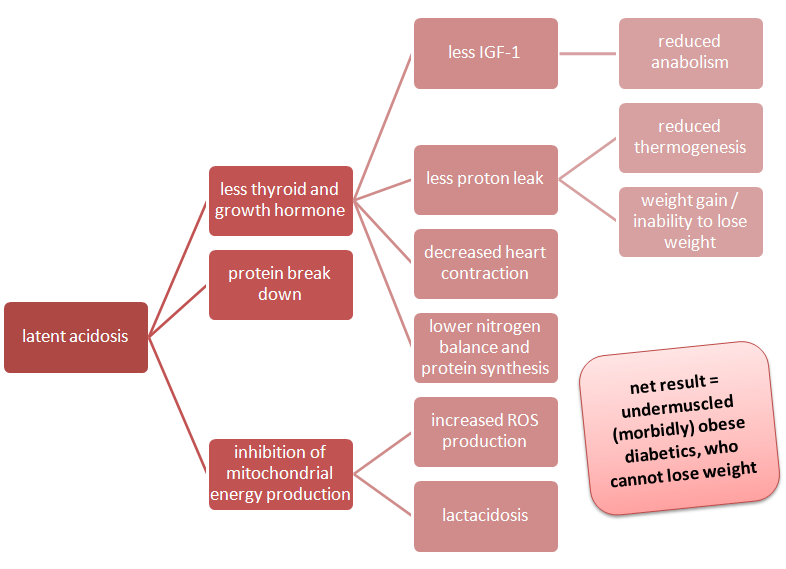
Latent metabolic acidosis hampers weight loss and muscle gains

Figure 3: The contribution of latent acidoses to the obesity epidemic and maybe even your inability to build muscle and/or lose weight
(based on Berkemeyer. 2009)
And even when you are not interested in your performance, a 2009 paper by Shoma Berkemeyer is by no means the only, nor the first article that linking an increased hydrogen ion concentrations (latent acidity, which can be countered by dietary bicarbonate) to weight gain and the obesity epidemic (Berkemeyer. 2009, cf. my summary in figure 3).

In view of the fact that even a latent H+ surplus could apparently compromise your efforts to lose fat and build muscle, it should be obvious that you better make sure to have enough alkalizing greens (and optional supplemental bicarbonate; not necessarily 30g, though ;-) in your diet - no matter if the whole acid/base balance issue, esp. the role of a high protein intake, is still very controversial.
More scientific evidence for the combination of bicarbonate & creatine in a more recent article | read it!
Practically speaking, what do I do? Since loading is not necessary unless you have a competition right ahead and this is the first time you take creatine you just take 3-5g of creatine monohydrate with approximately the same amount of sodium bicarbonate per day.

Larger doses of sodium bicarbonate as they would be used for acute performance enhancing effects are (almost certainly) not necessary to increase the efficacy of creatine. If you want the acute benefits, but get diarrhea from 15-20g of bicarbonate, I suggest you try to serial load.