.

.
marylin monroe
Showing posts with label undereating. Show all posts

Overtraining, Undereating & Self-Inflicted Hypothyrodism: Thresholds for Low T3 and High Reverse T3 Levels at 8% & 15% Reduced Energy Intake + Exercise After Only 4 Days!

This is not a "woman thing" only and your T3 levels are not the only thing that's going to "fall flat" if you starve yourself through your workouts! Yep, low libido => low total testosterone => low free testosterone => hypogonadism, that's what we are talking about, guys.
While I did promise to summarize some of the things, I said about creatine kinase, ALT, AST & Co on the last installment of the SuppVersity Science Round-Up on the Super Human Radio Network (I will do that in a future blogpost), today's SuppVersity article will focus on a single and in my experience often misinterpreted and / or overlooked symptom of overtraining that I personally have encountered numerous times in both male and female trainees: Self-induced hypothyrodism, low T3- or the euthyroid sick syndrome are just a couple of names that have been used in the science and laypress to describe this peculiar result of the way trainees deliberately ruin their metabolism by training for hours day in and day out, while following a diet that would hardly nourish a sedentary person, let alone the athlete or fitness model whose physique they are aspiring to achieve.

Pertinent studies are scarce, but they exist

I don't know if the shortage of scientific evidence is a result of the general ignorance of professional athletes, trainers and above all the "average gymrat" that he or she has an organically  healthy thyroid that's just shut off by your body in order not to waste precious muscle and organ weight in a state of constant catabolism.

Despite the scarcity of research, there are two pertinent studies from the Department  of  Biological  Sciences at the College  of  Osteopathic  Medicine of the Ohio  University. Both studies were published in the early 1990s and deal - as you would expect it with female subjects (with no recent history of dieting or weight loss were recruited from the university and surrounding community) who were randomly assigned to a 3x2 experimental design of aerobic exercise and energy availability treatments. The subjects had kept detailed food logs (including weighing and measuring all their foods) before the intervention to have a baseline reading for their energy intake and their heart rates and VO2 max were established during testing seasons before the first workout day.
  • Table 1: Detailed information about the participants in the 1993 (Study A) and 1994 (Study B) studies by Loucks et al. (Loucks. 1993 & 1994)
    participants in study A (Loucks. 1993): 51 volunteers 18-29 years of age
  • participants in study B (Loucks. 1994): 28 volunteers 18-29 years of age 
  • none of the participant was using medication including oral contraceptives, no history of heart, liver, or renal disease, diabetes, menstrual or thyroid disorders, or a history of severe dieting; all had  at least 3 mo of documented menstrual cycles 26-32 days in length and had exercised for only ~60 min per week in the previous 3 months 
Since the basic design of the studies did vary, we are now going to look at the studies separately and in the order in which they've been conducted. This does obviously mean that we'll start with study A the subjects were randomized to groups
  • exercising not at all (Z; zero exercise group), 
  • expending 1,300kcal/day on low (40% VO2max) intensity exercise (LO)
  • expending 1,300kcal/day on high (70% VO2max) intensity exercise (HI)
The exercise was performed under continuous supervision on treadmill and cycle ergometers in 30min and 60min bouts for the high and low intensity groups, respectively.

"So what did happen? Did they drop dead?" Not exactly, no...

Figure 1: Experimental design: dietary energy intake (I), energy expenditure during exercise (E), and net energy availability (A) in the 3 x 2 (exercise X energy availability) experimental design; note: B indicates adequate energy intake, D indicated reduced energy intake (Loucks, 1993)
On the 4 subsequent treatment days the women consumed a liquid clinical dietary product (Ensure, Ross Laboratories, Columbus, OH) was consumed by all subjects as their only food source. The latter contained either
  • 30kcal/kg body weight per day (~1,750kcal/day of available energy) in the normal energy group (B) and
  • 8kcal/kg body weight per day (~500kcal/day of available energy) in the low energy group (D)
According to the protocol of study A, no effort was made to compensate for the daily energy expenditure and other than the liquid meal replacement Ensure (250 kcal/can, 15% protein, 30% fat, and 55% carbohydrate) the subjects were allowed to consume only plain water.

The blood was sampled for 8 days beginning on the day before the intervention began, in order to track (a) the time course of the development and (b) the persistence of the hormonal changes in the subjects.
Figure 2: Thyroid hormones at the end of the 4-day intervention expressed relative to baseline (Loucks. 1993)
Now, while there were no differences in baseline thyroid status for the participants a brief glance at the data in figure 2 will suffice to see that those were present during and after the intervention. And while the scientists state that ...
"[w]hen dietary energy intake was increased in exact compensation for the energy cost of exercise (LB, HB) [...] even the large volume of exercise performed in this study (similar to running a half marathon each day) had no effect on T3 levels." (Loucks. 1993)
I have my doubts whether "training in the zone" for hours everyday will not shut down the thyroid after 3 weeks and thus 5x the duration of the study. I mean -10% T3 & 5%+ increase in reverse T3 are certainly boding ill (see my comment in figure 2). The data from the two-way ANOVA plotted in figure 3, on the other hand, confirm that the scarcity of energy and thus your bodies' desire to conserve energy is the main factor, here. 

"You're thyroid function is fine - rather high than low!", says the Dr. to the patient

The experiment Loucks et al. conducted does also shows why most patients don't receive adequate counseling (there is no need for treatment) by their doctors and statements like the one above are rather the rule than the exception.

Figure 3: Treatment effects on the changes of total T3 (in nmol/l) in the study particpants of study A (Loucks. 1993)
With normal or low TSH levels (not measured in the study at hand; generally indicating normal or even high thyroid function) and normal or increased T4 levels (this is an exclusive feature of the earlier stages of the overtraining + undereating syndrome) usually being the only additional value you may be able to convince your medical practitioners to measure this appears like an adequate diagnosis. The lowered T3 and even more so the increasing rT3 levels, on the other hand, will go unnoticed by the majority of GPs whose text-book tells them that even a mere TSH test should suffice to determine your thyroid health (in fact that's true, because your thyroid is perfectly healthy).

In a way this is yet better than a Dr. prescribing T4 in these situations. The latter will only be converted to rT3 and can aggrevate the sluggishness and apathy that comes with the low metabolic function due to "low T3 syndrome".

We need more data: Study B (Loucks. 1994)

"How did I let this happen again?", asks Oprah in her own magazine  - the answer is simple, Oprah! Your "diet" programmed the YoYo effect! It happened not after, but right while you were starving... ah, pardon "dieting"! Learn more about the benefits of dieting down slowly.
It goes without saying that the results of study A (Loucks. 1993) of which the scientists themselves point out that it had a "limited purpose" which was to determine (Study B; Loucks. 1994)
  1. whether exercise training is capable of altering thyroid metabolism in women, and, if so, 
  2. whether this alteration can be wholly explained by the impact of exercise on energy availability, with all other physiological processes occurring during exercise training (i.e., “exercise stress”) having no influence on thyroid metabolism. 
are of low practical relevance, as I would hope that even the most notorious masochists out there won't try to cut on a "8kcal/kg per day" diet... well, I got to qualify this statement, I suppose. In the obese "diets" like that are actually common practice - the "biggest loser" diets often contain 800kcal per day, as does the HCG diet and if you take into account that almost all obese men and a significant amount of obese women weigh more than 100kg, the protocol does no longer seem to be that unrealistic.

Still, I and I would guess, you, as well, will appreciate that Loucks & Heath conducted a follow up study, in the course of which they wanted to elucidate how important the dietary compensation of the exercise induced energy expenditure is, if you want to keep your thyroid hormone metabolism intact. To this ends the subjects were randomly allocated to four groups (ordered from lowest to highest energy intake):
  • 10.8kcal/kg LBM available energy -- this is what's left from a baseline intake of 39.5kcal/kg LBM, after the energy expended during the workouts is subtracted from a diet with a caloric deficit of ~23% below the participants' habitual intake
  • 19.0kcal/kg LBM available energy -- this is what's left from a baseline intake of 48.6kcal/kg LBM, after the energy expended during the workouts is subtracted from a diet with a caloric deficit of ~6% below the participants' habitual intake
  • 25.0kcal/kg LBM available energy -- this is what's left from a baseline intake of 53.4kcal/kg LBM, after the energy expended during the workouts is subtracted from a diet that had an identical energy content as the participant's habitual diets
  • 40.4kcal/kg LBM available energy -- this is what's left from a baseline intake of 68.4kcal/kg LBM, after the energy expended during the workouts is subtracted from a diet with a caloric content that was ~32% above the participants' habitual diets (typo in kcal values corrected)
All subjects performed the high intensity protocol of the previous study (70% VO2max) and expended 30 kcal kg LBM of energy in daily exercise for four consecutive days beginning on day 2, 3,4, or 5 of the menstrual cycle (this is important, because the energy expenditure during the workouts was obviously not compensated for in the habitual diet). Just as in the previous study the exercise sessions were performed on treadmill or cycle ergomenter, and in 30 min bouts with 10min breaks in between (obviously until the target calorie expenditure was met).
Figure 4: Effects of training at 70% VO2max aiming for a total energy expenditure of 30kcal/kg LBM at different levels of available energy (intake - expenditure in kcal/LBM) on thyroid hormones; values expressed rel. to baseline (Loucks. 1994)
As the literal "blind man" should see, the combination of what most people would not even necessarily call overtraining (after all it's just 4 days and "only" 70% VO2max) reduces the T3 reserves (total T3) to zero and reduce the purportedly active T3 levels by 28% - a reduction that will have a significant impact on how you feel and how your metabolism will function.
Figure 5: The changes in thyroid hormones come "stepwise" with thresholds at 22.5kcal/LBM body weight for FT3 and  ~14kcal/LBM available energy for FT4 and rT3 (Loucks. 1994)
As the text boxes in figure 5 already tell you, we are dealing with a general 2-step mechanism, here, and it it is fully dependent on the extent of the calorie deficit. For a ~8% reduced total energy intake that corresponds to an available energy level of  ~22kcal/LBM, we see "nothing" but a drop in active thyroid hormones FT3, when the energy deficit increases (and I assume when it persists for longer than 4 days), this reduction is no longer enough to minimize the energy expenditure so that your body resorts to what you may term an STRM, a selective thyroid hormone receptor modulator that goes by the telling name reverse T3. Since rT3 is produced from T4 and the other metabolic pathway, the conversion of T4 to T3 is already shutting down, we see an increase in free T4 levels, which will serve as a substrate for the production of rT3 to further slow down the metabolism (in the days/weeks to come TSH will probably go further down so that you will end up with all levels being suppressed and only rT3 high - if anything).

As you can see, your body is smarter the average starvation dieter thinks he is. So the bottom line is easily formulated: Don't starve yourself if you don't want do feel and look like miserable, hold water, get fat from whatever you eat and end up as a physiological and psychological wrack.

References:
  • Loucks AB, Callister R. Induction and prevention of low-T3 syndrome in exercising women. Am J Physiol. 1993 May;264(5 Pt 2):R924-30.
  • Loucks AB, Heath EM. Induction of low-T3 syndrome in exercising women occurs at a threshold of energy availability. Am J Physiol. 1994 Mar;266(3 Pt 2):R817-23.

The (Over-)Motivational Roots of Orthorexia, Overtraining & Co - Plus: Symptoms, Recovery Times & Scientific Questionnaire to Recognize Early Signs of Overtraining

Image 1: Does not look motivated, right? This kitty just knows about the value of carefully planned laziness!
Originally I had planned another article for today, but after Adelfo's somewhat unexpected "2nd place victory", I do not just want to go back to business as usual and thusly decided to take a brief look at what science has to say about winning, losing, motivation and getting back on track. And lo and behold loosing due to the obviously subjective decision of judges and the subsequent "discouragement", which, in psychological terms, could be subsumed under "non-self determined amotivation", is something that is significantly more prevalent in high performing athletes (Bulgarian title and medal holders in this particular study) than in the 2nd row of top athletes (Chantal. 1996).

When it comes to motivation "over-" can be worse than "under-"

And while the Bulgarian athletes in the 1990s certainly had other "amotivational" factors they were suffering from than our friend Adelfo, his original motivation - his accident and the subsequent paraplegia - serve as a valid example that determination and the absolute will to achieve your aims is not only able to overcome adverse events, aka extrinsic amotvational factors, but that it is in your hands, or rather your mind, to turn remove the preceding "a-" and turn "a-motivation" into true motivation.

For some of you this may seem pretty irrelevant. A brief example and another piece of information from the Chantal study, will yet probably disabuse you. Let's assume you are working towards a 200lbs bench press, or trying to shed the notorious last inches of body fat from wherever they are bothering you and if I asked you "How motivated are you?", your answer would be "crazy" or "insanely motivated!" and "at least more motivated than the guy with the 250lbs bench press over there, man!" If you recognize yourself, you got something in common with the low performing top athletes from the Chantal study. They were across-the-board more (intrinsically) motivated than their peers.
Image 2: If you start avoiding going out with your friends because of the food, you are already in serious trouble and all the "healthy eating" you believe you do won't help that.

Over-motivation and the slippery slope to serious health problems

Now, does that mean that being intrinsically motivated is a bad thing? That really wanting to achieve your aims in the absence of people putting spokes into your wheels is a disadvantage? Certainly not. Without appropriate motivation you are not going achieve anything in life. On the other hand, being highly motivated can be a double-edged sword - an in the case of exercise and nutrition, it very often is! A group of Italian researchers has recently published the findings of a large scale investigation into the dietary patterns of 577 athletes and came up with pretty unsettling results: 28% of the subjects scored high to very high on the so-called ORTO-15 test, a questionnaire that was developed to identify pathological eating behaviors characterized by the obsessive desire to eat healthy - or what the patients believe to be healthy.  

Orthorexia nervosa or other eating disorders are yet by far not the only negative side effects of being over-motivated. A more subtle and yet in essence similar consequence which is the probably the most common cause of failure for the average gym rat is over-training - and this is true for both the obese (pre-)diabetic, as well as the lean workout machine. In both groups you will find those, who - often against better judgement - follow the "more is more and if that does not work better, I'll do even more" principle to overtraining, over-dieting, "chronic fatigue" and "adrenal burnout". Other than orthorexia, where your social environment will probably soon discover that something is getting out of hand (listen to the early warnings!), overtraining often goes unrecognized until the hole you have been digging for weeks, months and sometimes years is so deep that performance stagnation and decline are the least of your worries.

Is it even possible to recognize "overtraining" before it is too late?

The reasons for the difficulties trainees as well as trainers have to determine whether stagnation or decreases in performance are a result of "under-" or overtraining are manifold, one obviously is the mere necessity of overload to induce adaptation and thus increases in performance, muscle size and weight loss (the latter in response to "dietary underload" ;-) - the proverbial work in the park is getting you from one side of the park to the other, but not next to Adelfo on the stage. Unfortunately(?), the same holds true for the seven two-hour mega-workouts some people perform 52 weeks per year.
Figure 1: Brief overview of the different "types" of what often is referred to as "overtraining", the symptoms, and the average recovery times (based on Purvis. 2010)
If you take a closer look at the overview the three degrees / types of overtraining the words "months to years" referring to the time it will take you to recover from real overtraining will hopefully make you rethink my previous warnings that it is more than likely that overtraining and not thyroid, adrenal or whatever other primary (not secondary to OT) pathologies is the real culprit in >50% of the "sudden" instances of "adrenal burnout", "chronic fatigue syndrome" and co. amongst the low-carb paleo crossfit crowd.

Mind over motivation! But can you identify when much becomes too much?

Against the background that Dianna Purvis and her colleagues from the Uniformed Services University of the Health Sciences, Bethesda, conclude in a 2010 review of the literature  that we still don't have identified a "single factor" or found a reliable "diagnostic tool [...] to definitively establish a diagnosis".(Purvis. 2010), it is all the more important to tame your motivation and let reason prevail, when it comes to planning your nutrition and workout schedule.
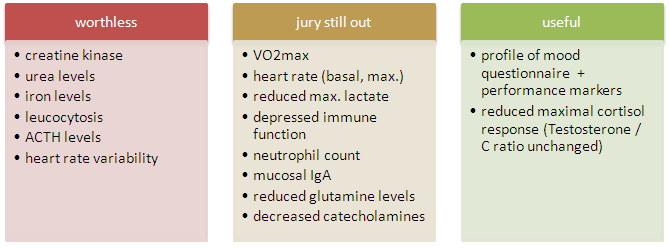
Figure 2: Overview of selected biomarkers that have been investigated for their usefulness to idenfify over-reaching or overtraining (based on an overview in Purvis. 2010)
By incorporating and sticking to appropriate recovery phases, both on a short-, as well (and this is often neglected) on a long(er) term basis and keeping an eye on those markers I put in the "useful" column in the above overview of hitherto scientifically investigated biomarkers for overtraining, you should yet hopefully be able to avoid at least "phase three" of the overtraining syndrome, where taking 2-3 months is no longer an option, but a physiological necessity.

And if you don't have a "profile of mood questionnaire" handy, but still believe in the power of evaluations based on 0-4 scales, I highly suggest you download the free staleness score test Dr. Jack Raglin developed for the US military. It's free, so don't be shy! Here you go for the download: "Training Distress Scale"

Overtraining Research: New Insights into Athlete Triad. Plus: Depression, Palpitations, Urination, Injuries and Weight & Performance Plateaus, the Many Faces of Overtraining

Chronic overtraining is one of the main contributers to the occurrence of often likewise chronic injuries, which persist even, when you finally realized that your own ambition is about to ruin your health.
It's the last day of the SuppVersity Exercise Science Week with a topic of which you actually have read as an aside, or "read up on" note in the previous installments, already: Overtraining and the infamous athlete's triad (read the whole SuppVersity Special here). Since I know that especially the male SuppVersity readers tend to believe they were bullet, or rather overtraining proof by nature, I decided to add a more general follow up to the results of a tightly controlled rodent experiment from the Graduate School of Sport Sciences at the Waseda University and the National Institute of Health and Nutrition University in Japan (Yanaka. 2012), which provide insights into the etiology of the (female) athlete triad phenomenon. A follow up with a potpourrie of studies pertaining to hard to diagnose pathology that goes by the name "overtraining" and is something I guess every training has experienced at least once in his or her career.

The female athlete triad - female only by definition

While Kaoru Yanaka, Mitsuru Higuchi and Yoshiko Ishimi follow the current scientific paradigm and discuss the problem in a female specific context, I want to remind everyone that the athlete triad, which is defined as the triad of eating disorders, amenorrhea, and osteoporosis is in fact female specific (at least I have not yet seen a guy with amenorrhea), but will - in a very different, much more subtle form featuring orthorexic eating patterns, loss of libido and general fatigue - also occur in men.

Figure 1: Time effect of restricted feeding on body weight, food intake and voluntary wheel running in sedentary + ad libitum diet (full filled rhombus; obviously not present in the running distance graph), vol. exercising + ad libitum diet (filled circles) and dietary restricet + ad libitum exercised rats (Yanaka. 2012)
As the data in figure 1 goes to show you, the ergolytic effect on endurance exercise performance was very short-lived and compensated for, when the body weight levels reached a new steady state (see figure 1, left). In other words, once you're caught in the spiral, you will probably not even notice this due to further weight loss and/or noticeable performance declines - specifically if you are not strength training or put an (over-)emphasis on volume training.

Weakening bones and infertility in the presence of (in parts) normal hormonal status

What's even nastier and actually different to human studies, where the "voluntary" exercise is actually compulsive and thus probably way more demanding, is the fact that even some of the hormonal you would expect to be good indicators of the athlete triad, namely estrogen (E2 and osteocalcin (OC), don't differ between the ad libitum and the restricted feeding group.
Figure 2: Levels of estrogen (E2), the bonebuilding protein osteocalcin (OC) and luteinizing hormone (LH) in the sendentary (SED) and voluntary wheel running ad-libitum (RC) and restrictedly fed (RR) rodents (Yanaka. 2012)
That being said, LH remains as the sole, reliable marker of the athlete's triad in response to insufficient food intakes. Whether it is similarly sensitive to overtraining and how the interaction between these two aspects of the athlete triad actually are (beyond increased energy needs in response to exercise) would yet have required a different study protocol, which the rodents being dumped into a container full of water to have them swim to exhaustion on a daily basis. What? That's animal abuse? True. It is however the perfect model for what I see people do at the gym day in and out - the same people who will then tell me that they cannot get rid of their belly fat, although they are "on a calorie deficit, avoid carbs like a plague, eat 100% clean and never miss a workout". My reply in these cases usually is: "You see, and that's why!"

A couple of additional findings on overtraining

Since I know that many of you will simply ignore the above post, because they feel that it does not affect them (don't tell me that's not you, guys ;-), I will summarize a handful of significant findings from general studies revolving around "overtraining" in general.
    Table 1: Symptoms of overtraining (Fry. 1992)
  • 10 days of 2x daily HIIT induce fatigue and compromise immune system for longer than 5 days (Fry. 1994) -- The five well-trained men (mean(s.d.) age 31.6(3.5) years; members of the Special Air Services Regiment of the Australian Army) who performed 15x 1 min HIIT protocols (2min rest between sprints) and 10 "sets " of the same protocol in the PM for ten days were unable to fully recover from this intermediate overexertion within the following 5 days of active recover.

    And while the overall mood disturbance index was remained only nonsignificantly 15% elevtet (p > 0.05), the soldiers felt still 7x more confused, 5x more depressed, 6x more angry.

    The exercise performance, on the other hand was restored to normal levels and that despite persistent immune system deficits. This is in line with the findings of the above rodent studies, where the volume of voluntary wheel running was not a reliable criterion to identify overtraining / undereating. So you better be careful about the "well, I did my 10 squats with 250lbs as usual"-mentality that lulls us into the believe that we are fully recovered and just did not sleep long enough and therefore feel fatigued.
  • It's not in table 1, but not just in the case report by Uusitalo et al. from 2004, frequent urination (especially nightly) is one of the classic features of severe overtraining.
    Overtraining induced depressive mood state is not related to depressed 5-HT reuptake, but tinnitus, palpitations & frequent urination are additional symptoms of OT (Uusital. 2004 & 2006) -- Contrary to what you could assume the OT induced depressive mood states are not mediated by decreased serotonin reuptake, which means that they will be resistant to the standard treatment with serotonin-reuptake inhibitors (SSRIs). With this study the scientists did by the way refute a hypothesis they themselves had proposed in a study 2 years earlies, where single-photon emission computed tomography (SPECT) of a single patient had suggested that it was a decreased 5-HT uptake that was behind the major depression he had in addition to continuous fatigue, tinnitus in his left ear, disturbing palpitation and pollacisuria (frequent urination) he had developed after upping his training volume by 100% (Uusitalo. 2004)
  • High intensity + low rest times = increased risk of overtraining (Szivak. 2012) -- In Szivak et al.'s 2012 study, the 18 trained men (age: 23.5±3.5 years, height: 172.4±4.0cm, weight: 77.8±8.8kg) and women  (age: 22.9±2.0 years, height: 168.4±9.4cm, weight: 68.5±10.4kg) completed high intensity short rest protocol (HI/SR) participated consisting of a descending pyramid scheme (from 10 down to 1 rep) of back squats, bench presses, and deadlifts. The ensuing increases in lactate (IP men: 17.3 mmol·L, IP women: 13.8 mmol·L) and cortisol (+15 men: 1860.2 nmol·L; +15 women: 1831.7 nmol·L) were considerably greater than those produced in typical resistance exercise programs. The scientist interpret this absorvation as indicative of the fact that coaches should implement HI/SR protocols only sporadically, and prefer a gradual reduction in rest interval length with concurrent gradual increase in intensity to minimize potential negative effects such as non-functional overreaching.
  • The self-perpetuation viscous cycle of upping your efforts, decreasing your returns and reupping your efforts again is actually the real danger - and I don't care if you call it overtraining or athlete triad + suggest you don' either (learn more)
    Mental exhaustion and vigorous-intensity training are significant correlates of the occurrence of injuries (Vetter. 2010) -- While mental exhaustion during and outside of the competitive season is a risk for chronic injuries in women, in men, only intra-seasonal mental exhaustion correlates with acute injuries, the occurrence of which is likewise increased with the number of vigorous-intensity training days per week, which in turn is a reliable predictor of mental fatigue in the off and on-season. You see, we are going round in circles once more.
  • Hitting it hard to frequently will downregulate the beta-2 adrenergic receptor (Fry. 2006) -- If you are fatiqued and stims have long seized working for you, you are likely to be chronically overtraining. That's the practical implication of a 2006 study by Fry et al. who found that subjects who performed 10 x 1 at 100% 1 RM daily for 2 weeks on a squat simulating machine, ended up suffering from a -8kg decrease in their 1-RM max, as well as a -36.3% decrease in mean power at 100% 1-RM loads. While this was to be expected and not actually new, the -37% reduced muscle beta(2)-adrenergic receptor density and 49% increases in nocturnal urinary epinephrine in the overtraining group suggest a
    "decreased beta(2)-AR sensitivity for the OT group (2.4-fold increase) [suggesting] that this may be an important contributor to performance decrements due to excessive use of maximal resistance exercise." (Fry. 2006)
    That this will likewise compromise your efforts to lose weight and blunt many of the beneficial fat loss effects you may have in mind, when thinking about brief, hard and frequent training, is not mentioned in the paper and should yet be as obvious as the cardio-protective effect of this adaptations. After all, the beta-adrenergic receptors, which are targeted by endogenous catecholamines and stimulated either directly or indirectly by many stims (most prominently clenbuterol and ephedrine) are responsible for the activation of the sympathetic nervous system, which mobilize the body's nervous system fight-or-flight response, increase the heart rate, widens the pupils, kicks the fat out of the adipocytes to have it available as additional fuel etc.

That's not the breakfast of a champion, that's the breakfast of a complete moron and if that's even remotely to what your breakfast looks like, it's high time to learn about the 3 Simple Rules of Sensible Supplementation
I guess you would like to have some supplement recommendations now, but I won't give you any - aside from the advise to abstain from cortisol blockers and the abuse of stimulants, which are only going to deepen the whole you have been digging (on a related note: I suggest you check out the recent facebook post on the -80% risk reduction for obesity in women with high morning cortisol; Manesh. 2012).

Adequate rest and nutrition cannot be compensated for by any supplements and if you allow yourself both, you won't be overtraining in the first place.

Once you have established that baseline, you are obviously free to use the Three Simple Rules of Sensible Supplementation to optimize your results.

References:
  • Fry RW, Morton AR, Garcia-Webb P. Craford GPM, Keast D. Biological responses to overload training in endurance sports. Eur J Appi Physiol 1992; 64: 335-44.
  • Fry RW, Grove JR, Morton AR, Zeroni PM, Gaudieri S, Keast D. Psychological and immunological correlates of acute overtraining. Br J Sports Med. 1994 Dec;28(4):241-6.
  • Fry AC, Schilling BK, Weiss LW, Chiu LZ. beta2-Adrenergic receptor downregulation and performance decrements during high-intensity resistance exercise overtraining. J Appl Physiol. 2006 Dec;101(6):1664-72.
  • Uusitalo AL, Valkonen-Korhonen M, Helenius P, Vanninen E, Bergström KA, Kuikka JT. Abnormal serotonin reuptake in an overtrained, insomnic and depressed team athlete. Int J Sports Med. 2004 Feb;25(2):150-3.
  • Szivak TK, Hooper DR, Kupchak BK, Apicella JM, Saenz C, Maresh CM, Denegar CR, Kraemer WJ. Adrenal Cortical Responses to High Intensity, Short Rest, Resistance Exercise in Men and Women. J Strength Cond Res. 2012 May 3.
  • Uusitalo AL, Vanninen E, Valkonen-Korhonen M, Kuikka JT. Brain serotonin reuptake did not change during one year in overtrained athletes. Int J Sports Med. 2006 Sep;27(9):702-8.
  • Vetter RE, Symonds ML. Correlations between injury, training intensity, and physical and mental exhaustion among college athletes. J Strength Cond Res. 2010 Mar;24(3):587-96. 
  • Sedaghat F, Rabiei S, Rastmanesh R. Bassak Nejad S, Poloi Shahpor Abadi F, Davoudi I. The Relationship between Serum Cortisol and Vitamin C Levels with Obesity. Jundishapur Sci Med J. 2012;11(4):341-353 
  • Yanaka K, Higuchi M, Ishimi Y. Effect of long-term voluntary exercise and energy restriction on bone mineral density in mature female rats. J Phys Fitness Sports Med . 2012; 1(4): 695-702.