.

.
marylin monroe
Showing posts with label visceral obesity. Show all posts

Gene-ial or Dan-Gene-rous? Better Make Sure You Are Made For Every Other Day Fasting, If You Don't Want to Ruin Your Glucose + Lipid Metabolism and Become Viscerally Obese

Yes! I freely admit that I do have a problem with the subliminal "binge and starve" of the popular every other day fast, because it paves the not so royal road to binge eating disorders.
Only 2 years ago, there was hardly anyone but the followers of Martin Berkhan's "Lean Gains" regimen who knew what intermittent fasting would be. Ironically, now that mainstream is catching on, the hype within the fitness community is slowly abating  - maybe part of the reason is that it's no longer "cool" enough now that your fat neighbor does it ;-).

It goes without saying that the mainstream version comes without an obligatory exercise component and - what's probably even worse - in the absence of macronutrient, let alone food prescriptions that would make sure that the every other day fasts that are becoming increasingly popular these days become "binge and starve" protocols.

The every other day fast, a gateway to eating disorders?

I could probably write a whole article about the potential of feast and fast strategies to function as a gateway to binge-eating disorders, but I know that most of you will discard that by stating: "Pah, that's happening only to the psychologically labile person who can't control his-/herself"... I will argue against that in another article, but I want to let you know here and now, that you could hardly be more off.
Did you know that eggs can improve the lipid profile of most of us?
Stay calm! In view of the fact that rodents in the wild-type control group, who had fully functional LDL receptors did not show a similar negative response to the well-meant dietary intervention, the results of the study at hand are hopefully irrelevant for most of you. If you do have friends and relatives with inexplicably high cholesterol levels, you would however be ill-advised to encourage them to battle their problems with every other day fasting.
Anyway... What this article is actually about is a paper from the British Journal of Nutrition. It was written by Dorighello et al. and has been published online ahead of print. The corresponding study was designed to test the hypothesis that alternate day fasting, which has previously been shown ... 
  • to decrease established metabolic risk factors of CVD and diabetes in human subjects and rodents (Varady. 2007),
  • to reduce the production of liver mitochondrial reactive oxygen in mice (Caro. 2008), and 
  • to increases the lifespan of rodents (Martin. 2006)
would ameliorate tissue mitochondrial oxidative stress and glucose intolerancr in LDL-receptor knockout mice. The LDL-receptor negative mouse is a common, or rather the scientific model of familial high cholesterol (these are the people who are put on a statin the very moment, they enter their doctor's office).

What the scientists expected and what they found were two pair of shoes

I guess you don't have to be a rocket scientists to see what the data in Figure 1 is telling us: In spite of a 20% reduction in energy intake (over the whole week), the rodents in the Dorighello study did not benefit from their every other day fasting regimen (EODF)
Figure 1: Changes in lipid and blood glucose levels (relative to control on ad libitum diet; left) and carcass composition in % of total weight (right; data based on Dorighello. 2013)
Accordingly, the Brazilian scientists who had expected that the fasting induced energy restriction, (-20%), alone, should ameliorate the metabolic disturbances in LDL-receptor knockout mice, and reduce their susceptibility to atherosclerosis, had to acknowledge that their clever every other day fasting regimen can have unexpected and, in the last consequence, eventually fatal effects on the heart health of the laboratory mice:
  • Epididymal and carcass fat depots and adipocyte size were significantly enlarged by 15, 72 and 68 %, respectively.
  • Pasma levels of leptin were 50 % higher in the EODF mice than in the ad libitum-fed mice.
  • EODF mice showed increased plasma levels of cholesterol -  total cholesterol (37 %), VLDL-cholesterol (195 %) and LDL-cholesterol (50 %). 
  • The glucose homeostasis of the "EODF mice" also disturbed. The scientists observed a +40 % increase in glycemia and a +50% increase in insulinaemia. In short, the mice became glucose intolerant and insulin resistant.
  • The significant increases in systemic inflammatory markers, TNF-a and C-reactive protein, only topped the list of negative side effects of the every other day fast off.
Overall this lead to a 3-fold increase in spontaneous atherosclerosis development, an effect of which it cannot be said often enough that it was observed exclusively in the LDL-receptor negative mice.
Practically speaking... In spite of the fact that the main take home message of the study at hand may be relevant only for those who harbor a certain genetic disposition, I do not recommend a zero calorie every other day fast to anyone - irrespective of whether he or she does or doesn't have LDL receptors  ;-)
If you are not aware of cases of familiar hyper-cholesteraemia and want to improve your lipid metabolism by fasting and eating clean, I suggest you re-read my previous article about the "Two Day High-Protein, Low-Carb Fast" and try this, or a classic intermittent fasting routine with a 6-8h feeding window to shed some body fat and get in better metabolic shape.
So what does this mean? The results of the study at hand are exemplary of something regular SuppVersity readers have encountered a dozen of times, already. A fact that vindicates the often-heard, but rarely understood notion that "we are all different". As the study at  hand clearly shows, our gene's and their consequences on our physiology determine not just what we should eat, but also when we shoult eat it. 

You got to be wary, though! Contrary to what you may read in some shiny magazines and on banners on the Internet, the often advertized "gene type diet" is not even on the horizon, yet.

Yes, we can (theoretically) identify each and every gene in our bodies, but in contrast to a general LDL receptor dysfunction, many of the more subtle genetic differences are as of yet totally unknown. Any list of foods, or, as this study shows, suggest food frequency rules you may get are up to know about as accurate as the names of the man or woman of your dreams you will get if you follow the friendly advice the music television advertisement gives you and "send an SMS with the keyword 'love' and your name" to a random number. Even for the well-studied APO-E polymorphisms, scientists are time and again surprised to find that their results are not in line with data from previous studies. Contemporary accepted implications, such as "people whose apolipoproteins belong to the APO-E4 class will do more harm than good if they consume larg(er) amounts of fish oil" could thus be as flawed as the idea that only fat can make you fat - likewise the result of premature conclusions that seemed logical in view of the contemporarily available, highly insufficient data, by the way.

References:
  • Caro P, Gómez J, López-Torres M, Sánchez I, Naudi A, Portero-Otín M, Pamplona R, Barja G. Effect of every other day feeding on mitochondrial free radical production and oxidative stress in mouse liver. Rejuvenation Res. 2008 Jun;11(3):621-9.
  • Martin B, Mattson MP, Maudsley S. Caloric restriction and intermittent fasting: two potential diets for successful brain aging. Ageing Res Rev. 2006 Aug;5(3):332-53.
  • Varady KA, Hellerstein MK. Alternate-day fasting and chronic disease prevention: a review of human and animal trials. Am J Clin Nutr. 2007 Jul;86(1):7-13. Review.

Going Nuts On Berries: Ellagic Acid in Rasp- and Blueberries, Pecans, Walnut & Co Protects Against Visceral Obesity

Image 1: I hope you are not one of the guys who spits the tiny seeds of the raspberries out. That is not just disgusting, you would also spit away ~90% of their ellagic acid content.
Nuts and fruits, once hailed as healthy superfoods have been under serious scrutiny within the sometimes overtly "health-conscious" blogosphere. Yeah, consumed in excess both will make you fat; but I would venture the guess that it would be easier to kill yourself by drinking too much water, than by eating too many almonds and bananas... well, before I get derailed here, let's take a look at the data from a recently published study on the effects of ellagic acid, a dilactone of two gallic acid molecules that is found in a wide variety of - guess what? - nuts (pecans, walnuts, cashews, brazil nuts, etc.) and fruits (raspberries, pomegranates, grapes and blackcurrants, plums, grapes, cherries and the list goes on)!

Good for your heart, good for your gut, good for your metabolism, ... but bad for you belly fat

In previous studies ellagic acid has already been identified as a potential heart protectant (Kannan. 2011a, 2011b); it has been shown to ameliorate the progress of cancer (Losso. 2004), to protect from Staphylococcus aureus biofilm formation (Quave. 2012), to exert potent anti-inflammatory effects (Umesalma. 2010), to protect the gut (Gonzalez-Sariaz. 2010),... an open list of health benefits, on which the anti-visceral fat effect Panchal et al. observed in their 16-week rodent trial is probably not going to be the last health-benefit to be added.
Figure 1: Ingredient (g/kg) and macronutrient (% of total energy) composition of the control and the HCHF diet (diet according to Pudjal. 2010, which was used as a reference diet by Panchal. 2012).
In the study at hand Sunil K. Panchal, Leigh Ward and Lindsay Brown kept 8-9 week old male Wistar rats on regular (extreme high carbohydrate, cf. figure 1) or high carbohydrate + high fat (the scientists even state that explicitly and don't mislabel their diet as simply being "high fat"!) diets either with or without 0.8g ellagic acid per kg chow.
Figure 2: Ellagic acid (µg/g dry weight) content of methanol extract of selected nuts and fruits (based on Daniel. 1989)
In view of an average food intake of 30g and 22g in the control and HCHF diet groups and given an average weight of 400-450g per rodent, the animals thusly consumed roughly 40-60mg ellagic acid per kg body weight per day*:
  • control: 60mg/kg per day - human equivalent ~ 10mg/kg
  • HCHF: 40mg/kg per day - human equivalent ~ 6mg/kg

    *note: I calculated those myself, Panchal et al. provide an estimate of 50mg/kg, as a reference
If we take the data from a 1989 study by Daniel et al. as a reference (figure 2) and assume that you weigh ~80kg and that your stomach is about as effective in extracting the ellagic acid from the dry part of the fruit (it is interesting to note that in strawberries >90% of the ellagic acid is in the pulp, while in raspberries 87% is in the seeds) as the laboratory equipment of the scientists was, and if we further take into account that most fruit are ~90% water, you would have to eat ~3,200g of raspberries or blackberries to get your daily dose of 6mg of ellagic acid; or, due to the lower water content (most nuts have ~5% moisture; cf. Beuchat. 2006) 2,181g pecans or 1,220g walnuts.
Note: The above calculation is by no means scientifically valid. In addition to that, the ellagic acid content of fruits and nuts vary according to season, origin, storage, etc. So, don't blame me, if - despite adding a bag of walnuts and a huge basket full of raspberries to your pizza, cola, pasta, twinkies, hamburger, fries, etc - you still gain weight on your high fat high carbohydrate (=standard American diet), ok?
No matter how (in-)accurate the above calculations may be (as I noted, they are probably not very accurate), I am not as confident as Panchal et al. that the average diet with its ~1g of total polyphenols would more or less 'automatically' contain the required 480mg-800mg of ellagic acid, "if the majority of polyphenols in the diet are taken from the fruits and nuts containing ellagic acid".

A cup of blueberries and a handful of nuts a day keep the doctor away?

Although it would seem that Panchal et al. have not done their homework as far as the real-world implications are concerned (and as I will argue in the conclusion - mishaps like these are at the heart of the "superfood myths"), the results of their experiments suggest that ellagic acid could be one of the rare cases, where it may be worth helping nature along, by extracting and capping a polyphenol that is, at least in some cases - such as pomegranate, for example, where large amounts are contained in the leaves (Lei. 2003) - not even necessarily contained in the edible part of the fruit / plant.
Figure 3: Body weight gain, food intake, water intake and energy intake (left); body composition data (right) of rodents fed either a standard high carbohydrate (regular corn starch) or an energetically dense high carbohydrate high fat diet with or without 0.8mg/kg chow ellagic acid for 16-week (data adapted from Panchal. 2012).
If you take a look at the ameliorative effect the lower ellagic acid dosage ('lower' simply due to the lower intake of the energetically more dense high carbohydrate high fat chow) exerted you will see that its effects are surprisingly depot-specific: Contrary to the total body fat mass, which is (within the statistical margin) virtually identical in all groups, the allegedly dangerous abdominal fat was reduced by -33% and -36% by the treatment in both the control (remember >90% of the energy from cornstarch ;-) and the HCHF group, respectively (the reduction was similar in all visceral fat depots; data not shown).
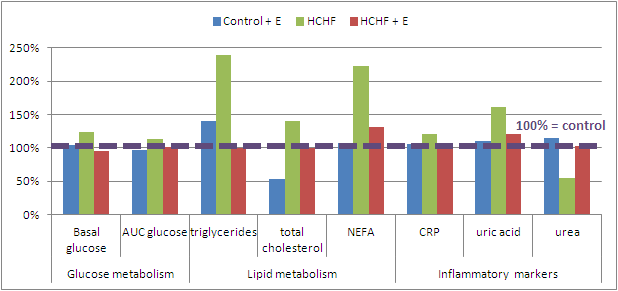
Figure 4: Basal glucose, AUC glucose after 2 g/kg body weight glucose load, triglycerides, total cholesterol, non-esterified fatty acids, c-reactive protein, uric acid and urea levels in rodents fed the supplemented control and the unsupplemented and supplemented high carbohydrate high fat diets; data expressed relative to unsupplemented control diet (data calculated based on Panchal. 2012).
These profound reductions in the amount of inflammatory visceral body fat, stand in line with the statistically significant improvements in glucose and lipid metabolism (cf. figure 4). As you can see the diet-induced increases in glucose, NEFA, triglyceride, cholesterol, CRP and uric acid, as well as the reduction of its counterpart, urea were completely blunted in the high carbohydrate + high fat group that received the ellagic acid enriched chow, an effect, the researchers attribute to...
  • an increase in fatty acid oxidation, indicated by increased CPT1 activity and
  • reduced inflammation, indicated the reversal of diet-induced increases in Nrf2 and NF-kappaB 
... in heart and liver of the rodents. That the addition of ellagic acid to the diet also minimized the necrotic damage to the liver of the animals, is thusly not surprising.

"So, shall I embark on the fruit and nuts diet?"

Despite those scientifically 'proven' benefits I should yet not have to tell you that it would not be particularly wise to take this study as an opportunity to ransack Trader Joe's dried fruit and nuts warehouses... As unreasonable as the contemporary condemnation of real (not dried!) fruit and (non-rancid!) nuts may be, it did not come out of nowhere, but has its roots in the detrimental overconsumption of both, nuts and fruits in the media-driven believe that adding tons of those healthy "superfoods" to your diet would allow you to live into your late 90s without ever having to worry about any of the ailments of the Western society. Both, nuts and fruit are yet only two "superfoods" within a "superfood diet", ... ah pardon, a whole foods diet, where neither of them is a "treat" or "cheat", but simply nutrition!
On a side note: Can you imagine that your ancestors sprouted a handful of nuts after all the work they had to shell them? They must have been nuts, if they did - don't you think so?
 Contrary to the impression you may get, when you follow the discussion on certain bulletin boards, eating healthy does thus not imply that you have to restrict your dietary repertoire to meat, fish, butter, eggs and the occasional sweet potato; this is all the more true, since ellagic acid is only one example for the myriad of already known and still to be discovered micronutrients with beneficial health effects, of which you would be depriving yourself, if your list of "allowed foods" contains no more than 5-10 items.

Think about it: Just as the FDA-approved food additives are "harmless" if you consume only one of them and potential hazardous, when you eat the whole variety that is present in the fast-food laden SAD diet, it is the synergy of all those ellagic acids and whatever their names may be that makes a varied whole-foods diet so healthy - don't miss out on that!

Do You Have the Gut(s) to Lose 8% Belly Fat in 12 Weeks? Lactobacillus gasseri (LG2055) Can Fix Your Gut Problems

As a diligent student of the  SuppVersity, you'll obviously know that beer is not the main cause of the eponymous belly (Bobak. 2003). Although..., when when you come to think about it: For every glass of beer you drink, you're probably drinking a glass of probiotic yogurt less ;-)
You've done everything you could and still feel like a whale? You've been low-carbing, even have made sure you are in ketosis by consuming an only 10% protein diet and still the fat won't disappear? Well, I guess it sounds unfair, if I do now tell you that you YOU JUST DON'T HAVE THE GUTS it takes to get rid of that pouch that blocking the view on your toes, when you are standing.

Now calm down, I am not talking about not being able to curb your insatiable appetite or skipping 90% of your workouts, here. I am talking about your gut(s), literally! Your digestive tract and it's inhabitants. Those critters which are also at the heart of the soon-to-be-published paper by scientists from the Milk Science Research Institute in Fukoaka, Japan (Kadooka. 2013) - a paper, the results of which I am about to present in the next few paragraphs.

Probiotic in fermented milk shred visceral fat

I am not telling you something new, when I say (or write) that scientists have long identified the modulation of the gut microbiome, i.e. the bacterial ecosystem in your intestines, could be the long-sought-for lever to get rid or at least ameliorate the negative effects of the way we live and eat promotes the expansion of the highly inflammatory "stress fat" that fills the room between the organs in your trunk. Most of the hitherto published peer-reviewed research has yet been conducted in rodents. The existing evidence from well-controlled human studies, on the other hand is scarce.

Suggested read: "Probiotics for Athletes: The Supplemental 10 Billion CFS Leaky Gut Solution for the Fermented Food Refusinek?" (read more)
One of these studies has been conducted by Kadooka et al. in 2010 (Kadooka. 2010). In the pertinent paper the researchers from the Milk Science Research Institute in Japan reported that the provision of 200g/day of fermented milk containing 10^8 colony-forming units (cfu)/g of Lactobacillus gasseri strain SBT2055 (LG2055) led to significant reductions in visceral fat in male and female subjects with " higher body mass index" (BMI: 24.2-30.7 kg/m²) who had been randomized to the active arm of the study. Now, roughly three years later, are about to publish a follow-up paper with great practical relevance, as it summarizes the results of what Kadooka et al. say is the first human trial that examines the effect of different doses of probiotics on abdominal adiposity.

"We know that it works, but we don't know how much we need to elicit the desired effects"

The design of the study at hand is essentially identical with the one in the 2010 trial. It is based ona multi-centre, double-blind, parallel-group RCT with 210 healthy Japanese adults with large visceral fat areas (80.2–187.8 cm²), who were now randomly assigned to three instead of two groups who consumed 200g of fermented milk with either 1,000,000 CFU (1m), 10,000,000 CFU (10m) or just the normal yogurt probiotics (control) per gram for 12 weeks.

The intention was to determine whether the effect of LG2055, which is by the way a probiotic lactic acid bacterium that originates from the human intestine, would be observed with lower / more realistic dosage regimen as well and whether possible reductions in the effect size would be dose-dependent.
Figure 1: Reduction in visceral and subcutaneous adipose tissue, as well as waist circumference after 8 and 12 weeks on 1,000,000 CFU/g or 10,000,000 CFU/g yogurt drink; data expressed relative to group baseline (Kadooka. 2013)
If you take a look at the results, the first thing that strikes the eye in figure 1 is that the lactobacilli did their job and that in both the low and high dose group:
  • Even in the 10x and 100x lower dosages there was a significant reduction in the amount of visceral fat the  33/36 respectively 36/35 men and women in the in the 1 million and 10 million CFU/day groups, respectively.
  • The effect size of both dosages of LG2055 was identical, so that it would not actually matter if you consume just 100g or 1kg of an imaginary commercially available milk drink with 1,000,000 CFU of LG2055 per 100g.
In view of the >8% reduction in visceral fat mass, it should not come as a surprise that the reduction in waist size was likewise statistically significant - both on its own, as well as in comparison to the control group, What is yet not so obvious and probably somewhat disappoint for you is the fact that the reduction in the ugly, but benign subcutaneous fat was statistically and practically non-significant.

"Visceral fat loss, only? But what about my thigh fat?"

Not all probiotics are created equal: As the scientists emphasize in the discussion, the "it is also worth noting that the test FM containing both LG2055 and yogurt cultures reduced abdominal adiposity when compared with the control FM containing yogurt cultures alone, even though the bacterial counts of LG2055 (106 and 107 cfu/g) were lower than those in the yogurt cultures (109 cfu/g)." (Kadooka. 2013) The observed superiority of this particular strain of bacteria stands in line with previous rodent studies and is imho one of the reasons we are seeing so much research in this area. How's that? Well, easy: If you came up with a particularly potent strain and patented that, this would be the literary cash machine.
If you are no newbie to the SuppVersity you will yet be aware that it is by no means extra-ordinary that "healthy fat burners", which work their weight loss magic mostly by modulating local and/or whole body inflammation, have little or no effects on the amount of subcutaneous body fat.

If you discarded any statistical shenanigan and simply went by the height of the small bars in the middle of figure 1, you could yet probably argue that it appears as if there was a trend towards greater subcutaneous fat loss in the high(er) dose LG2055 group. If you went a step further and made the unwarranted assumption that you could simply compare the results from the study at hand to those of the aforementioned 2010 study b Kadooka et al. you could support this argument by stating that there was a clear trend here with 1.2%, 2.6% and 3.3% reductions in subcutaneous fat with LG2055 at concentrations of 1, 10 and 100 million CFU per gram of the fermented milk drink.

In the overall context it is yet important to point out that it is as of yet unknown whether the composition of colonic microbiota has a direct influence on abdominal and/or subcutaneous adipose tissue (Hildebrandt. 2009; Conterno. 2011). Moreover, ...
"[...] environmental factors, including genetics and age, makes it difficult to discuss the causal relationship between adiposity and intestinal microbiota." (Kadooka. 2013)
The latter are particularly difficult to access in a study like this, where the subjects maintain their habitual mode of living, including diet, and no strict dietary control is applied. Kadook et al. are thus right to point out that "the relation ship between adiposity and intestinal microbiota" has to be investigated more closely "under a strict diet, together with the latest methodology" (Kadooka. 2013) to finally make some progress in our understandings of the intricate interaction between the human gut microbiome and our metabolism.


Even the nicest subtenants can become a real problem, when they come over without being asked. Unfortunately, all sorts of gut bacteria (even the "good" ones) have a similarly nasty habit of translocating through a leaky gut wall into parts of your body, where you don't wont them (learn more)!
Bottom line: In view of the fact that the subjects shed the superfluous body fat in the absence of a reduced energy intake and/or exercise / increases in physical activity, the results are unquestionably impressive. To speak of "probiotic fat burner" would yet still not be warranted. After all, the subjects were all overweight and had an average body fat content of 32%, the baseline diet does - at least by the available data - not look really optimal (protein intakes of 0.8g/kg; macro-composition of 15/57/28% from protein, carbs and fats) and the non-disclosed insulin and HbA1c levels as well as the markers of inflammation will probably have left more than enough room for the "get healthy lose weight" effect.

Against that background I have my doubts that you can expect anywhere similar effects in lean, let alone athletic individuals. This does yet not negate the general usefulness of probiotics, after all, health is something you take for granted only, when you've never been sick - if you want to avoid that, the incorporation of fermented foods makes sense for everyone from the sedentary slob to the elite level athletes*...

* Note: I am writing the above although it gives me tummy aches (pun intended). Specifically with respect to the use of high dose probiotic supplements, I am asking myself, whether we really know enough about the potential downstream effects of long-term / high dose supplementation. In that, I am particularly concerned about shifting the balance from an "A"-dominant and unhealthy state in which the attributes "good" and "bad" are all of the sudden reversed and the previously dominant "bad" strain X gets totally replaced by the allegedly "good" strain Y that will then turn out to be just as nasty as X, once its natural arch enemy X is no longer present.

References:
  • Bobak M, Skodova Z, Marmot M. Beer and obesity: a cross-sectional study. Eur J Clin Nutr. 2003 Oct;57(10):1250-3.
  • Conterno L, Fava F, Viola R, et al. Obesity and the gut microbiota: does up-regulating colonic fermentation pro- tect against obesity and metabolic disease? Genes Nutr. 2011; 6:241–260.
  • Hildebrandt MA, Hoffmann C, Sherrill-Mix SA, et al. High-fat diet determines the composition of the murine gut microbiome independently of obesity. Gastroenterology. 2009; 137:1716–1724.
  • Kadooka Y, Sato M, Imaizumi K, Ogawa A, Ikuyama K, Akai Y, Okano M, Kagoshima M, Tsuchida T. Regulation of abdominal adiposity by probiotics (Lactobacillus gasseri SBT2055) in adults with obese tendencies in a randomized controlled trial. Eur J Clin Nutr. 2010 Jun;64(6):636-43. 
  • Kadooka Y, Sato M, Ogawa A, Miyoshi M, Uenishi H, Ogawa H, Ikuyama K, Kagoshima M, Tsuchida T. Effect of Lactobacillus gasseri SBT2055 in fermented milk on abdominal adiposity in adults in a randomised controlled trial. Br J Nutr. 2013 Apr 25:1-8. [Epub ahead of print]
     

20 Weeks of Gluttony Without Gaining a Single Gram of Visceral Fat? A Water Extract From Hops Made It Possible

Hops: More than an ingredient of the majority of OTC sleeping pills (photo LuckyStarr)
Hops beer made from the female flowers of Humulus lupulus was the (safer) alternative to untreated water in medieval Europe. Hops are the female flowers (also called seed cones or strobiles) of a hop species and are currently still used as a flavoring and stability agent in beer. Aside from that, the vigorous, climbing, herbaceous perennial has a longstanding history of medical uses and is probably best known for its sedative effects. That a hot water extract from hop could make an excellent addition to an anti-obesity and even fat loss regimen is yet news and - in view of its efficacy - even SuppVersity news ;-)

Eat like a pig, look like a goddess with hops!

Actually the subheading is pretty unfair, after all pigs don't eat much different from us, they are opportunistic omnivores... but this is no biology lesson, so let's get back to the topic at hand. There was a time, when I thought that 99% of us would eat crap all day, if it would not make us fat - well, unless I realized that I would not and that there are many others out there who don't even like crap (=convenience food) who would refuse to eat pizza, chips, fries, pancakes, ... all day long. That being said, imagine you could do just that or, if you were a rodent in a lab cage, gorge yourself on a high fat diet with 30% maize starch, 14% casein, 10% sugar, 5% cellulose, 4% soyabean oil, 32.5% lard and some minerals and vitamins (546 kcal/100 g diet - calorically and macrowise this looks much like chocolate and candy bars to me ;-) and end up not just exactly as lean, but even a little leaner than your peers on a "healthy" after two years of gluttony? Sounds crazy? Yeah, but it worked!

In the latest study from the Ehime University Graduate School of Medicine in Japan (Sumiyoshi. 2013), the scientists demonstrated that 20 weeks on the previously described high fat diet (if you use the rule of thumb that a mouse year equals 40 human years this would be the aforementioned 2 years).
Figure 1:Body weight trajectory and micrographs of the adipose tissue (Sumiyoshi. 2013)
Not being fat on the outside and, even more, having a regular weight on the scale is yet only the superficial clue to a more subtle, yet highly important internal difference: the fat cell size. With the hop extracts ability to inhibit lipid accumulation within adipose tissue cells by down-regulating our new acquaintance PPAR-gamma (see "PPARs - High or Low? How Are They Supposed to Be?", red box) and thus blocking both their expansion and their proliferation, the mice in the male C57BL/6J and Balb/c mice in the hop extract groups did in fact end up with less visceral body fat than their peers on the regular chow:
Figure 2: Organ weights (rel. to group on standard chow) and blood glucose clearance in OGGT (Sumiyoshi. 2013)
And if that's not enough as far as good news are concerned, their insulin sensitivity and ability to clear glucose from the blood stream was not compromised, either. In this context, it is also worth mentioning that the hop water extract had no effect on faecal fat excretion in mice fed a HF diet (in vivo), and pancreatic lipase activity (in vitro). In other words, the remarkable results were not simply the result of an inhibition of fat absorption.

Do you remember Rhein the natural PPAR-gamma antagonist in Rhubarb? No? Then I suggested you go back in the archives and (re-)read the respective article. You will be surprised how similar the results were... a total amelioration of the HFD induced weight gain, normal body fat levels and no insulin resistance - sounds familiar, no?
Bottom line: So, just as the scientists point out in their discussion of the results, the main mechanism behind this miraculous anti-obesity effects is the suppression of the HFD induced increases in PPAR-gamma activity. Against that background it appears ridiculous that already overweight, often obese diabetics and pre-diabetics are still treated with thiazolidinediones including pioglitazone and rosiglitazone (all PPAR-gamma agonists), which 'improve' insulin sensitivity by allowing the adipose organ to proliferate via adipocyte differentiation and increases in lipid and glucose uptake, and fatty acid storage.

According to the researchers, "[e]xperiments are now in progress to isolate the active substance(s) of hop extract". However, we all know that once this substance is found, the "logical" (actually this is business, not real logic) next step is to add a twist that turns it into a patentable not naturally occurring molecule and make counterproductive and (business logic) no longer really profitable PPAR-gamma agonists with another drug.

References:
  • Sumiyoshi M, Kimura Y. Hop (Humulus lupulus L.) extract inhibits obesity in mice fed a high-fat diet over the long term. Br J Nutr. 2013 Jan;109(1):162-72.