|
Image 1: There is more to a strong core
than just the m. rectus abdominis aka
'the abs' (red); its imperative to train your
obliques (blue) and the muscle strands
of the erector spinae muscles which
stabilize your spine (violette) |
"
6 weeks to 6-pack abs" - although we all know that this is unattainable for the majoritity of beer-bellied casual Men's Health reader, headlines like that still make the sales of today's fitness magazines go up. On the other hand, Charles Atlas, John Grimek, Ray Parks, Eugen Sandow and the other fathers of physical culture would certainly turn in their graves, if they saw the metrosexual size zero bans on the covers of respective 'lifestyle' magazines and read about the 'cult of sculpted abs' that has befallen their 'grandchildren'... well, I guess you don't care about those 'grandpas', let alone my rants, and still want your sixpack to shine in its full glory on the next spring break, no matter what? Ok, but beware,
even the best exercises won't help, as long as your glorious rectus abdominis is covered by an unaesthetic layer of adipose tissue - the key to sculpted abs is dieting! As far as core training is concerned, it is imperative to understand that building a stable core, which is a major yet often disregarded prerequisite for lifelong mobility, is not only about 'ab-training'. Its about training
all those exterior and interior muscle strands that keep you upright:
- the m. rectus abdominis (image 1, red), which consists of two parallel muscle strands that run vertically on each side of the anterior wall of the human abdomenis and are often simply referred to as 'the abs'
- the external and internal oblique muscles (image 1, blue), which pull the chest downwards and compress the abdominal cavity (external) also have a limited action in both flexion and rotation of the vertebral column (both) and cover the transverse abdominis muscles, which are located beneath the obliques and help to compress the ribs and viscera, thus providing thoracic and pelvic stability
- the muscles of the erector spinae (image 1, violette), which are of paramount importance to your life, because they stabilize and protect your spine
Now that you know what this issue of the
SuppVersity EMG Series is all about, I do not want to put you on the abwheel, ah... pardon, the rack any longer, but just in case you agree with me that a great physique is not about having abs alone, you may want to
check out some of the other parts of this series, as well.
| | | |  | | |
| Chest | Biceps | Back | Core | Legs | Triceps | Shoulders |
| Navigate the SuppVersity EMG Series - Click on the desired body part to see the optimal exercises. |
The SuppVersity proudly presents: The
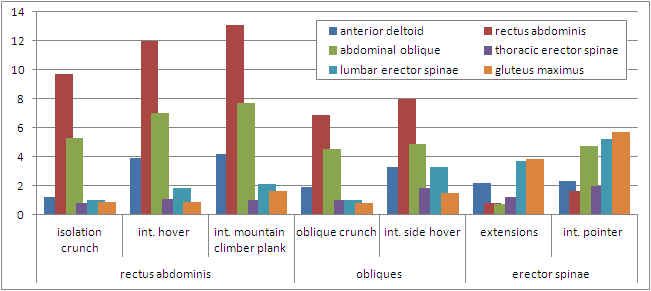
most effective exercises, as measured by electromyography (10 male resistance-trained subjects, mean age 22y, mean body-fat 13%; data from Boeckh-Behrens & Buskies. 2000) for your abs, your obliques and your the stabilizer muscles...
I. Training the m. rectus abdominis (aka 'the abs') & the oblique muscles I want to begin with a word of caution, although 'the abs' do in fact comprise two muscle strands, the two strands ran vertically and parallel to your spine. The assertion that there are 'upper' and 'lower' abs is thus not supportable from a purely anatomical point of view. If you do ab-exercises and even more so, if you do full body movements like squats, deadlifts or military presses,
the muscle strands of your rectus abdominis (as well as your obliques and the erector spinae muscles) will always be engaged as a whole. As it is the case for the latissimus dorsi, another of the large muscle groups in your body, it is yet possible to put a special emphasize on the upper or lower part of your abs. Remember that, when you read about the best exercises for 'upper' and 'lower part' of the
m. rectus abdominis in the following overview.
Six or eight packs - genetics or training? It is an urban or, I should say a 'gym myth' that you "progress from a six- to an eightpack" by training your abs until they hurt. The way your 'abs' look, which includes the number of packs, is determined by genetics and body fat level. The latter, by the way, is the reason why so many trainees believe they would just have to keep training until - almost magically - the 7th and 8th pack would pop up. While this does work for many people, it is not because of training-induced hypertrophy, but rather due to atrophy - adipocyte-atrophy, or fat loss to be precise. Especially the lowest of the six or eight packs tend to be covered by a very stubborn layer of stress-fat, that's why many peple begin to see them, when their training advances and their body fat levels drop.
The EMG data from Boeckh-Behrens & Buskies also goes to show that
even in the case of the rectus abdominis and the external and internal oblique muscles, true isolation is impossible. Everytime you engage in any type of core exercise both the central, as well as the lateral stabilizers or, in other words, the abs
and the obliques will be working.
 |
| Figure 2: EMG activity of m. rectus abdominis (upper part), m. rectus abdmonis (lower part) and oblique muscles during twelve selected core exercises relative to muscle(-part) specific reference exercises as indicated by the asterisk '*' (data adapted from Boeckh-Behrens & Buskies. 2000) |
The graphical illustration of the relative EMG activity of twelve selected core exercises confirms the statement that any given exercise for the 'abs' will inevitably also involve a certain degree of oblique activity. It is however also quite obvious that
trainees can easily emphasize a certain muscle group (or part) by selecting the appropriate exercises from the following top 12:
 |
| Table 1: Top 12 ab- and oblique exercises; ranking according to Boeckh-Behrens & Buskies, 2000 |
It is quite obvious that with a set of 3-6 exercises (I marked the top exercises in green) you can effectively train the whole anterior part of your core and still keep enough variety to avoid getting bored - and, what's probably even more important, to
"keep your body guessing". It is yet also obvious that much more than it is the case with exercises for other body parts,
there is huge inter-personal variety in terms of which ab-exercises work best for whom. Therefore I decided to give you some additional data on the exact mean ranks of the specific exercises - something I omitted in the previous issues of the
SuppVersity EMG Series simply because (with the exception of the chest, where I mentioned it in the text) the mean rank and the mean EMG activity toplists would have been identical, anyway.
Perfect form counts, especially on the advanced movements  |
| Image 2: Trainees tend to (ab-)use the psoas major and thus decrease the activation of the 'abs', when doing leg raises, sit-ups etc. (image by Beth ohara @ Wikipedia) |
A perfect example of improper form compromising exercise efficiacy is the
hanging leg raise, where, in the case of the upper part of the
m. rectus abdominis, you can see that
the exercise must have produced an extraordinarily high EMG activity in some, and a rather mediocre muscular activation in other subjects. Otherwise the
ranking according to mean EMG for the exercise over all subjects (rank 2) and the
mean exercise rank for the individual (rank 3) would be identical. Those of you who know how to do the exercise properly will know that even under professional supervision many trainees fail to actually flex their abs and thus train their
psoas major (cf. image 2) instead of their abs, when they hang like a flabby sack from the bar and swing their legs up and down. A similar shift away from the
m. rectus abdominis and towards the
psoas, occurs in all ab-exercises where your legs are held in a fixed position, the most dreaded example being the classic sit-up, from which generations of trainees developed a hollow back (hyperlordosis); a pathology that cannot only entail lower back pain, but will also make your abdomen stick out even further, the result of which would be
an untrained pair of abs that "sticks out" not in the intended metaphorical, but in the unwanted literal sense. Don't get me wrong,
I am not generally against doing sit-ups, let alone leg raises (they are in fact among my favorite core exercises), I just want you to make sure, you are doing them right, so that you...
- do not get hurt,
- do not develop muscular imbalances, where despite or rather due to improper ab training your m. rectus abdominis becomes the weakest link and thus
- do not put yourself at danger of developing a (painful) hollow back and an untrained pair of abs on a portruding abdomen
Therefore I would advice beginners to follow exercise tip #1 to build up the strength of your abs and learn how to do the hanging leg raises properly before you wrack havoc on your lower back.
Exercise tip #1 - the road to correct hanging leg raise: Done properly, hanging leg raises are
the king of all ab-exercises, which does yet require practice
and a core that is already pretty strong. Therefore I would suggest beginners start out with the
lying leg raises with their hands or one of those pillows under their lower back for lumbar support. By trying to
press their hands / the pillow into the floor in the course of the movement, they will develop the core stability that is necessary to progress
- from the supported to the unsupported lying leg raises
- from leg raises on the floor to leg raises on a decline
- from decline leg raises to hanging leg raises
Note: It is
neither necessary nor advisable to fully extend your legs during any of these exercises. Doing any of these movements with your legs straight tends to shift the relative workload away from your abs and towards the psoas major, and it increases the overall load on your lower back - the same applies for the dreaded sit-ups with leg-fixation, as well.
I suppose, some of you may be disappointed, that exercises like the
cable crunch or your favorite
abdominal trainer have not made it to the list. While I think that many of the ab-machines share the same problematic
psoas major activity as improperly executed hanging less raises or sit-ups,
I count the cable crunch among the most effective ab exercises one can do.
 |
| Image 3: Exercise variation is key, especially for advanced trainees, who do not want to hit a plateau. Therefore, even self-proclaimed 'pros' should not back off from stability exercises like the side plank, which is the 2nd most effective exercise for the oblique muscles in the top 12 (image from www.everkinetic.com) |
That being said, EMG data, no matter how scientifically objective it may seem, should never have you give up what works for you.
Ab training, just like everything else you do in the gym, is not about doing, but about feeling the movement. Or, in other words, if the consequence of extending your arms behind your head is that you stop feeling how your upper abs are contracting, chances are that the purported #1 exercise for the upper part of the
m. rectus abdominis, the crunch with extended arms, is not for you. The possible reasons for that are manifold, with the two most likely reasons being that you're simply not doing the exercise right (remember: doing crunches is not about raising your head off the floor ;-) and/or the exercise intensity is not appropriate for your training level. The latter is an oftentimes overlooked factor which hampers progress in beginners and advanced trainees, alike. I've hinted at this in exercise tip #1, already
rookies need to build a foundation before they start doing 'advanced' exercises such as
hanging leg raises - you would not tell a toddler who has just taken his/her first steps to go and compete in the Olympic 200m race, would you? In the same vein, you will probably get neck and lower back problems if you start doing 100s or 1000s of 'ballistic' sitpus, where you're virtually trying to lift your upper body from the floor by pulling it up from your ears or the back of your head. Believe me, many of the pot-bellied weekend warriors I see doing this type of "ab training" would be better off doing a single set of 6-12 properly performed
crunches with peak contractions. Unfortunately, many of them cannot do even one of those, because their
m rectus abdominis is simply too weak to lift their massive upper body off the floor. Similarly, I see some advanced trainees still perform an hour-long crunch workout, carefully making sure that they perform at least 50 reps of each and every funky move they have ever seen in one of those stupid fitness magazines - come on guys (interestingly only few girls seem to be stupid enough to do so), I know you have not been making
progress in years... always remember. progress, or rather
progressive muscular (not lumbar ;-) overload that is the key to success in whatever you do in the gym.
Exercise tip #2 - Exercise intensity and the myth of high-rep-training for abs: In that it is important to accept that they may be no limit to the number of 1.25 pounds of weight you want to try to add to the bar every week, there certainly is one to adding another rep to the number of crunches, leg raises or side-bends you perform. In the case of the crunch, for example, the beginner would first have to practice doing the basic crunch right, to feel his abs working, to be able to stop half-way up or down and deliberately contract his muscles and to "peak-contract" his
m. rectus abdominis until it hurts. The advanced trainee, on the other hand, will have to
refrain from increasing the number of reps beyond a max of 20 reps. Instead, they should focus on increasing torque by either
- varying the position of his arms - beginner: hands support lower back; intermediate: hands on the chest / at the sides of your head; advanced: arms extended behind the head
- adding light weights - e.g. holding a light dumbbell in your hands when you do the crunch with your arms extended behind your head, on the leg raises you could use some of those weight straps for the ankles, etc.
- switching to more advanced exercises - properly executed hanging leg raises, for example, activate the upper part of the abs almost as effectively as crunches; they are the #1 exercise for the lower abs and #3 for the obliques; but they are difficult to do and require an already fortified core (cf. exercise tip #1)
Rookie or pro, training abs is
not essentially different from training any other muscle group - its about feeling the contraction not about lifting the weight (your body), let alone impressive rep counts and without proper rest, i.e. at least 48h to the next ab workout, the
m. rectus abdominis will rather atrophy than shine in full glory.
If you are doing the right exercises and increase reps and then weights, incorporate advanced exercises and still do not
see progress, I can tell, without even even knowing what you had for breakfast that it ruined your efforts in the gym. Having great abs is 75% diet and 20% whole body training and 5% ab training, remember that whenever you get the idea that doing another 100 sit ups or training your abs every day (every other day = max) would magically melt the fat away... you better
save the time for some serious squatting, deadlifting or high intensity interval training if you want your abs to shine in their full glory.
II. Training the erector spinae (focus on lumbar part) Contrary to having "great abs", which is probably the #1 on the wish-list of trainees in gyms all around the world, impressive erector
spinae muscles appear to be way less popular in a world where the divide between morbidly obese exercise dyslectics and ripped exercise freaks is ever increasing. And while the former simply ignore that a strong lower back may save them from a whole host of minor ailments of will experience on top of heart disease, diabetes and Alzheimer's in their later life, the latter keep looking at their sixpacks and simply take for granted that the literal flipside of what they consider the epitome of a fit and healthy body (their sixpack) would look alike. Sometimes this may be the case, more often than not, those are however the same guys and girls who neither squat or deadlift, because they falsely assume that this would make them bulky. The EMG data by Boeckh-Behrens & Buskies goes to show that, due to this commonly held misconception many trainees miss out on the two most effective (hard-)core exercises.
 |
| Image 4: Variations of the deadlift (here the romanian deadlift) are still the most basic lower back movements |
The best exercises with standard equipment - Leg raises on the lying leg curl machine*
- Classic squat
- Hackquat machine
- Deadlift (100% body weight)
- Romanian deadlift (50% body weight)
- Partial Deadlift (50% body weight)
* The leg raise on the lying leg curl machine is done with your hamstrings flexed by just rising your quads off the pad with the muscles of your lower back - the move is quite tricky and I personally would suggest you refrain from doing it, when you do not have any health issues that hinder you from doing squats and deadlifts  |
| Figure 3: EMG activity of erector spinae (lumbar part) during six selected core exercises with standard equipment relative to the "king of all exercises", the squat (data adapted from Boeckh-Behrens & Buskies. 2000) |
I consider it noteworthy that the decrease in weight on the deadlift (done to avoid injury) obviously takes away from the EMG activity Boeckh-Behrens & Buskies were able to measure. It is thus highly likely, that
- the deadlift is the most taxing and at the same time most stimulating exercise for the muscles of the erector spinae, and
- the partial romanian deadlift (legs straight) is probably even more taxing and thus more stimulating than the "classic" deadlift (the EMG data seems to confirm that, as the subjects lifted 2-times the amount of weight on the classic deadlift, yet the muscular activation increased by only 76%)
That being said,
at least one of the two fundamentals of true strength, i.e. deadlifting or squatting, should be part of everyones routine - no other exercises will fortify your core and whole body in a similar fashion as these two. Add one, maximal two of the following body weight exercises and your lower back is ready to roll... pardon me, to lift!
 |
| Image 5: The flutter kick with endcontractions & the pelvic lift, which is similar to the lying hip extension with the exception that you bend the free leg (100°) turn to be slightly more effective than the good old reverse extensions |
The best body-weight exercises - Flutter kicks, prone position, with peak contractions
- Pelvic lift, knee angle 100°
- Hyper-/reverse extensions
- Bird (plank position, no arm activity)
- Sitting upright arms spread like an eagle
I find it quite telling that just sitting 100% straight on a bench with your arms in the eagle position (90° between upper arms and torso, arms slightly bend, so that your palms are facing upward / has something of a preacher ;-) still produces 25%
of the activation classical reverse extentions do. This goes to show you how demanding everyday life is for your lower back!
 |
| Figure 4: EMG activity of erector spinae (lumbar part) during five selected body-weight exercises relative to the well-known hyper-/reverse extensions (data adapted from Boeckh-Behrens & Buskies. 2000 |
III. Conclusion: 3 basic moves for a fortified core!I suppose, there were not too many big surprises in this issue of the
SuppVersity EMG Series, or at least I would hope so... you did not believe all those exotic contortions Men's Idiocy & co invent each spring to attract new readers would be worth doing. Did you?
Some sort of crunch, some leg raises and one of the core (this refers to both your core as well as the core of your workout) exercises, i.e. deadlifting or squatting max 2-3 times a week is all it takes to fortify the center of your body. If you want the additional bonus of a shiny six (or eight-)pack, do at least as many squats and deadlifts as you do crunches, add in some HIIT (high intensity interval training) and stick to your diet.
 |
Image 6: You asked for it, here is the
info - the ab-roll-out probably is probably
among the most effective ab-exercises, as well. |
User requested update: "Dr. Andro What about the Ab-Roll-out?" This question has now been posed twice and not only because one of the persons who asked was my Buddy Duong, I dug a little in the archives of exercise sciences and came up with a study that compared
8 Swiss ball exercises (
roll-out, pike, knee-up, skier, hip extension right, hip extension left, decline push-up, and sitting march right) and
2 traditional abdominal exercises (
crunch and
bent-knee sit-up) and found that EMG signals for the upper and lower part of the
m. rectus abdominis, as well as the obliques were
"greater compared to most other exercises". In that it has to be said that the movements were
performed for 5 reps only and that even the authors remark that higher / more diverse repetition ranges could have influenced the overall results they summarize in their conclusion as follows: "The roll-out and pike were the most effective exercises [in this study! a direct comparison of the EMG data with the one from the Boeckh-Behrens Buskies study would of course be invalid] in activating upper and lower rectus abdominis, external and internal obliques, and latissimus dorsi muscles".
Bottom-line:
Daron,
Duong & the rest - keep doing your roll-outs, if you like them ;-)
 |
| Image 7: The kneeling cable crunch (image shows seated) is one of my favorite exercises for the m. rectus abdominis; although the authors did not measure EMG activity, Boeckh-Behrens & Buskies explicitly mention this ab-exercise as being particularly effective for advanced trainees (image from everkinetic.com) |
There is of course a myriad of ways of combining the individual exercises, my personal recommendation for overall core development (based on EMG measures) would yet be as follows*:
- Crunches < 20 reps; vary arm / hand position or add weight + peak contractions to build intensity without going past max. 25 reps
- Leg raises < 15 reps; vary according to exercise tip #1; do at least one of your sets with your legs / torso rotating sideways, alternate left and right
- Deadlift variety 10-12 controlled reps; select the deadlift variety you feel isolates your lower back best
* "<" indicates that you should not be able to perform another rep with perfect form You may alternate that with:
- Kneeling cable crunch < 15 reps; add weight whenever possible
- Side bends < 15 reps; add weight if necessary, be cautious not to bend over or go into hyperlordosis
- Hyperextensions** < 12 reps, with proper form + peak contraction; add weight if necessary
** I chose the hyperextensions over the other two movements, because you can easily add weight by grabbing a plate and holding it before your chest You may notice that I do not make volume (i.e. set) recommendations. This is due to the fact that I found that everyone has to
find what works best for him / her in terms of optimal volume and training frequency. This may also change over time / according to lifestyle factors / nutrition and supplementation.