.

.
marylin monroe
Showing posts with label brazil nuts. Show all posts

Brazil Nuts & Selenium: Are You Nuts If You Have More Than One Per Day? Putting the Toxicity Issue into Perspective

Brazil nuts & selenium: "How much is too much?" A weighty question.
"Isn't it dangerous to consume Brazil nuts on a regular basis?" This is probably one of the most common questions I have been getting in relation to posts about selenium.

In fact, the issue of selenosis (=toxically high selenium levels) from the intake of brazil nuts resurfaced only a couple of days ago in the comment area of one of the blogposts and since I am a lazy bast*** and unwilling to answer this question time and again, I decided to try and settle the issue once and for all by writing this post about the health hazardous effects of Brazli nuts...

Well, ok - maybe they are not so health hazardous, after all

Despite the fact that the evidence from human studies is not exactly extensive, the studies we do have would suggest that going nuts on brazil nuts is much safer than the hilarously high selenium content of Brazli nuts from certain regions in (you guessed it) Brazil would suggest (see table 1)

Now the data in table 1 alone should tell you that the question "how much is too much" is not an appropriate question to be asked. After all, you could eat almost 20x more bulk-shelled nuts in from the Secor study than shelled nuts from Autazes (Brazil).
Table 1: Mean, minimal and maximal selenium content (in µg/100g)
Instead of figuring out whether a handful of Brazil nuts a day is already too much, it does therefore appear to be more prudent to check whether eating plenty of Brazil nuts will bring about any general health problems. Luckily, Brazil nuts do not just originate from the Amazonian regions in Brazil, but are also traditionally consumed there.

"Toxically high" selenium levels in the blood and perfect health!?

In this respect the inhabitants of the Tapajós River region are a particularly interesting community to study, as their naturally high selenium levels in the blood (142 and 2447 μg/L in whole blood; Lemire. 2006, 2009; Pinheir. 2005) comes exclusively from local dietary selenium sources, such as Brazil nuts (Berthollethia excelsa), domestic chicken, game meat and certain fish species (Lemire. 2010) and not from drinking water, or industrial sources. Interestingly, even here...
Figure 1: Location of the study area
"[t]here are significant variations in Se status between villages and seasons, and the highest Se levels are among persons who consume large amounts of Brazil nuts, particularly during the Brazil nuts season, from December to April, when the mature nut capsules fall from the trees." (Lemire. 2011)
Accordingly the object of a 2011 study by Lemire and other researchers from Université Laval, the Université du Québec à Montréal, the Universidade de Brasília, the Universidade Federal do Rio de Janeiro and Universidade de São Paulo was to evaluate dermal signs and sentinel symptoms of Se toxicity in relation to plasma and whole blood biomarkers of Se status in the communities along the Tapajós River.
Figure 2: Precentage of study subjects showing hair- (left) or nail-related (right) symptoms of selenium toxicity (Lemire. 2011)
As you can see in figure 1 there is actually no difference as far as the occurrence of common hair- and nail-related signs selenium toxicity are concerned. The same was true for the occurance of garlic breath or dermal signs of selenium toxicity, such as a general irritation or mycosis on the body, which occured in ~1/4 of all subjects irrespective of selenium status and a whole host of neurological problems ranging from disorientation, tingling hands, tiredness or pain in the extremities, hand tremors, muscle twitches and camps, joint pain, memory problems, headaches or depression. Accordingly, the researchers conclude:
Signs of early selenosis: White-brownish discoloration of the nail (Schuh. 2007)
"In this study population, there were no apparent cutaneous or breath-related signs, or sentinel symptoms (gastro-intestinal disorders andmotor or sensory deficits) of selenosis, despite highSe body burdens in some individuals.

On the contrary, these findings are consistent with other results in this study population showing positive associations between Se status and motor performances and near visual acuity and a lower revalence of age related cataracts among those with elevated Se." (Lemire. 2011)
This is in fact surprising, after all, the selenium levels of some of the study participants were almost 3x higher than those in a 2007 study by Schuh & Lappe who report cardiometabolic changes in response to supplemental selenium at blood levels as "low" as 350 μg/L (Schuh. 2007).

Not so fast, though...

Now, despite the fact that there is no evidence of seleno-toxicity in any of the indigenous inhabitants of the Amazon delta with "toxic" (according to Western standards) selenium levels in the blood, it is by no means sure that the ingestion of several hundred grams of high (or even "low") selenium brazil nuts is save for you. I mean what if there was something that distinguishes you from the average Amazonian that makes you more susceptible to the negative effects of selenium?
  • The epigenetic / hormesis hypothesis: One of the potential downsides of high selenium intake that is commonly overlooked, is the development of insulin resistance and diabetes. For someone who subscribes to black/white painting of the blogosphere this may be difficult to understand, but in view of the fact that selenoprotein P and hepatic gluconeogenesis share common metabolic pathways and selenium compounds such as glutathione peroxidases interfere with insulin-regulated molecular pathways, it is actually only logical that the overconsumption of selenium may lead to the development of diabetes.

    A whole foods diet is unquestionably the most natural anti-cancer agent and if it contains not just veggies and fruit, but also selenium containing foods like Brazil nuts, its anti-skin cancer effects are going to be even more pronounced. At least that's what a recent study  from the Huntsmen Cancer Institute in Salt Lake City did suggest (learn more).
    Moreover, the fact that this process is related to the expression of certain enzymes could also mean  that someone who has been exposed to high selenium levels during his fetal development may be capable to deal with much higher amounts of selenium in his diet than the average Westerner whose mother was rather selenium deficient than -toxic during her pregnancy (ATSDR. 2003). Studies that were conducted on Inuit who are not yet following the McDonald's diet, would support this hypothesis. Despite dietary selenium intakes of up to 3,500µg/day, their diabetes rate (3%) is comparatively low (Chateau-Degat 2010). In fact, Mark P. Mattson even speculates that the chronic exposure to increasing amounts of selenium could induce a hormetic reaction that may be at the bottom of the many positive effects that are ascribed to this potentially toxic mineral (Mattson. 2008)
  • The mercury hypothesis: Another potential confounding variable of which I would hope that it is not something you are affected by is the high amount of mercury both the inhibants of the Amazonas and the Inuits are exposed to. High dietary selenium would after all not only offset the mercury toxicity, the high intake of mercury, on the other hand, would also bind tons of selenium and thus reduce, as Khan & Wang suggest the "excess" of selenium and thus inhibit or reduce its potentially toxic effect (Khan. 2009). 
  • Selenium and mercury make a perfect match. One inhibits the toxicity of the other - if they come in the right ratios (learn more)
    The organic vs. inorganic hypothesis: In view of the fact that the upper uptake levels are largely based on selenium toxicity that was observed as a consequence of the exposure to inorganic forms of selenium it is no wonder that third potential confounding factor that may influence the toxicity of selenium is the form of the non-metal you are exposed to. In view of the increasing number of reported cases of selenosis that occurred in response to the ingestion of obviously organic, supplemental selenium, the validity of this hypothesis has been questioned.

    It should also be noted that the most commonly sold over-the-counter supplements (even the high(er) quality ones) contain selenomethionine, which will - much contrary to selenocysteine - accumulate in the in plasma proteins and erythrocytes, where it replaces the existing methionine. From an evolutionary perspective this may be considered advantageous. After all, the protein-bound selenium may serve (hypothetically) as a storage pool. With the continuous supply of exuberant amounts of selenium it could however become a serious thread to your health. 
As you can see, there are still a couple of questions to be answered and hypothesis to be evaluated before the "Brazil Nuts Kill" myth is fully busted.

Brazil nuts in bad stored conditions infected by Aspergillus flavus. (Freita-Silva. 2011)
Bottom line: The assumption that handful of Brazil nuts eaten once or twice a week will kill you rather sooner, than later is still totally flawed, regardless of whether or not you are "selenium adapted" or not...

And in case you still die, I'd suggest you tell your relatives to check not the selenium but rather the aflotoxin content of your Brazil nuts. It is after all about as, if not much more probable, that the carcinogenic "exrements" of the fungi that are accumulating on the nuts, when they are not appropriately handled by the manufacturers are going to kill you than the "innocent" selenium that's buried beneath the mold (Freitas-Silva. 2011).

References:
  • Agency for Toxic Substances and Diseases Registry (ATSDR). Toxicological profile for
    selenium. Atlanta; 2003.
  • Chang JC, Gutenmann WH, Reid CM, Lisk DJ. Selenium content of Brazil nuts from two geographic locations in Brazil. Chemosphere. 1995 Feb;30(4):801-2.
  • Chateau-Degat ML, Ferland A, Larmarche B, Counil E, Lemire M, Dewailly E. Selenium and type 2 diabetes: insight from a population highly exposed. J Diab Metab. 2010(Suppl1):060.
  • Freitas-Silva O, Venâncio A. Brazil nuts: Benefits and risks associated with contamination by fungi and mycotoxins Food Research International. 2011. 44;5: 1434–1440 
  • KhanMAK,Wang F.Mercury-selenium compounds and their toxicological significance: toward a molecular understanding of the mercury–selenium antagonism. Environ Toxicol Chem 2009;28:1567–77. 
  • Lemire M, Fillion M, Frenette B, Passos CJ, Guimarães JR, Barbosa Jr F, et al. Selenium from dietary sources and motor functions in the Brazilian Amazon. Neurotoxicology 2011;32(6):944–53. 
  • Lemire M, Mergler D, Fillion M, Passos CJ, Guimarães JR, Davidson R, et al. Elevated blood selenium levels in the Brazilian Amazon. Sci Total Environ 2006;366: 101–11.
  • Lemire M, Fillion M, Frenette B, Mayer A, Philibert A, Passos CJ, et al. Selenium and mercury in the Brazilian Amazon: opposing influences on age-related cataracts.Environ Health Perspect  2010b;118(11):1584–9.
  • Lemire M, Philibert A, Fillion M, Passos CJ, Guimarães JR, Barbosa F Jr, Mergler D. No evidence of selenosis from a selenium-rich diet in the Brazilian Amazon. Environ Int. 2012 Apr;40:128-36.
  • Mattson MP. Awareness of hormesis will enhance future research in basic and applied neuroscience. Crit Rev Toxicol 2008;38:633–9. 
  • Pacheco AM, Scussel VM. Selenium and aflatoxin levels in raw Brazil nuts from the Amazon basin. J Agric Food Chem. 2007 Dec 26;55(26):11087-92. 
  • Pinheiro MCN, Müller RC, Sarkis JE, Vieira JL, Oikawa T, Gomes MS, et al. Mercury and selenium concentrations in hair samples of women in fertile age from Amazon riverside communities. Sci Total Environ 2005;349:284–8.
  • Schuh B, Jappe U. Selenium intoxication: undesirable effect of a fasting cure. Br J Dermatol. 2007 Jan;156(1):177-8.
  • Secor CL, Donald JL. Variation in the Selenium Content of Individual Brazil Nuts.Carol L. Journal of  Food  Safety. 1989. 9:279-281
  • Thorn J, Robertson J, Buss DH, Bunton NG. Trace nutrients. Selenium in British food. Br J Nutr. 1978 Mar;39(2):391-6.
  • Vonderheide AP, Wrobel K, Kannamkumarath SS, B'Hymer C, Montes-Bayón M, Ponce De León C, Caruso JA. Characterization of selenium species in Brazil nuts by HPLC-ICP-MS and ES-MS. J Agric Food Chem. 2002 Sep 25;50(20):5722-8.

Going Nuts! Brazil Nuts Improve HDL to LDL Count, Reduce Triglycerides and Increase Red Blood Cell Velocity

Have you ever wondered about the "pill-form" Brazil nuts naturally exhibit? Well, I guess nature wanted you to recognize Bertholletia excelsa as natural medicine. Brazil nuts which come from the Amazon have a "complex matrix, composed of bioactive substances, such as selenium, α- e γ-tocopherol, phenolic compounds, folate, magnesium, potassium, calcium, proteins and mono (MUFA) and polyunsaturated (PUFA) fatty acids" and can thus be far more than mere selenium suppliers in your diet.
Figure 1: Changes in blood parameters after 16 weeks (t1) of Brazil nut consumption @ 3-5 Brazil nuts a day.
(data adapted from Maranhao. 2011)

As a randomized placebo-controlled study published in Nutrition & Metabolism shows (Maranhao. 2011), the consumption of 3-5 Brazil nuts per day for 16 weeks led to significant improvements in
selenium levels (p=0.02), RBCV (p=0.03) and RBCVmax [Red Blood Cell maximal Velocity] (p=0.03) and reduced total (TC) (p=0.02) and LDL-cholesterol (p=0.02).
in 17 obese female adolescents. Even more importantly, it also decreased triglycerides and the amount of oxidized LDL in the blood of the subjects. The waist circumference of the participants, on the other hand did not benefit - in fact, it increased in both the placebo, as well as the treatment group by a few centimeters. In combination with a sound diet and exercise regimen, however, Brazil nuts would certainly be a candidate for the "natural anti-obesity supplement of the day"-award. And, what's more, they are really tasty (well, at least I like them ;-)

Going Nuts On Berries: Ellagic Acid in Rasp- and Blueberries, Pecans, Walnut & Co Protects Against Visceral Obesity

Image 1: I hope you are not one of the guys who spits the tiny seeds of the raspberries out. That is not just disgusting, you would also spit away ~90% of their ellagic acid content.
Nuts and fruits, once hailed as healthy superfoods have been under serious scrutiny within the sometimes overtly "health-conscious" blogosphere. Yeah, consumed in excess both will make you fat; but I would venture the guess that it would be easier to kill yourself by drinking too much water, than by eating too many almonds and bananas... well, before I get derailed here, let's take a look at the data from a recently published study on the effects of ellagic acid, a dilactone of two gallic acid molecules that is found in a wide variety of - guess what? - nuts (pecans, walnuts, cashews, brazil nuts, etc.) and fruits (raspberries, pomegranates, grapes and blackcurrants, plums, grapes, cherries and the list goes on)!

Good for your heart, good for your gut, good for your metabolism, ... but bad for you belly fat

In previous studies ellagic acid has already been identified as a potential heart protectant (Kannan. 2011a, 2011b); it has been shown to ameliorate the progress of cancer (Losso. 2004), to protect from Staphylococcus aureus biofilm formation (Quave. 2012), to exert potent anti-inflammatory effects (Umesalma. 2010), to protect the gut (Gonzalez-Sariaz. 2010),... an open list of health benefits, on which the anti-visceral fat effect Panchal et al. observed in their 16-week rodent trial is probably not going to be the last health-benefit to be added.
Figure 1: Ingredient (g/kg) and macronutrient (% of total energy) composition of the control and the HCHF diet (diet according to Pudjal. 2010, which was used as a reference diet by Panchal. 2012).
In the study at hand Sunil K. Panchal, Leigh Ward and Lindsay Brown kept 8-9 week old male Wistar rats on regular (extreme high carbohydrate, cf. figure 1) or high carbohydrate + high fat (the scientists even state that explicitly and don't mislabel their diet as simply being "high fat"!) diets either with or without 0.8g ellagic acid per kg chow.
Figure 2: Ellagic acid (µg/g dry weight) content of methanol extract of selected nuts and fruits (based on Daniel. 1989)
In view of an average food intake of 30g and 22g in the control and HCHF diet groups and given an average weight of 400-450g per rodent, the animals thusly consumed roughly 40-60mg ellagic acid per kg body weight per day*:
  • control: 60mg/kg per day - human equivalent ~ 10mg/kg
  • HCHF: 40mg/kg per day - human equivalent ~ 6mg/kg

    *note: I calculated those myself, Panchal et al. provide an estimate of 50mg/kg, as a reference
If we take the data from a 1989 study by Daniel et al. as a reference (figure 2) and assume that you weigh ~80kg and that your stomach is about as effective in extracting the ellagic acid from the dry part of the fruit (it is interesting to note that in strawberries >90% of the ellagic acid is in the pulp, while in raspberries 87% is in the seeds) as the laboratory equipment of the scientists was, and if we further take into account that most fruit are ~90% water, you would have to eat ~3,200g of raspberries or blackberries to get your daily dose of 6mg of ellagic acid; or, due to the lower water content (most nuts have ~5% moisture; cf. Beuchat. 2006) 2,181g pecans or 1,220g walnuts.
Note: The above calculation is by no means scientifically valid. In addition to that, the ellagic acid content of fruits and nuts vary according to season, origin, storage, etc. So, don't blame me, if - despite adding a bag of walnuts and a huge basket full of raspberries to your pizza, cola, pasta, twinkies, hamburger, fries, etc - you still gain weight on your high fat high carbohydrate (=standard American diet), ok?
No matter how (in-)accurate the above calculations may be (as I noted, they are probably not very accurate), I am not as confident as Panchal et al. that the average diet with its ~1g of total polyphenols would more or less 'automatically' contain the required 480mg-800mg of ellagic acid, "if the majority of polyphenols in the diet are taken from the fruits and nuts containing ellagic acid".

A cup of blueberries and a handful of nuts a day keep the doctor away?

Although it would seem that Panchal et al. have not done their homework as far as the real-world implications are concerned (and as I will argue in the conclusion - mishaps like these are at the heart of the "superfood myths"), the results of their experiments suggest that ellagic acid could be one of the rare cases, where it may be worth helping nature along, by extracting and capping a polyphenol that is, at least in some cases - such as pomegranate, for example, where large amounts are contained in the leaves (Lei. 2003) - not even necessarily contained in the edible part of the fruit / plant.
Figure 3: Body weight gain, food intake, water intake and energy intake (left); body composition data (right) of rodents fed either a standard high carbohydrate (regular corn starch) or an energetically dense high carbohydrate high fat diet with or without 0.8mg/kg chow ellagic acid for 16-week (data adapted from Panchal. 2012).
If you take a look at the ameliorative effect the lower ellagic acid dosage ('lower' simply due to the lower intake of the energetically more dense high carbohydrate high fat chow) exerted you will see that its effects are surprisingly depot-specific: Contrary to the total body fat mass, which is (within the statistical margin) virtually identical in all groups, the allegedly dangerous abdominal fat was reduced by -33% and -36% by the treatment in both the control (remember >90% of the energy from cornstarch ;-) and the HCHF group, respectively (the reduction was similar in all visceral fat depots; data not shown).
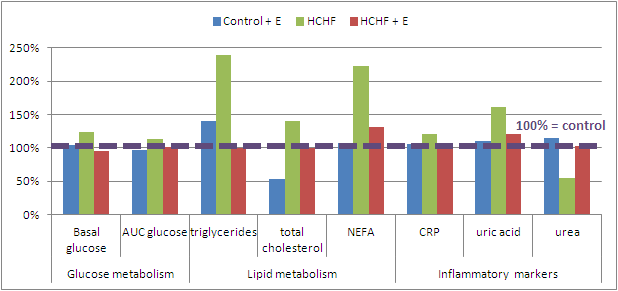
Figure 4: Basal glucose, AUC glucose after 2 g/kg body weight glucose load, triglycerides, total cholesterol, non-esterified fatty acids, c-reactive protein, uric acid and urea levels in rodents fed the supplemented control and the unsupplemented and supplemented high carbohydrate high fat diets; data expressed relative to unsupplemented control diet (data calculated based on Panchal. 2012).
These profound reductions in the amount of inflammatory visceral body fat, stand in line with the statistically significant improvements in glucose and lipid metabolism (cf. figure 4). As you can see the diet-induced increases in glucose, NEFA, triglyceride, cholesterol, CRP and uric acid, as well as the reduction of its counterpart, urea were completely blunted in the high carbohydrate + high fat group that received the ellagic acid enriched chow, an effect, the researchers attribute to...
  • an increase in fatty acid oxidation, indicated by increased CPT1 activity and
  • reduced inflammation, indicated the reversal of diet-induced increases in Nrf2 and NF-kappaB 
... in heart and liver of the rodents. That the addition of ellagic acid to the diet also minimized the necrotic damage to the liver of the animals, is thusly not surprising.

"So, shall I embark on the fruit and nuts diet?"

Despite those scientifically 'proven' benefits I should yet not have to tell you that it would not be particularly wise to take this study as an opportunity to ransack Trader Joe's dried fruit and nuts warehouses... As unreasonable as the contemporary condemnation of real (not dried!) fruit and (non-rancid!) nuts may be, it did not come out of nowhere, but has its roots in the detrimental overconsumption of both, nuts and fruits in the media-driven believe that adding tons of those healthy "superfoods" to your diet would allow you to live into your late 90s without ever having to worry about any of the ailments of the Western society. Both, nuts and fruit are yet only two "superfoods" within a "superfood diet", ... ah pardon, a whole foods diet, where neither of them is a "treat" or "cheat", but simply nutrition!
On a side note: Can you imagine that your ancestors sprouted a handful of nuts after all the work they had to shell them? They must have been nuts, if they did - don't you think so?
 Contrary to the impression you may get, when you follow the discussion on certain bulletin boards, eating healthy does thus not imply that you have to restrict your dietary repertoire to meat, fish, butter, eggs and the occasional sweet potato; this is all the more true, since ellagic acid is only one example for the myriad of already known and still to be discovered micronutrients with beneficial health effects, of which you would be depriving yourself, if your list of "allowed foods" contains no more than 5-10 items.

Think about it: Just as the FDA-approved food additives are "harmless" if you consume only one of them and potential hazardous, when you eat the whole variety that is present in the fast-food laden SAD diet, it is the synergy of all those ellagic acids and whatever their names may be that makes a varied whole-foods diet so healthy - don't miss out on that!