.

.
marylin monroe
Showing posts with label men. Show all posts

First Dates - This is How They Work: Cliches, Prejudices & Scientifically Verified Dating Scripts

Holding each other's hand is part of the dating scripts of both men and women.
No, you did not enter the wrong URL - this is  the SuppVersity! And yes, I know this does not sound like a SuppVersity topic, but let's be honest: a satisfactory love-life (spiritual and physical) is in as much part of a healthy lifestyle and as a healthy diet and a reasonable amount of exercise. Against that background I thought it's warranted to write an article about the Rules of Engagement and what men and women expect from a first date - and yes, I willingly admit I was sort of fed up with "diabesity", muscle and performance "gainz" and wanted to write about something else, today.

The corresponding research is unfortunately already 5 years old, but I guess most of it is still valid (although there is no information about Facebook, Twitter and general smartphone use on the first date included - for me, personally, a total turnoff, by the way). That being said, the Mary Claire Morr Serewicz and Elaine Gale did a pretty decent job, when they analyzed the first-date scripts of  209 college students in the Midwestern United States.
Don't forget: Dating is an art! I truly believe in science, but when it comes to interpersonal relationships and love, all the science in world can - at best - prepare you for what's going to happen. So don't take this as a blueprint and rather trust your instincts than the stats, when you stand in front of your date's door and think about what today's SuppVersity post taught you about "polite leave-taking" ;-)
You have no idea what kinds of results this research could possible deliver? Well, here are a couple of examples:
  • Women are more creative than men: Men’s scripts will show greater redundancy than will women’s scripts.
  • Men are wired to think about how to score with their dating partner: Men’s scripts will include more sexual behavior than women’s scripts.
  • Women know what they want: Female-initiated dates will include more sexual behavior than male-initiated dates.
All these are actually prognoses the researchers formed based on results from previous studies. The same goes for the hypotheses that
  • keg parties a good place to date if you want to get down and dirty after your date, while
  • coffee-shops are the right locations for intimate communication
I guess all that is not actually surprising to you - unless you have been spending most of your live on Facebook and don't even know what a keg party is, obviously. That's you? Well, the following information may be particularly valuable for you; that is if you ever plan to leave the secure and cosy light / dark blue world of fake friends and faked profile pictures and go on a real date.

So let's see what men and women have on their minds when they're dating

The first-date script the Mary Claire Morr Serewicz and Elaine Gale constructed based on their interviews and questionnaires contained 23 actions, 20 of which were unique actions. Two actions, get ready and talk, were repeated. Ten actions were mentioned by at least 50% of participants: get ready, pick up date, go to movie, pay, talk, go to café/party, talk(2), walk/drive home, kiss, and future plans.

Included in the following list are all items that were mentioned by at least 25% of the study participants. Practically speaking, this means for example that whenever you go on four subsequent dates (at least) one of your dating partners will have "holding hands" on his / her mind.

MaleFemale
GET READY
PICK UP DATE (M)
Feel nervous
GO TO MOVIE
Pay (M)
TALK
Get something to eat
Flirt
Hold hands
GO TO CAFÉ/PARTY
TALK
Touch/hug (M)
Drink alcohol
Deep conversation
Evaluate relationship (M)
Talk
Leave party
Invite the other in
More than kissing
WALK/DRIVE HOME (M)
KISS
FUTURE PLANS (M)
Walk/drive home (M)
GET READY
PICK UP DATE (M)
Feel nervous
Talk to friends (W)
GO TO MOVIE
PAY (M)
TALK
Pay (M)
Hold hands
GO TO CAFÉ/PARTY
Smile/joke/laugh
Nonverbal closeness
TALK
Drink alcohol
Touch/hug
Mingle with others
Deep conversation
Talk
Leave party
WALK/DRIVE HOME (M)
Polite leave-taking
KISS
FUTURE PLANS
Part for the night (M)
Ok, I see you are (rightly) confused; and honestly, I did feel the same, when I saw this table. Let's first get the meaning of the CAPITAL and bold items straight. As I already mentioned, the table lists only those items that have been mentioned by at least 25% of the respondents. The items in CAPITAL LETTERS were even more frequent. They have been mentioned By at least 50% of the participants. Actions in bold, on the other hand, are sex specific that means they were mentioned only by men or women, but not by both sexes.

Some things you would, some things you wouldn't expect

12 Things Everyone Should Know Before His / Her Next Date
  • He should not buy new clothes for a date, woman don't expects that.
  • Ladies & gents, you better shave / use make-up! Your date expects you to do so.
  • The car is his job. The same goes for making sure it does not break down!
  • He pays! And ladies, don't take that away from him: He actually wants to pay!
  • She loves flowers. 79% of the women wouldn't mind a long-stemmed rose.
  • He picks her up. That's something men and women agree upon.
  • Be prepared to meet the parents guys, 58% of the ladies expect that of him.
  • He opens the door for her. Well, unless she is one of the 11% of the women who do not expect that.
  • He takes the first step. More than 50% of both men and women agree even initiating a hug is his job.
  • She loves "deep conversations". They are in the toplists of 50% of the women but only 43% of the men know that.
  • It's his duty to take her home. 88% of the ladies and 90% gents believe that.
  • Women will call a friend after the date.  54% of the guys know that.
These "facts" are based on a study by Laner & Ventrone from 2000.
I guess few of you will be surprised that "get something to eat" is a male exclusive, right? I mean that's caveman speaking here ;-) What may be more surprising is that "evaluate relationship" is likewise a male exclusive. With the (M) signalling that the men expected of themselves to do that, it would appear that a statement like "I just wanted to see where we are at" is rather to come from the male date partner than from his female counterpart who will be less concerned about "being invited in" and "receiving more than a kiss" (yes, I know ladies, we are Neanderthals ;-) than about a possibility to "tell her friends about the date".

Apropos women, the results Mary Claire Morr Serewicz & Elaine Gale present in their paper do not suggest that you must sit 10 meters apart from your date, guys. Quite the opposite, as long as you "smile, joke and laugh" you are welcome to "keep eye contact" and even "sit close" to your inamorata (both "keeping eye contact" and "sitting close to each other" belong to the nonverbal closeness category). In most cases you may also take and hold her hand, but you should be aware that your are not only expected to "pay the bill", but also to "drive her home" and once you are there you  may - if you are lucky - "kiss her" before you "leave politely" and "part for the night".

I hope this short tale of the all-American standard date (as Sereictz' and Gale's subjects see it) did promote your understanding of how you can read the results in the tabular overview. Before I leave you to your own interpretation, I do however want to take a departing look at the difference between male vs. female initiated dates.

Influence of the gender of date initiator

Traditionally it's up to us (men) to ask you (ladies) out and, as we have already seen, to pay for the bills. With the emancipation, though, things have changed... well, at least as far as the initiation of the date goes (not so sure about paying the bills, to be honest). From a 'date-scientific-perspective' it's thus important to understand the difference between male and female initiated scripts. And I bet you will be surprised what the researchers found ... no, the guy is still expected to pay the bill, so that's not the surprise!

While the male initiator scripts follow the classic "smile, laugh, joke"-"go to the cinema"-"talk"-"take her home and leave"-script, a female initiated date is much more laden with Neanderthal expectations: Aside from "getting something to eat" and "drinking alcohol", female-initiated dates are way more often expected to end on "invite the other in" and "more than kissing" than male-initiator scripts... hmm, I guess my grandma was right, then: "You better beware of those women" ;-)
What's the use of all this? In case this is what you are just asking yourself, it probably did not hurt you that you've just been thinking about something else but optimal protein intakes, macronutrient ratios and ergogenic supplements.

Believe it or not: There is a world out there, where looking good naked may come very handy and is still not all that counts. Don't forget that!
References:
  • Laner MR, Ventrone NA. Dating Scripts Revisited. Journal of Family Issues. 2000; 21:488.
  • Serewicz, MCM, Gale E. First-date scripts: Gender roles, context, and relationship. Sex Roles. 2008; 58(3-4): 149-164.

Women Have a Much Harder Time Losing Body Fat Than Men, But Both Benefit From Doubling Their Protein Intake!

Image 1: Looks good, tastes good, is good - and contrary to zinc, ingesting 2x the RDA will help you lose body fat, instead of setting you up for insulin resistance.
Enough of useless (ALA, zinc) and useful (glutamin) supplements for at least 24h! Let's get back to what really counts: Training? No, not today,.. the other thing! The one, which is actually to be supplemented - your diet! Believe it or not - even after all those years, I am finding time and again that the food you put into your mouth has much more pronounced effects on the ways you look feel and perform than any of the countless useless and useful supplements. Accordingly and in response to the futile notion of "calories in vs. calories out" and the bomb-calorimeter representation of the human metabolism as a simple furnace, the past couple of years have seen an increasing public and (as of late) scientific interest in the effects varying macronutrient compositions will have on your ability to shed weight and, more importantly, to keep it off in the long run.

Submitted on December 30, 2011 and published in the latest issue of the Journal of Nutrition & Metabolism (9:55) the results of a "randomized clinical weight loss trial" comparing more or less isocaloric (-500kcal/day) weight loss regimen in 130 (58 male, 72 female) overweight middle-aged (40-56) subjects (BMI  =  32.5  ±  0.5 kg/m²) provide further insights into the real-world effects of  prescribed minimal protein intake levels on the outcomes of a 4 months weight loss and 8 months weight maintenance intervention (Evans. 2012).

RDA = 0.8g/bw vs. 2x RDA = 1.6g/bw protein - Round 1: Education & Adherence

In many of the previous posts on this issue (e.g. "High Carb vs. High Fat for Obese Type II Diabetics and What Really Happens, When Science Meets Real Life"), adherence or even an appropriate awareness of what "high protein" actually means turned out to be one of the main culprits as far as the significance of respective data is concerned (Krebs. 2012). In this respect, the subjects in the study by Evans et al. who were supported by a pretty extensive educational and support program that included
  • the provision of electronic food scales and instruction on how to weigh and record food servings at all meals (logs were monitored for compliance on a weekly base!)
  • a specific diet program with detailed instructions from a research dietitian including the menus, food substitutions and portion sizes
  • an obligatory weekly 1 h meeting at the weight management research facility, where they received dietary counseling, had the ability to pose questions and instructions referring to the minimum of 30 min of walking 5 d/wk
constitute a positive exception from the average "study participant" who receives a handout with instructions and a clammy handshake for his/her willingness to step on the scale twice within a given time-frame.
Figure 1: Energy intake (total) from different macronutrients (left) and relative reduction compared to basesline in the 4-month weight loss and the subsequent 12 months "maintenance" period (based on Evans. 2012)
Based on the activity logs, the average amount of exercise was less than 100min/wk and not different between the two treatment groups. As far as the drop outs are concerned, there was yet a trend for lower drop out rates of the male participants in the protein compared to the carbohydrate group (9/28 vs. 18/30). 
Figure 2: Adherence to the prescribed macronutrient ratios was similarly "good" for men and women in both the high carbohydrate and high protein arm of the study (based on Evans. 2012)
The overall adherence to the prescribed nutrient ratios, i.e. 15% protein, 55% carbohydrates and 30% fat in the high carbohydrate and 30% protein, 40% carbohydrates and 30% fat in the high protein group was similarly good (the deviations were smaller than one standard deviation) among both men and women; and still, the net results of the study appear somewhat disappointing - at least if you make the all too common mistake of judging the outcome of an already intrinsically mislabeled "weight loss" intervention solely by the figures on your scale, which were, for the subjects in the study at hand, identical for both groups (PRO:-10.7  ±  6.8 %, CARB:-10.1  ±  6.2 %, expressed relative to body weight at baseline).

Feminists beware! Life is not fair...

A closer analysis of the data does yet reveal that despite an overall greater reduction in calorie intake in the high protein group (-31% vs. -22% in the weight loss phase and -27% vs. -16% in the maintenance phase) and slightly but statistically non-significantly greater body fat loss in the male participants on the high carbohydrate diet at the end of the maintenance phase, the "net" effect on the lean to fat mass ratio in men and women speaks in favor of increased protein intakes during phases of reduced energy intake.
Figure 1: It is obvious that compared to baseline the loss in body fat (expressed relative to baseline, left) was significantly more pronounced in the male compared to the female participants; the favorable effects of the high(er) protein diet on the lean to fat mass ratio (4% and 6% greater improvements) is yet of even greater importance for the ladies.
There is yet no denying that middle-aged women are - irrespective of their diets - having a substantially harder time losing body fat than men of the same age. In view of the fact that this is at least partly mediated by their significantly lower lean body mass to fat mass ratio (1.3 in women vs. 2.2 in men), the aforementioned protein sparing effects of "high" protein diets are of even greater importance for female dieters than for their male peers (cf. figure 3, right) - unfortunately, even the latter rarely rarely spare a thought about that, when their short-sighted and often likewise overweight Dr. tells them "you got to lose weight, if you want to see your grand children graduate, buddy!"

... and if you want sexual equality you got to lift weight and eat your meat ;-)

Against that background the results of the recently published exercise-only trial by Washburn et al. come to mind (cf. "Strength Training Ain't For Women -  Really!?" and Washburn. 2012). In the study at hand, The absence of at least a minimalist strength training regimen, as it was employed in the Washburn study, could in fact be one of the major reasons for the small overall effect size Evans et al. observed in their "walk in the park if you will" study. Eventually, the preservation of an already low amount of lean tissue mass is one thing, increasing the latter and thusly building the metabolic advantage of greater lean muscle mass, based on which the male study participants shed roughly 15% more body fat within the 12 month than their female peers is yet another one, of which I can hardly repeat often enough that it will not turn Angels into Divas over night (see image 2). And while you can easily regain 2 pounds of fat you lost, you will have to acknowledge that the lean mass you have either never built or lost over years of mainstream dieting, won't come back easily (cf. Beavers. 2011).

Image 2 (unkown Facebook source): Strength training and a high protein diet don't turn Angel's into Divas over night - what a pity ;-)
Bottom line: Regardless of whether you are a woman or a man, an angel or a diva, Homer Simpson, Peter Griffin, or Stanley Smith (cf. "Stocktaking, Goal Setting, -Tracking & -Resetting to Achieve a Healthy Weight & Shed Excess Body Fat"), greasy steaks, eggs, fish, dairy and a gym membership will not just have a much more pronounced impact on the outcome of your next diet, than all the diet products and books your money can buy, as an elementary part of your new lifestyle they will also lay the foundation of your future health - and what's even better: You will have more than enough extra years to spend all the money you would otherwise have spent on all those gimmicks, false promises, useless supplements and defacing cosmetic surgeries! Now you tell me eating a high(er) protein diet and spending time in the gym instead of the office was uneconomical ;-)

References:
  1. Beavers KM, Lyles MF, Davis CC, Wang X, Beavers DP, Nicklas BJ. Is lost lean mass from intentional weight loss recovered during weight regain in postmenopausal women? Am J Clin Nutr. 2011 Sep;94(3):767-74. Epub 2011 Jul 27.
  2. Evans EM, Mojtahedi MC, Thorpe MP, Valentine RJ, Kris-Etherton PM, Layman DK. Effects of protein intake and gender on body composition changes: a randomized clinical weight loss trial. Nutr Metab (Lond). 2012 Jun 12;9(1):55.
  3. Krebs JD, Elley CR, Parry-Strong A, Lunt H, Drury PL, Bell DA, Robinson E, Moyes SA, Mann JI. The Diabetes Excess Weight Loss (DEWL) Trial: a randomised controlled trial of high-protein versus high-carbohydrate diets over 2 years in type 2 diabetes. Diabetologia. 2012 Apr;55(4):905-14. 
  4. Washburn RA, Kirk EP, Smith BK, Honas JJ, Lecheminant JD, Bailey BW, Donnelly JE. One set resistance training: effect on body composition in overweight young adults. J Sports Med Phys Fitness. 2012 Jun;52(3):273.

Strength Training Ain't For Women, One Set is Not Enough and Without a 100% Dialed in Diet Lifting Weights is Useless, Anyways - Really!?

Image 1: Minimalist strength training for maximal results? In the long run even a one set strength circuit can elicit astonishing changes, if you train consistently, progressively, heavy and with picture perfect form (image Paramount Fitness).
Unconventional wisdom days at the SuppVersity: After yesterdays "news" (I hope it was not real news for the majority of you) about the superiority of high intensity interval over classic steady state cardio in at the lower end of the "fat burning zone", today's news is going to cause a couple of other set-in stone paradigms to totter:
  1. resistance training ain't for women
  2. low volume resistance training won't help you lose body fat
  3. resistance training requires a high protein diet to work
The respective data comes from a recently published study by R. Washburn and his colleagues from the Center for Physical Activity and Weight Management at the University of Kansas and researchers from the Southern Illinois University and the Birgham Young University (Washburn. 2012).

Minimal effort, maximal adherence, ...

In their 6-month intervention trial, Washburn and his colleagues set out to evaluate the effect of a minimalist resistance training routine consisting of no more than a single set of 9 different exercises that had to performed three times per week. The sessions were supervised and the participants, overweight young men and women in their early twenties (BMI 27.2kg/m²; age 20.7y; BF% by DEXA 27.6% men, 38.9% women) performed all their exercises on standard gym equipment (Paramount Fitness, not a sponsor of the study!); an adherence of >90% was required and the supervisors made sure that all exercises were performed in the prescribed 3-6RM (85% of 1RM) with a cadence of 2s for the concentric and 4s for the eccentric period of each exercise with picture perfect form:
    Tip for advanced beginners You are already training for 4-6 months? Why don't you add in a 2nd circle, 1s concentric, 2-3s eccentric, in the 8-12 rep range. I don't need a scientific study to confirm that this will be able to propel your gains. And with a couple of tweaks to your diet, e.g. 20g of quality protein with every meal and a reduced carbohydrate intake (~25-35% of total energy or 120-250g of carbs) from whole food sources, only, it won't take too long very long to see visible results.
  • chest press,
  • back extensions,
  • lat pull down,
  • triceps extensions,
  • shoulder press, 
  • leg press, 
  • calf raise,
  • leg curl,
  • crunch
Whenever subjects were able to perform more than the required 6 repetitions with good form the resistance was increased by ~2.25kg. In other words the participants followed a stupidly simple linear progression protocol with a clear focus on strength, an ultra-low volume (per muscle group) and picture perfect form.

... results despite unaltered and obviously obesogenic eating habits

Dietary intake before and during the 6-month study period was assessed, I quote, "during one randomly selected period" each month (24hr food recalls on 2 weekdays and one day on the weekend, each) and remained at ~2300kcal. The majority of the daily energy intake came from carbohydrates (51% ~290g) and fats (33% ~95g), while the protein intake (16% ~92g) despite being at the upper level of the RDA would be considered "borderline deficient" from the perspective of most strength trainees.
Note: It stands to reason that a higher protein intake of ~120g+ could have had beneficial effects on strength gains and changes in body composition. Notwithstanding, the results of this study do confirm that not everything that has been shown to facilitate gains is actually necessary and protein intakes in the >3g/kg body weight range, despite not being as bad for your health as the medical orthodoxy would have it, will offer little to no marginal utility and may even turn against you, when you keep upping your protein intake at the expense of more readily available energy sources such as carbohydrates and fats so that the lion's share of your energy has to be derived from dietary protein via glyconeogenesis... add an energetically demanding training program on top of this, call it either adrenal fatigue or central fatigue syndrome and join the other obstinate whiners on the various overtraining, ah... I mean fitness and bodybuilding boards on the Internet.
Without any cardiovascular training, not a single change in their obviously unhealthy dietary habits (why else would these young men and women have become overweight in the first place?) the 37 formerly sedentary twens in the resistance training (RT) training arm of the study derived non-negligible benefits from their weekly workouts:
Figure 1: Changes in BMI, fat free mass (FFM) and fat mass (FM) in male and female study participants in the control and resistance training arm of the 6-months exercise-only single-set circuit training (9 exercises total, 3 training sessions per week) intervention (data based on Washburn. 2012)
I mean, as disappointing as the non-existent weight loss may seem in a society, where the majority of people is so fixated on nondescript figures on a scale, you can hardly argue that
  • increasing your muscle mass by +1.5kg,
  • decreasing your fat mass (women), or at least 
  • ameliorating your fat gains (men) 
would not be better than losing muscle and becoming fatter and fatter as it happened to the subjects in the control arm, right? And that the anti-obesity (as defined by too much body fat, not too much body weight) effects were more pronounced in the 15 women than in their male peers goes to show you that exactly those people (=women ;-) who usually don't lift weights will benefit most from hopping of their steppers, treadmills and recumbent bikes three times a week to do nothing but a single full-body strength circuit.

Training is a nutrient repartitioner, but if the diet does not deliver those the results are suboptimal

These unquestionably favorable (compared to the sedentary control), yet hardly earth shattering results would certainly have been way more impressive, if the study participants had made appropriate changes to their diets. For most of them, it would probably have been enough to simply switch from fast-, fried- away-from-home- and ready-made foods to self-prepared meals, to double, if not triple their results (cf. Taveras. 2005; Wosje. 2010; see also red box below). With the aforementioned tip to get at least 20g of lean protein with every meal and a progression not just on the weight, but also on the volume side of things (yet to no more than 2-3 circles per training, cf. Van Etten, 1997; Shaibi. 2006; Shaw. 2006), the same simplistic full-body circuit would certainly have had a much greater impact on the chubby physiques of the soon-to-be obese type II diabetics.
Food quality? It is quite interesting that both Taveras and Wosje identify fried foods as especially problematic for children and adolescents (Taveras. 2005; Wosje. 2010). And while those were related to higher body fat levels, another common scapegoat, processed meat, showed a clearcut and unquestionably beneficial relation to high bone mass in the Wosje study (Wosje. 2010). On the other hand, dark-green and deep-yellow vegetables (eg, spinach, romaine lettuce, broccoli, carrots, and sweet potatoes), though not something you will usually see among the favorite dishes of most kids, adolescents and college students, would probably have prevented the twens in the Washburn study from being eligible to participate in the trial, in the first place. Why? Well, the BMI and, more importantly, the body fat levels of the veggie (+meat ;-) eaters would probably have been way below the obesity cut-off for the Washburn study.
If there was a single take home message from this study, one that probably won't apply to you, a seasoned physical culturist and avid trainee, though, but maybe for your sedentary niece or nephew, it would unquestionably be that physical culture does not start at the Olympia level and that doing something is better than surrendering to your "bad genes", the greatest influence of which oftentimes is inherited laziness and the stubborn adherence to a lifestyle of which even young adults should know that it will get them right into the clutches of the pharmocracy.

References:
  1. Shaibi GQ, Cruz ML, Ball GD, Weigensberg MJ, Salem GJ, Crespo NC, Goran MI. Effects of resistance training on insulin sensitivity in overweight Latino adolescent males. Med Sci Sports Exerc. 2006 Jul;38(7):1208-15. 
  2. Shaw I, Shaw BS. Consequence of resistance training on body composition and coronary artery disease risk. Cardiovasc J S Afr. 2006 May-Jun;17(3):111-6. 
  3. Taveras EM, Berkey CS, Rifas-Shiman SL, Ludwig DS, Rockett HR, Field AE, Colditz GA, Gillman MW. Association of consumption of fried food away from home with body mass index and diet quality in older children and adolescents. Pediatrics. 2005 Oct;116(4):e518-24. 
  4. Van Etten LM, Westerterp KR, Verstappen FT, Boon BJ, Saris WH. Effect of an 18-wk weight-training program on energy expenditure and physical activity. J Appl Physiol. 1997 Jan;82(1):298-304.  
  5. Washburn RA, Kirk EP, Smith BK, Honas JJ, Lecheminant JD, Bailey BW, Donnelly JE. One set resistance training: effect on body composition in overweight young adults. J Sports Med Phys Fitness. 2012 Jun;52(3):273.
  6. Wosje KS, Khoury PR, Claytor RP, Copeland KA, Hornung RW, Daniels SR, Kalkwarf HJ. Dietary patterns associated with fat and bone mass in young children. Am J Clin Nutr. 2010 Aug;92(2):294-303. Epub 2010 Jun 2.

Man or Woman, Trunk or Leg Fat - Adding a Full Body Strength Workout to Your Aerobics Will Burn the Fat Off!

Image 1: "Get up and move!"
Doing cardio is better than doing nothing. In the end, aerobic training does yet rarely produce those changes in body composition most "dieters" have in mind, when they embark on their daily jogging regimen and combine those with the latest and greatest diet fad they read about in magazines or on the Internet. If these people just added a few strength workouts to the equations, though, their bodies would begin to change; and what's even more exciting, according to a soon to be published study from the Pamukkale University in Denizli, Turkey, they will do that in the absence of any dietary changes and in exactly those problem areas, men and women usually hate the most about themselves: The trunk, for men, and the legs, for women (Sanal. 2012).

"Dieting"? Why, if working out alone elicits favorable changes in body composition?

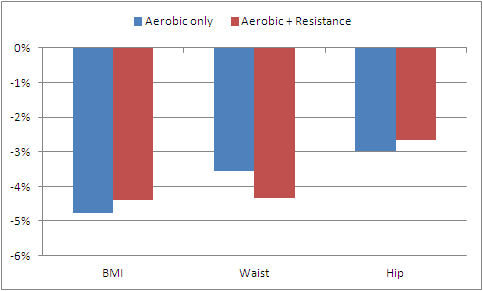
The 92 healthy, yet sedentary and overweight men and women in the study were randomly assigned to either aerobics only (AE) or the combined aerobic + resistance exercise (ARE) regimen. Dropout rates (N=12 and N=11) were identical between the two 12-week interventions, which involved
  • AE: 3x per week 15 min @50-80% maximum heart rate in the 1st, 4x per week 20-30min in the 2nd and 5x per week 30-45min in the 3rd month aerobic training on the cycle ergometer
  • AER: Same as AE but additionally 2x per week full-body workouts with 2 min rest between sets and 3-6 sets of 10 repetitions @50% of their 1RM in the first 6 weeks, and 2-3 sets of 10 repetitions @75-80% of the 1RM during the second 6-week phase of the study
With the resistance protocol simply being added on top of the initially light aerobic workouts, it is quite clear that aside from the fundamental beneficial effects of strength training, the subjects in the AER group would capitalize on the overall higher workload, as well. After all, it is not very likely that the formerly sedentary study participants suddenly lead a more active life outside of their scientifically prescribed duties.
Figure 1: Relative changes in BMI, waist circumeference and hip circumference during the 12-week study period (calculated based on Sanal. 2012)
Against that background it may be initially counter-intuitive that the resistance aerobics + resistance training group did not lose more weight than their lazier peers (cf. figure 1), if you look at the data in figure 2, however, it becomes obvious why doing aerobics only really is not worth it, if your goal is to look better and get healthier, which both depend mainly on reducing your body fat levels, and not your body weight!
Figure 2: Relative changes in fat (FM) and fat free mass (FFM) in the course of the 12-week study period (DEXA data; calculated based on Sanal. 2012)
The dual-energy X-ray absorptiometry (DEXA; very precise method to measure the exact body composition) data confirms what every good trainer will be telling his clients, when they complain about "not losing weight" - the highly desirable changes in body composition are oftentimes not detectable with regular scales; and as this example shows, sometimes not even with my favorite tool, the measurement tape!

Men are different women, too, and strength training works for both!

And though this may sound like yet another prejudice, my personal experience tells me that women are usually much much more focused on the non-significant figures on the scale. Against that background I feel that the detailed analysis of sex difference with respect to the relative loss in body fat and increases in lean mass are of paramount importance, because they confirm: It does not matter if you are a man or a woman. If you want to look better, you got to lift weights!
Figure 3: Additional changes in body composition in aerobic + resistance training vs. aerobic only group (data calculated based on Sanal. 2012)
And while the added bonus of resistance training may be overall larger in men, than in women. It should be noted that the decrease in fat which was present in both groups, happened to be prominent in exactly those body parts which are usually held to contain sex-specific fat depots, i.e. the pot-bellied trunks of obese men and the "they are too fat for my skinny jeans" legs of chubby women.

Get going, don't stop eating, damnit!

Image 2: Some of you may remember my previous blogpost on the superior effect of HIIT vs. classic "cardio" on appetite and energy intake in obese boys. This is also why the SBSG Fat Loss Workout relies on both LISS and HIIT training.
Aside from the sex-specificity, this study provides an even more substantial argument in favor of exercise and against the "exercise just makes you hungry" hypothesis than the previously cited study (cf. "Dr. Oz Was Right, Taubes Wrong"). The question should thus no longer be "Shall I add exercise to my diet?", but rather which diet is most appropriate to propel the exercise-induced changes in body composition I am striving for.

In view of the fact that the study participants in this study, simply continued on their regular dietary regimen, you can only speculate how profound the changes would have been if the same 5x per week aerobic + 2x strength training regimen had been combined with a revised, not even necessarily energy deficient whole foods diet!?

45x More Testosterone Yet Identical Increase in Protein Synthesis: MPS Response to Exercise + 25g Whey in Men vs. Women Challenges Common Wisdom About Androgens

Image 1: Is it not testosterone that makes the difference?
It is an open secret that women are having a much harder time building muscle than men, and it is another instance of (bro-)scientific wisdom that the obvious lack of testosterone in female strength athletes would be the underlying reason. Right from Stuart M. Phillips lab at the Department of Kinesiology of the McMaster University in Hamilton, Ontario, Canada, comes a new study (West. 2012) which puts yet another questionmark behind the anabolic prowess of testosterone (if you still believe that a transient increase in testosterone will help you build muscle, I suggest you read up on "The Big T" in the Intermittent Thoughts on Building Muscle).

Women are different, but it's not about protein synthesis

In the recently conducted trial Daniel W.D. West, who has also been the lead author of the "Never Sip Your Whey" study, I covered back in November 2011, undertook another attempt to identify the intricate endo- and paracrine mechanisms of skeletal muscle hypertrophy and its sex-specific variability. To this ends, West et al. recruited 5 male and 5 female subjects, who "who were habitually engaging in two to five sessions of physical activity per week including", yet did not train legs more than twice a week.
Image 1: In this case, testosterone took a backseat, as well. With synthol, protein synthesis is yet unnecessary anyway.
Note: The selection of advanced trainees as study participants is the first huge plus of this study. After all, we all know that the exercise induced hypertrophy response diminishes with training and those of you who read the whole Intermittent Thoughts on Building Muscle series will also be aware that the protein synthetic response is limited by the maximal domain size. Further growth thusly requires restructuring / the recruitment of satellite cells and installment of new myonuclei (cf. "Growing Beyond Temporary Physiological Limits"), a time-consuming and complex process which is probably one of the underlying reason for the "growth difference" between beginners and advanced strength athletes.
On the day of the experiment, the study participants, who had consumed a standardized diet containing 15% fat, 30% protein and 55% carbohydrates (the macronutrient ratio was adapted to their habitual diets) on the previous day, reported to the lab at 6am. After the infusion of the tracer that is necessary to evaluate the protein flux and an initial biopsy, all subjects performed a bout of  intense, high-volume lower body exercise consisting of
  • 5 sets of 10 repetitions of leg press at ~90% of their individual 10RM, and
  • 3 super-sets of 12 repetitions of leg extension/leg curl at ~90% of 12 RM
The rest intervals between the sets were 60s, so that the whole workout should not have lasted longer than max. 20min. Directly thereafter, the subjects consumed the "obligatory" (for Phillips lab this has in fact become obligatory ;-) 25g of whey protein from the usual New Zelandian source, Phillips et al. used in all their previous study (as ridiculous as this may sound but this is a nice means of standardization ;-) and rested in a supine position for the rest of the trial. Biopsies were taken and the subjects who were sent home with a launch packet consisting of their standardized meals had to report back to the lab on the following morning for another three biopsies 24h, 26h and 28h after the test workout (the subjects remained fasted and received another 25g of whey 26h post, i.e. before the last four blood samples were drawn and the last biopsy at 28h post was performed).
Figure 1: Serum testosterone levels (in nM) and myofibrillar fractional protein synthesis rate (in %/h) before and after the resistance workout, as well as on the morning and at noon of the 2nd day (data adapted from West. 2012)
As the data in figure 1 shows, the (expected) huge difference in both basal as well as exercise induced increases in circulating androgen levels (45-fold in men vs. women) had no (not even a statistically non-significant) beneficial impact on the exercise induced increase in protein synthesis in the 28h window of opportunity (cf. "Opening the 'Anabolic Barn Door' with the Key of Science").
Akt Ser473 phosphorylation increased at 1h ( P < 0.001, main effect for time) and to a greater extent in men (sex × time interaction, P = 0.018). Phosphorylation of mTOR Ser2448 was increased at 1, 3 and 5 h (P < 0.001; Figure 4B); there was a main effect for sex (men > women, P = 0.003). Phosphorylation of mTOR Ser2448 was elevated similarly between sexes after next-day protein feeding, approximately 26 h after the exercise bout (sex  × time interaction,  P = 0.49; main effect for time, 28 > 26 h,  P = 0.006).  Phosphorylation of p70S6K1 Thr389 increased at 1, 3 and 5 h (all  P < 0.001; sex × tim e interaction,  P = 0.13) and there was a significant interaction with next-day feeding (28 > 26 h in women only, sex × time interaction,  P = 0.016; data not shown). Androgen receptor content was greater overall in men (P = 0.049) but there was no significant interaction ( P = 0.47).  
The greater increase in mTOR and Akt (both hitherto regarded as the "gas pedals" of the skeletal muscle protein synthetic machinery) are not only less pronounced, than one would expect if there was a direct interaction with testosterone levels, they also lack real world significance. After all, the area under the myofibrillar protein synthesis curve (a measure for the total protein synthetic response to exercise) was identical in the 1-5h period right after the exercise and - although West et al. did not include the respective data in their article - I would suspect that the data from the subsequent day (cf. figure 1, right) would even suggest that it must have been slightly greater in the female participants.

Testosterone useless and mTOR and Akt unreliable indicators at best?

Now, which conclusions shall be drawn from these results? Is testosterone useless? Does it not contribute to the overall greater muscle mass in men compared to women? It stands to reason that this conclusion would be about as flawed as the notion that testosterone alone would suffice to build muscle. Rather than its "inefficiency" in building muscle, this study only shows that its importance in relation to the exercise-induced increase in protein synthesis is probably way overrated.

A similar point could be made for mTOR and Akt, as well, though. Or as West et al. put it in their discussion of the results and the respective implications for future studies:
In light of this disconnect, it is worth recognizing that the phosphorylation of signalling proteins is a temporal snapshot of the propagated signal for translation initiation. It is also unclear if there is a minimum threshold signal required to initiate and completely activate or  ‘turn on’ translation. If  there is such a threshold then it seems plausible that greater phosphorylation above such a  threshold would be unlikely to further amplify the signal/lead to increased rates of translation.
For a physicist or anybody who knows a thing about "energy levels" the existence of "threshold" levels in processes taking place at a molecular level should not come as a surprise.

I suspect, we are still missing the boat with our focus on protein synthesis alone

Another question, I have been hinting at in many of my previous blogposts on the insightful studies from Stuart Phillips lab at the McMaster University, is yet whether or not the acute increase in protein synthesis (alone) is actually an acceptable predictor of skeletal muscle hypertrophy, a process which, as I have explained in detail in the Intermittent Thoughts on Building Muscle is only partly mediated by the simple accrual of amino acid chains (=proteins) within existing myofibrillar domains.
Figure 2: Graphical illustration of the processes and their respective triggers which contribute to the exercise induced increase in skeletal muscle mass (click here for detailed elaborations).
If you take another look at the complex network of endo- and paracrine signalling cascades and the number of factors which contribute to a process that is generally reffered to as "skeletal muscle hypertrophy" (cf. figure 2) and is, at least in my mind, falsely reduced to the influx of amino acids into the muscle, it should be clear that testosterone does play a central role in the actual exercise induced growth response. That the latter is less pronounced than bro-science would have it (esp. when we are talking about physiological levels, cf. "Quantifying the Big T") and that testosterone itself and its metabolites, DHT and estrogen are probably of greater importance in the "restructuring" process, which in turn facilitate the accrual of even more protein within the muscle, does after all not imply that the huge differences in androgen levels are not the reason for the differential hypertrophy response in men and women - and I guess, I don't have to tell you that you just have to take a glimpse at the female IFBB (International Federation of Bodybuilding and Fitness) competitors to know that androgens can make a difference ;-)

Cardio & Strength Training in a Single Workout: "What Do I Do First?" Plus: Could the Answer Be Sex-Specific?

"Men are different women, too..." We all know that, but can we still train together or will women have to do cardio first, while men would be better off starting out lifting weights?
This is not the first and certainly not the last article on what should come first, if you actually have to or want to do endurance and resistance training in single workout session. Today's SuppVersity article is however the one on the study with the most detailed evaluation of the differential effects of "endurance vs. resistance training first" on the endocrine response, neuromascular fatique and power in men and women, I have seen in a while. The pertinent paper is titled "Acute Hormonal and Force Responses to Combined Strength and Endurance Loadings in Men and Women: The 'Order Effect'" and has been written by Ritva S. Taipale and Keijo Häkkinen from the Department of Biology of Physical Activity at the University of Jyväskylä in Finland (Taipale. 2013).

60 minutes LISS + 45 min leg circuit or vice versa - what's best?

The intention of the researchers was to "to examine the acute exercise induced serum hormone and neuromuscular responses and the time course of changes during recovery in response to a combined strength and endurance training session in recreationally endurance trained male and female runners and whether this response would differ if the participants started their workout with a ...
  • steady state running exercise at an intensity between each subject’s previously determined individual lactate threshold (LT) and respiratory compensation threshold (RCT) for 60 minutes, or 
  • a circuit leg workout with 2 minutes rest between sets that implemented both maximal and explosive strength exercises at loads of 70–85% of the individual 1RM for three sets of 5–8 repetitions, with the final repetition of each set being performed to "near failure" and explosive strength exercises of 8-10reps at a maximal velocity using only 30-40& of the 1EM load on the bilateral leg press (3 sets maximal and 3 sets explosive), the squat (3 sets maximal), loaded squat jumps (3 sets explosive), and calf raises (2 sets maximal).
In short, the question the researchers had in mind when they came up with the research design was: "What's the best way to combine 60min of steady state cardio and an intense 45min leg routine into a single workout"?
Figure 1: Change in maximal voluntary contraction (MVC) in men (left) and women (right) during, immediately after and in the recovery period after the endurance first (ES) and strength first (SE) workouts (Taipale. 2013)
As the data in figure 1 goes to show you, the results were not exactly flattering to the strong sex (=us men), whose absolute maximal bilateral isometric (MVC) strength in the endurance first (ES) trial decreased significantly (28%, p = 0.002) following the 60 minutes of jogging (E), while it remained stable in the 10 female study participants. Luckily, there was still a follow up after which we were back on par (-22% in men and -21% in women).
"The relative loading-induced decreases (D%) in strength between ES and SE differed significantly at mid in men (p<0.001). The relative decreases (D%) in strength in men and women were similar at MID; however, at post, a significant difference between ES men and ES women was observed. The absolute rate of force development (RFD) decreased during both loadings in ES and SE men (at post -19%, p< 0.001 and -22%, p = 0.003, respectively)." (Taipale. 2013)
So once again, the "fairer sex" had an "unfair" advantage, as the rate of force development of the women did not decrease significantly after either the ES or the SE trial. However, it was on ony after the "endurance first" (ES) trial that this effect reached statistical significance.

Level playing field? You must be kiddin' the girls are on dope... ah estrogen ;-)

A similar advantage was observed for the recovery of the initially equally decreased maximum voluntary contraction (MVC) in men and women. Contrary to the ladies who bounced back to normal within the first 24 hours, the MVC of the men remained significantly below the baseline levels in both the strength- (ES) and endurance first (ES) arms of the study 24 h after the endurance first trial (-14% and -15%, respectively) and was still below baseline 48 h post (p < 0.01  -11%).
Figure 2: Endocrine response to endurance (ES) or strength first (SE) workouts in men an women (Taipale. 2013)
If we set these performance outcomes in relation to the endocrine changes the scientists observed, it's quite intriguing to see the that the highly significant increase in post-workout cortisol levels right after the strength-first trial in the men coincides with faster recovery in response to doing strength before cardio workout... or should I rather say in response to doing a steady state cardio session after your strength workout the guys recovered faster?

"Men better start with strength training. Women do whatever they like?! "

The faster recovery after the strength first, endurance second (SE) trial, as well as the 343x higher GH levels after the in this arm of the study appear to speak in favor of doing your strength training first, before you hop onto a recumbent bike or treadmill and add in another 40-60min of light intensity steady state training (LISS), if you are a man! In the fortunate case that you are a member of the estrogen driven fairer sex (= a woman ;-), the study at  hand appears to suggest that it would not really make much of a difference, whether you hit the weights first or second.

For people whose main goal it is to shed fat, the reduction in leptin with cardio first may argue in favor of during your cardio first (read more).
The SuppVersity veterans out there may now feel reminded of a 2012 study by di Blasio et al. that was likewise covered in the SuppVersity news. Di Blasio et al. were the first to investigate the effects of "doing cardio in between", i.e. hopping on the treadmill or cardio equipment of your choice after the completion of a strength circuit or any other given time point in your strength workout and returning to the weights, afterwards (learn more). Unfortunately, this still isn't the answer to everthing. In fact, you don't have to browse the SuppVersity archives for posts on exercise order for very long until you hit onto an article that carries the title "Cardio First if You Want to Leave the Gym More 'Anabolic' Than You Were When You Came in?" (read more) and points you into yet another direction...

So, which of the myriad of studies do we trust?

If it were not for one major glitch in the study at hand, I  would probably end this article on the note that the singularly long follow up period in the study at hand would clearly suggest that the results Taipale et al. generated in the course of their experiment had more practical value (we all know about the fallacy of the narrow minded focus on the immediate post-workout endocrine response; don't we?) the fact that they did not control for the workload is a real bummer.

Imagine the guys simply lifted way more weight in the strength first, endurance second trial - wouldn't an increased GH response to an identical endurance workout with way more depleted glycogen stores actually be what you would have to expect? Also, we all know that when you put men and women together in the gym, the former train until they drop, while the latter do as they are told and take their time looking at the sweaty guys while fumbling around with the weights... ok, that's a cliché, but there is way more than just the splinter of truth that's at the bottom of every of these commonly held prejudices.


Doing (intense) cardio first could promote anabolism (learn why).
Bottom line: In the end, I can only give you this advice. Try both! Try doing cardio before and after your workouts for 2 weeks each and decide afterwards which exercise order you like best. Things you should base your decision on are (a) the amount of weight you lift, (b) your performance during the cardio part of your workout, (c) how smooth the transition between one and the other goes, (d) how you feel the day after and during your next workout.

And don't forget, a glycogen depleting cardio session before your strength workout could increase the expression of the muscle building isoform PGC-1a (learn more)

References
  • Di Blasio A, Gemello E, Di Iorio A, Di Giacinto G, Celso T, Di Renzo D, Sablone A., Ripari P. Order effects of concurrent endurance and resistance training on post-exercise response of non-trained women. Journal of Sports Science and Medicine. 2012 Aug; 11:393-39.
  • Taipale R, Häkkinen K. Acute hormonal and force responses to combined strength and endurance loadings in men and women: the "order effect". PLoS One. 2013;8(2):e55051.

Supplemental (!) Coconut Diet Reduces Waist Circumference in Men more Than in Women While Leaving Lipid Profiles Unchanged

I take the recent New York Times Article on coconut oil as clear evidence of the fact that the health benefit of tropical oils is getting more and more public attention. Studies that establish the many anecdotal reports you can find all over the Internet may even speed up this process and thus I am happy to report the findings of a Malasian study (Liau. 2011) that clearly underlines that the "bad" saturated fat cannot be so "bad" after all.

The scientists had a group of 20 healthy, but obese Malay volunteers consume an additional 30 mL of coconut oil (approx 2 tablespoons) per day taken in three divided doses, half an hour before each meal (as far as digestive side effects are concerned, this was the best tolerated dose as assessed before the actual study) and found...
that only waist circumference [WC] was significantly reduced after one month of VCO with a mean reduction of 2.87 +/-4.95 cm.
The high standard deviation of this data may well be attributed to the fact that there was no additional control of the dietary habits of the volunteers. The study says subjects "continued their weight loss efforts", but you probably know these "efforts" often turn out to be hardly comparable. I also feel that the real-world significance of the scientists statistical assessment "WC reduction was only seen in males" must be reevaluated, especially in view of the fact that "the reduction [meaning in cm WC] was larger in females" and the reduction in females with BMI <30 (4.8 +/-6.1 cm), other than in females with BMI >30 2.61 +/-2.17) was statistically significant (for more data cf. figure 1).
Figure 1: Comparison of mean differences in anthropometric measurements and lipid profile values in 7 males and 13 females after VCO consumption. (Liau. 2011)
I refrain from commenting on the reasons and invite readers to come up with their own theories, why someone who has gotten to a BMI of >30 (!!) may have problems losing weight on an uncontrolled intervention. What this should tell you, however, is that you may safely assume that 2 x tablespoons of coconut oil (~30ml) à day may be a worthwhile addition to your well-planned diet & exercise regimen.

On a side note: Who knows how much centimeters the volunteers had lost if the had just replaced some of the "good" seed oils in their diets? Well, I guess in view of the fact that the scientists seemed surprised that the bad saturated fats in coconut oil did not ruin their volunteers fatty acid profiles, they probably considered it unethical to ask their participants to completely replace corn with coconut oil ;-)

Challenging the Special K Challenge: Especially Convenient or Especially Stupid 14-Day Weight Loss "Solution"?

Image 1: Is this really all it takes to lose those unhealthy and unaesthetic pounds? Two servings of a breakfast cereal a day, instead of two of your regular meals? Sounds too "good" (?) to be true, right? A study says it works, but only the SuppVersity will tell you the real costs!
For me, as a German, it is quite surprising that the words "Special K", or rather the reference to the eponymous product comes up pretty often in the health and nutrition blogosphere, when someone wants to point out an e-special-ly (K) unhealthy breakfast. While "low fat", still looms large here in Germany and "diet"-this and "diet"-that stickers (respective products usually carry the label "light", which shall obviously imply "light" as in "lightweight") are attached to an ever-growing number of products in the mainstream supermarkets, my fellow countrymen (I am unfortunately not so sure about the women, though) must yet have had advanced access to the data (not just the abstract - but more about that later) of Patricia K. Shaw's master thesis (Shaw. 2011), which has been peer-reviewed and published only recently, and are thusly mostly avoiding this "healthy whole grain" product from a company with a >13b revenue in 2010.

"Special K Challenge" - What does it challenge? Weight loss or yo-yo-effect?

In the respective 14-day intervention trial 24 subjects (12 men and 12 women) with a mean age of 34.7 years and a pretty chubby physique (BMI 28.6 kg/m², but body fat 28.8% and 40.7% for men and women, respectively) had to follow the "Special K Challenge" (official website), the central idea of which is that you are going to lose weight and get healthier if you replace two of your regular meals by a predefined amount of yummy (and nutritious *rofl*) expensive cornflakes, ah... I mean "Special K"...
Figure 1: Macronutrient composition of the 174kcal Special  K + skim milk "meal replacement" and the Special K Snack Bars (83kcal) and Mini Breaks (99kcal) the participants consumed during the 14-day challenge and the consequent reductions in protein and fat intake relative to baseline (data calculated based on Shaw. 2011)
In view of the fact that everyone appears to be on the lookout for an easy and above all convenient way to lose weight, it was not difficult for Mrs. Shaw to recruit their subjects among the faculty staff and senior students from the University of Limerick, who actually had to do nothing, but adhere to these two "protocols" for 2x14 days:
  1. Control phase: Do what you usually do and eat what you usually eat for two weeks, log all your foods and get back to the lab to get another body weight, body water, body fat, lean body mass (the latter two via DXA scans), waist and hip circumference measurement taken.
     
  2. Special K Challenge: Keep doing what you usually do, keep eating what you usually eat, but replace 2 of your main dishes with Special K + semi skimmed milk and eat fruit and/or Special K Mini Breaks or Special K Snack Bars between meals (cf. figure 1), log everything you eat and return your hopefully lighter self as well as the logs to the lab in another two weeks.
About as convenient as the average pizza-ordering slacker likes it, right? It is thusly not really surprising that the overall compliance of 83% was above what you usually see in dietary interventions.

"I want my pizza back!"- and "I better completely stop eating to maximize weight loss"-effect

What is similarly unsurprising, is that the overall calorie intake is reduced (avg. energy deficit: 673kcal/day) by a "challenge" , in the course of which two of the main meals (of which most people obviously consume only three) are replaced with a 174kcal "meal replacement" in form of yummy cornflakes with watery skim milk (aside from the "bah, I want my pizza"-effect, I am thinking about the "hyperpalatability hypothesis" here, as well; cf. Guyenet. 2011). That it is so profoundly reduced that at least one male subject had a caloric deficit of 1555kcal per day (!), however, clearly suggests that the end-result of this type of "diet" (or shall we call it a hunger-strike?) is not going to work. It is thus all the more surprising, that, according to the conclusion of the abstract, ...
The results of the present study demonstrate that the Special K Challenge was effective in reducing total energy intake and resulted in a positive, health-related change in body composition. The reduction in total body mass, regional fat mass and waist circumference may act as an effective motivator to long term body mass reduction.
Certainly worth taking a closer look at the data, right? Well, for the first point, i.e. "effective in reducing total energy intake", we already know that this is true. "Effective", by the way, is effectively understated. Now, what about the "positive, health-related change in body composition"? What would that imply? A reduction in body fat and an increase in lean mass, right! And what have we got?
Figure 2: Lean mass and fat mass of 24 overweight  men and women before 2-week accommodation phase (pre) and before (basal) and after (Special K) 14-day "Special K Challenge" (data adapted from Shaw. 2011)
We got a reduction in body fat and a reduction in lean mass - and worst of all, the female study participants, who, with their 40%+ body fat levels already had no muscle to begin with, lost almost twice as much lean mass as body mass. Assuming that they are "scale watchers" (and should read the "How to track your progress on a diet & exercise regimen"), this may in fact have been an "effective motivator", but it is also a profound obstacle to the "long term body mass reduction", unless we want to define that as "starving your muscles away".

"But it does work! So what do you want?"

Even if you are not effected by it yourself, I bet that everyone of you knows someone who has maybe not even gained weight, but has become fatter and fatter with every diet he (or presumably "she") has "done". This study on the "Special K Challenge" shows you exactly what went wrong for him/her/them:

Image 2: Although common wisdom would say so, eating salad is no alternative either... when I come to think about it, it may be an alternative to eating toilette paper, but that won't help with fat (not just weight!) loss either.
  • believing in the existence of a "quick fix" and/or "convenient solution" that will work in 1-2 months, let alone weeks and thusly
  • going on a diet instead of changing your diet as part of changing your lifestyle 
  • not meeting your minimal energy requirements / starving yourself
  • not having enough protein and fat with EVERY meal
  • snacking, in general, and on processed foods, in particular
  • no exercise (in this case), or tons of endurance exercise to exercise your "cheats" away
  • using the scale as a measure of success
Taken together, all that programs failure, no matter how "motivating" it may be... or do you really believe the guy with the -1,500kcal/day deficit or his female counterpart with -1,139kcal/day will "stick" to this "diet" for longer than two weeks? I don't! And we both know what happens, when they are sitting with their friends and family at the coffee, next Sunday, right? ... I guess, it is thus unnecessary that I answer the question I raised in the headline, explicitly - Especially Convenient or Especially Stupid? You decide!