.

.
marylin monroe
Showing posts with label treadmill. Show all posts

Less Than 15mg of DHEA Exert Identical Beneficial Effects on Insulin Sensitivity as 1h of Cardio 5x Per Week. Both Effects Mediated Via Increases in Intra-Muscular DHT

Image 1: It has long been established that diabetics have particularly low DHEA levels (Loviselli. 1994), but what's the chicken and what's the egg here?
It is quite funny, sometimes you don't hear about certain supplements, (pro-)hormones, exercise-modalities etc. in years and then, all of a sudden, there are two studies on the respective topic in one week; and moreover, two pretty interesting ones! Last Friday, exactly 7 days ago, you've read here at the SuppVersity about the muscle-protective effects of low-dose dehydroepiandrosterone (DHEA) supplementation during a 5-day intense multiple-type exercise protocol (cf. "DHEA Blunts Muscle Damage During 5 Days of Combined Endurance, Strength and HIIT Training in Young Men"). Today, I have another interesting set of data for you - data which could not just shed some light onto the underlying mechanisms of the said protective effects against skeletal muscle damage, but also on DHEA's beneficial effects on insulin sensitivity.

Not younger, but leaner with a minimalist dose of DHEA?

In a 6 week trial, and thus over a more than eight times longer timespan than in the previously mentioned human study on skelatal muscle damage, Koji Sato and his (or her?) colleagues from the Ritsumeikan University, the Senshu University and the University of Tsukuba (all in Japan, as you probably already suspected) investigated the effects a low dose of DHEA (human equivalent: 0.16mg/kg per day => 10-15mg/day) supplementation on the insulin, QUICKI (=quantitative insulin-sensitivity check index) and intramuscular DHEA and DHT (dihydrotestosterone) levels in sedentary or exercised dietary obese male rodents.
Figure 1: Relative insulin levels, QUICKI, intramuscular DHEA and DHT content in obese male rodents after 6 weeks of DHEA or combined DHEA + exercise (1h, 5days/week) treatment (data adapted from Sato. 2012)
As you can see in figure 1 the effects of both 5x/week running on a treadmill (ETA: 1h) and orally administered DHEA were profound. If you compare the "exercise only" group (red) to the two DHEA groups (green and violet), you will yet notice interesting parallels. Not only were the decreases in serum insulin and the increases (=improvements of insulin sensitivity) in the QUICKI test very similar, the exercise regimen alone yielded a +56% increase skeletal muscle DHEA content and a +71% increase in DHT.

Exercise increases intramuscular DHEA & DHT...
 
Figure 2: Hormonal cascade from DHEA to DHT; all enzymatic conversions can take place on a systemic and intra-cellular level!)
At least the latter, i.e. the increase in DHT should not be news to you if you have been following the in-depth articles at SuppVersity over the past couple of months. From the Intermittent Thoughts on DHT you know that exercise in general and HIT endurance exercise in particular has been found to boost intramuscular dihydrotestosterone levels, as well. The bros, or friends of bros among you, will probably also have heard the horrific stories about creatine monohydrate leading to increased levels of DHT (van der Merve. 2009), of which every reasonable person must actually assume that they are nothing but a downstream effect of increased training loads and/or improved adaptation... I mean, think about it "paleo style": Why would the mammalian body (rodent and human appear to react alike here) increase the DHEA and, via 5-alpha reductase (cf. figure 2), the dihydrotestosterone levels in response to high volume exercise, if not as a means of adaptation?

Oral DHEA + exercise = double-whammy against obesity

The combined treatment, or I should say the exogenous support of the exercise induced changes had - and this is not visible from the data in figure 1, astonishingly profound effects on the diet induced weight gain of the lab animals. While all other rodents became fatter, those in the exercise + DHEA group remained at a steady body weight level; an observation the researchers comment as follows:
Although DHEA administration and exercise training each produced beneficial effects, 6-weeks of combination treatment were more effective for obesity. The precise mechanisms that reduced abdominal fat weight in the combination group remain unclear, yet we can propose several plausible hypotheses. 2 weeks of DHEA administration has been shown to activate fatty acid metabolism-related enzymes, such as long-chain fatty acyl-coenzyme A synthase, and to increase free CoA levels in liver (Mohan. 1998; Mohan. 1990). In addition, exercise training is  known to reduce adipogenesis via upregulation of fatty acid metabolism and increased energy expenditure (Hou. 2003). Therefore, 6-weeks of combination treatment may have promoted additive reductions in abdominal fat volume.

In other words, while DHEA increases the efficacy of fatty acid oxidation, exercise takes care of the increase in energy expenditure which is - all convictions wrt to "calories don't count" and the "calories in vs. calories out"-hypothesis aside - still a fundamental prerequisite that the fatty acids do actually get burned and are not released into circulation to be restored or replaced a couple of hours later.

"Ok, I am just ordering some DHEA, how much should I take?"

Before you head over to the online vendor of your choice to make sure you get your share of DHEA before the FDA hears that it could hamper the sales of diabetes drugs and removes it from the OTC market, I would like to remind you that despite the fact that Sato et al. rightly claim that a "combination treatment [with DHEA and DHT] may be more beneficial than either therapy alone", a cursory glance on the data in figure 1 should suffice to tell you that those additional benefits as statistically significant as they may be are just that "additional" and that exercise alone yielded about equal results, is free of negative and full of beneficial side effects (update: as long as you don't overtrain; thanks Stapedius for this important note) and does not have the same host of studies refuting its efficacy as DHEA has (Clore. 1995).

It is nevertheless intriguing that a hormone the medical orthodoxy has, more or less all of a sudden, dropped like a hot potato and declared "questionable" and "ineffective" is now, roughly 15-20 years being rediscovered... and I am pretty sure that this was not the last DHEA study you will see and read about here at the SuppVersity ;-)

References:
  1. Clore JN. Dehydroepiandrosterone and body fat. Obes Res. 1995 Nov;3 Suppl 4:613S-616S. Review.
  2. Hou CW, Chou SW, Ho HY, Lee WC, Lin CH, Kuo CH. Interactive effect of exercise training and growth hormone administration on glucose tolerance and muscle GLUT4 protein expression in rats. J Biomed Sci. 2003 Nov-Dec;10(6 Pt 2):689-96.
  3. Loviselli A, Pisanu P, Cossu E, Caradonna A, Massa GM, Cirillo R, Balestrieri A. [Low levels of dehydroepiandrosterone sulfate in adult males with insulin-dependent diabetes mellitus]. Minerva Endocrinol. 1994 Sep;19(3):113-9.
  4. van der Merwe J, Brooks NE, Myburgh KH. Three weeks of creatine monohydrate  supplementation affects dihydrotestosterone to testosterone ratio in college-aged rugby players. Clin J Sport Med. 2009 Sep;19(5):399-404.
  5. Mohan PF, Cleary MP. Effect of short-term DHEA administration on liver metabolism of lean and obese rats. Am J Physiol. 1988 Jul;255(1 Pt 1):E1-8.
  6. Mohan PF, Ihnen JS, Levin BE, Cleary MP. Effects of dehydroepiandrosterone treatment in rats with diet-induced obesity. J Nutr. 1990 Sep;120(9):1103-14.
  7. Sato K, Iemitsu M, Aizawa K, Ajisaka R. Testosterone and DHEA activate the glucose metabolism-related signaling pathway in skeletal muscle. Am J Physiol Endocrinol Metab. 2008 May;294(5):E961-8. Epub 2008 Mar 18.
  8. Sato K, Iemitsu M, Aizawa K, Mesaki N, Ajisaka R, Fujita S. DHEA administration and exercise training improves insulin resistance in obese rats. Nutr Metab (Lond). 2012 May 30;9(1):47. [Epub ahead of print]

Overtraining, Inflammation, Insufficient Repair: Scientists Shed Some More Light on the Counterproductive Triad of Ups & Downs in Testosterone, IL-6, IL-10, COX II & Co

Image 1: Part of Christian Bale's protocol to become the skinny Machinist was, you guessed it, overtraining - accompanied by undereating, the results (left) were profound.
The debate on the practical implications and even the existence of a certain physical condition that is generally referred to as "overtraining" is probably one of the most longstanding debates in the realms of physical culture. From a scientific point of view, it stands out of question that the same exercises that turn a stringbean into a heavily muscled berserk can also change him back into a stringbean, when the narrow yet tremendously productive margin between "just enough" and "already too much" is repeatedly exceeded. Scientists from the Department of Sports Medicine at the Shanghai University of Sport probed the underlying causes of this phenomenon and came up with a few interesting observations (Xiao. 2012).
Update: My friend Carl Lanore from Super Human Radio happened to read this post, yesterday and as chance would have it, had a show scheduled with Brooks Kubik on the issue of Overtraining and How it Pertains to General Health, he called me and we had a nice round-table discussion on air. So, in case you are interested, here is the podcast.
Overtraining is determined by an imbalance of pro- and anti-inflammatory factors

While many of  the results of their 11-week rodent study are not actually new (e.g. weight loss, drop in testosterone, etc. figure 1) and their significance for the average physical culturist, who won't be following an exclusively treadmill based exercise protocol are questionable, their findings pertaining to the cytokine response to overtraining could shed some light onto the underlying molecular underpinnings of both skeletal muscle atrophy and hypertrophy.
Figure 1: Study design (left) and relative changes in body weight, hemoglobin and testosterone compared to sedentary control in the overtrained rodents (data calculated based on Xiao. 2012)
It does not take much to identify the profound imbalance in pro- and anti-inflammatory cytokines the three weeks of excessive exercise brought about (cf. figure 2). In order to be able to understand how these changes affect your gains and eventually even make it impossible for your body to repair the damage you are doing on a daily basis, it is yet important to understand what the physiological role of the individual cytokines is.
Figure 2: Changes in inflammatory and anti-inflammatory factors (left) and change in gastrocnemius weight and ratio of body weight to gastrocnemius weight in the overtrained rat immediately after the protocol (OT) or after recovery (OTR; data calculated based on Xiao. 2012)
While most of you will probably be familiar with the "bad guys", IL-6, TGF-beta1, the physiological role of the "good guys", interleukin 10 (IL-10), cyclooxygenase II (COX II) or the more or less exotic urokinase type plasminogen activator (uPA) could be all Greek to you, even though they may be the ones which make the exercise induced gains we often take for granted possible:
  • IL10 is the "calming" counterpart to IL-6 and co. it acts directly on monocytes and inhibits the synthesis of pro-inflammatory cytokines such as IFN-γ, IL-2, IL-3, TNFα & Co.
     
  • COX in particular has been identified as a necessary factor for satellite cell activity (Hill. 2003) and muscle regeneration (Bondesen. 2004)
  • The inhibition of COX activity by ingestion of nonsteroidal anti-inflammatory drugs (NSAIDs) has been shown to to suppress the increase in mixed muscle protein synthesis due to exercise (Trappe. 2002
  • COX-2 null mutants also showed less macrophage invasion of injured muscle during regeneration (Bondesen. 2004), a factor about which you should have read in the Intermittent Thoughts on Building Muscle (Part II) that is a critical factor for the recruitment and "installation" of satellite cells into damaged or growing muscle tissue.
     
  • Urokinase type plasminogen activator (uPA) promotes the migration of numerous cell types, including macrophages, activated peripheral blood monocytes, endothelial cells, smooth muscle cells, and myoblasts (Novak. 2004). 
  • Several studies have shown that the accumulation of macrophage the damaged muscle was impaired in uPA-null mice (Lluis. 2001; Koh. 2005), with the result being impaired repair of the muscle tissue.
  • uPA increase the so-called hepatocyte growth factor, a paracrine signalling molecule that tells progenitor cells to "get going" and is required for skeletal muscle regeneration (Sisson. 2009), as well as the proliferation, migration and fusion of satellite cells (Bonavoaud. 1998; Munoz-Canoves. 1997; Fibbi. 2001) . 
You could thus summarize the results as follows, the profound skeletal muscle damage cannot be repaired, because
  1. the downregulation of IL-10 exasperates the inflammatory reaction to exercise induced muscle damage
  2. the reduction of COX II inhibits or mitigates the protein synthetic response to exercise
  3. low COX II and uPA levels counteract the necessary replacement of damaged, let alone the installment of new myonuclei from quiescent progenitor cells (satellite cells)
The results are profound and, as the body weight to gastrocnemius weight ratio in the OTR group suggests, had detrimental effects on the body composition of the rodents (cf. figure 2, right). So, unless your goal is to be skinny and you are willing to overtrain to stay that way for the rest of your life, you better stick to a reasonable training volume and allow your body the rest it needs to recover and grow.

Practical implications: Questionable

Yet while the study results should have made it pretty clear and yes, this means dragging yourself to the gym with delayed-onset-muscle soreness (DOMS) that requires "treatment" with NSAIDs is no longer an option, it is of little help to determine where exactly the initially mentioned margin begins and where it ends. I believe I have given you a couple of good starting points in the Step By Step Guide to Your Own Workout Regimen, but in the end, the number of factors which will influence both the position as well as the width of this margin are so numerous that is would be unrealistic to assume that any study, rodent or human, aerobic or anaerobic, one or twelve week, ... will ever provide you with the answer to the question I know you were just about to type into the comment area of this post: "Am I already training too much? Or would it be better if..."
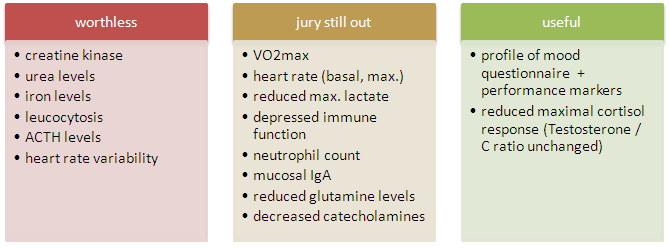
Figure 3: Overview of selected biomarkers that have been investigated for their usefulness to identify over-reaching or overtraining (first published in "The Overmotivational Roots of Overtraining"; based on an overview in Purvis. 2010)
What could yet potentially come out of this data is a test kit, one which would probably be a more reliable indicator of overtraining than DOMS or the creatine kinase levels which have long been touted as a potential candidate to distinguish between load and overload (cf. figure 3 and "The Overmotivational Roots of Overtraining"). Whether we will see respective test kits being available for the average Joe or Jane, is yet as questionable as whether the latter won't still rather waste his / her money on the latest and greatest supplement scam than on an optimized training routine. After all, a good personal trainer should - without any fancy tool-kits - be able to prescribe a routine that may not be 100% optimal, but will at least keep you within the repeatedly mentioned margin of productive overload, today!

References:
  • Bonavaud S, Charriere-Bertrand C, Rey C, Leibovitch M P, Pedersen N, Frisdal E, Planus E, Blasi F, Gherardi R, Barlovatz-Meimon G. Evidence of a non-conventional role for the urokinase tripartite complex (uPAR/uPA/PAI-1) in myogenic cell fusion. J Cell Sci 1997; 110 : 1083 – 1089
  • Bondesen B A, Mills S T, Kegley K M, Pavlath G K. The COX-2 pathway is essential during early stages of skeletal muscle regeneration. Am J Physiol 2004; 287 : C475 – C483
  • Fibbi G, Barletta E, Dini G, Del Rosso A, Pucci M, Cerletti M, Del Rosso M. Cell invasion is affected by differential expression of the urokinase plasminogen activator/urokinase plasminogen activator receptor system in muscle satellite cells from normal and dystrophic patients. Lab Invest 2001; 81 : 27 – 39
  • Hill M, Goldspink G. Expression and splicing of the insulin-like growth factor gene in rodent muscle is associated with muscle satellite (stem) cell activation following local tissue damage. J Physiol 2003; 549:409 – 418  
  • Koh T J, Bryer S C, Pucci A M, Sisson T H. Mice deficient in plasminogen activator inhibitor-1 have improved skeletal muscle regeneration. Am J Physiol 2005; 289 : C217 – C223 
  • Lluis F, Roma J, Suelves M, Parra M, Aniorte G, Gallardo E, Illa I, Rod-riguez L, Hughes S M, Carmeliet P, Roig M, Munoz-Canoves P. Urokinase-dependent plasminogen activation is required for efficient skeletal muscle regeneration in vivo. Blood 2001; 97 : 1703 – 1711
  • Munoz-Canoves P, Miralles F, Baiget M, Felez J. Inhibition of urokinase-type plasminogen activator (uPA) abrogates myogenesis in vitro. Thromb Haemost 1997; 77 : 526 – 534
  • Novak M L, Bryer S C, Cheng M, Nguyen M H, Conley K L, Cunningham A K, Xue B, Sisson T H, You J S, Hornberger T A, Koh T J. Macrophage-specific expression of urokinase-type plasminogen activator promotes skeletal muscle regeneration. J Immunol 2011; 187 : 1448 – 1457 
  • Sisson T H, Nguyen M H, Yu B, Novak M L, Simon R H, Koh T J. Urokinase-type plasminogen activator increases hepatocyte growth factor activity required for skeletal muscle regeneration. Blood 2009; 114 : 5052 – 5061
  • Trappe T A, White F, Lambert C P, Cesar D, Hellerstein M, Evans W J. Effect of ibuprofen and acetaminophen on postexercise muscle protein syn-thesis. Am J Physiol 2002; 282 : E551 – E556
  • Xiao W, Chen P, Dong J. Effects of Overtraining on Skeletal Muscle Growth and
    Gene Expression. Int J Sports Med. 2012 May 16. [Epub ahead of print]